What Was the Baroque? Drama, Light and Movement
A guide to Baroque art in seventeenth-century Europe and beyond: its origins in Rome, key painters, sculptors and architects, and how to recognise the style.
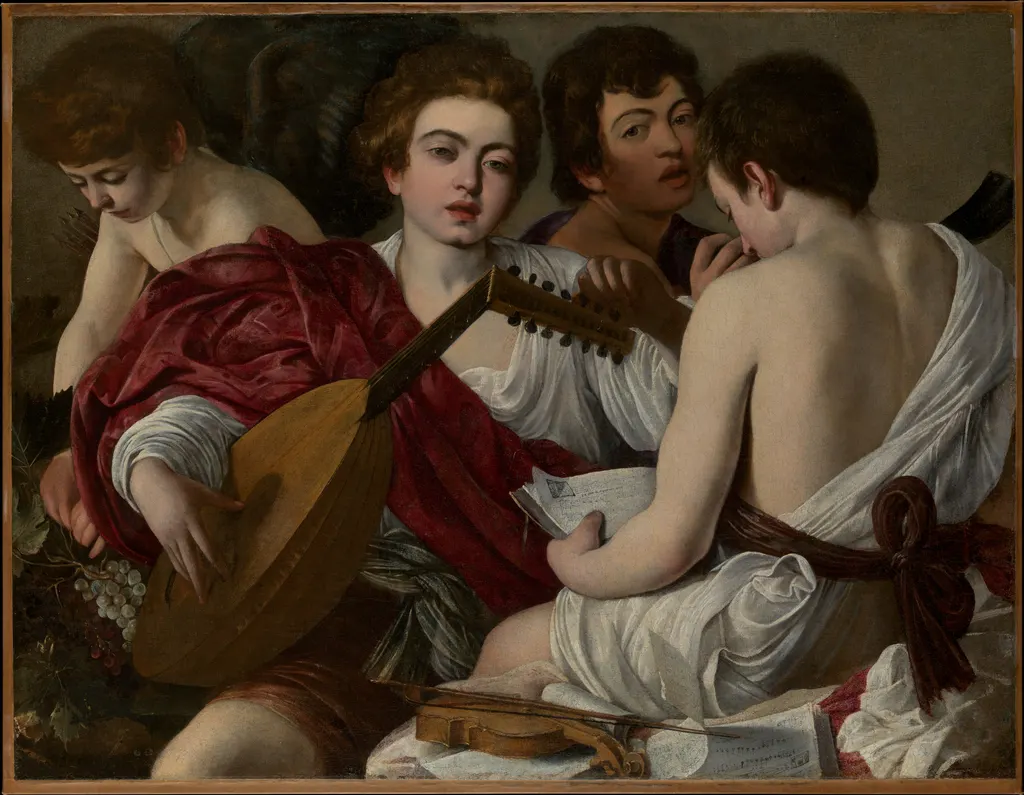
Caravaggio (Michelangelo Merisi)The Musicians, 1597Oil on canvasThe Metropolitan Museum of Art, collection record. CC0 1.0 (Public Domain)
In a side chapel of a Roman church, a shaft of light cuts across a dim room where a group of men sit counting money at a table. Two figures have just entered from the right. One of them, barely visible in the shadows, extends his hand towards the table, and an older man at the centre points to himself as if to ask, "Me?" Caravaggio painted The Calling of Saint Matthew for the Contarelli Chapel in San Luigi dei Francesi in 1599–1600, and it still hangs where he intended, showing the moment Christ summons a tax collector to follow him.
That painting stands at the threshold of the Baroque, the dominant style of European art for much of the seventeenth century and into the eighteenth. Baroque art set out to seize the viewer: to astonish, to persuade, to move. This article explains where the style came from, what it looks like, who its leading artists were, how it varied from country to country, and how to recognise it.
An awkward name
"Baroque" was not a term the artists used. It came into use in the eighteenth century as a criticism, meaning bizarre, extravagant or irregular; it is often said to derive from the Portuguese barroco, an irregularly shaped pearl, though the etymology is uncertain. Only in the late nineteenth century did art historians, most influentially the Swiss scholar Heinrich Wölfflin in Renaissance und Barock (1888) and later his Principles of Art History (1915), treat the Baroque as a coherent style with its own values rather than a decline from the Renaissance.
Wölfflin contrasted the "linear", clearly outlined, self-contained forms of Renaissance art with the "painterly", open, moving forms of the Baroque. His categories are now seen as too neat, but they remain a useful way to start looking.
Rome and the Counter-Reformation
The Baroque began in Rome around 1600. Its roots were partly religious. The Catholic Church, responding to the Protestant Reformation, reaffirmed at the Council of Trent (1545–63) the value of religious images for teaching and inspiring the faithful, provided they were clear, decorous and moving. Rome in the early seventeenth century was also a city of ambitious building, as popes and cardinals commissioned churches, palaces, fountains and squares.
Tate describes the Baroque as reaching its peak in Rome around 1630 to 1680, and identifies its defining qualities as dynamism, realism and direct emotional appeal. Three Roman careers show what that meant.
Caravaggio: light out of darkness
Michelangelo Merisi da Caravaggio (1571–1610) painted saints and apostles as ordinary, sometimes dirty-footed people, lit by a strong, raking light against deep darkness. This dramatic use of light and shade, often called tenebrism (from the Italian tenebroso, "murky"), was imitated across Europe by followers known as Caravaggisti. His influence reached the Dutch Republic through painters in Utrecht, and Spain through Naples. Artemisia Gentileschi (1593–1652/53), one of the most accomplished painters of the age, adapted his manner to powerful effect in works such as Judith Beheading Holofernes (c. 1620, Uffizi, Florence).
Bernini: sculpture as theatre
Gian Lorenzo Bernini (1598–1680) dominated Roman art for half a century as sculptor, architect and designer. His Apollo and Daphne (1622–25, Galleria Borghese) captures the instant the nymph turns into a laurel tree, leaves sprouting from her fingers. In St Peter's he designed the bronze baldacchino over the high altar (1623–34) and later the vast colonnade embracing the square in front of the basilica.
His most complete work of theatre is the Cornaro Chapel in Santa Maria della Vittoria (1647–52). In the centre, Saint Teresa of Ávila swoons in marble as an angel prepares to pierce her heart with a golden arrow; gilded rays descend behind them, lit by a concealed window. On the side walls, marble members of the patron's family, the Venetian Cardinal Federico Cornaro and his relatives, lean from what look like theatre boxes, watching.
Ceilings that open to heaven
Baroque painters dissolved ceilings into skies. Pietro da Cortona's ceiling in the great hall of the Palazzo Barberini, the Triumph of Divine Providence (1633–39), swarms with figures that seem to spill over the painted architecture. Later, the Jesuit painter Andrea Pozzo painted the nave vault of Sant'Ignazio in Rome (completed 1694) with an illusion so complete that, from a marker on the floor, the ceiling seems to rise into an infinite sky.
Look closer: In Baroque churches, look for where painting, sculpture and architecture meet. Painted clouds spill over stucco frames; sculpted figures seem to step out of painted scenes; hidden windows direct light onto altars. The aim was a single overwhelming experience, which Italian writers later called a bel composto, a beautiful whole.
How to recognise Baroque art
| Feature | Renaissance tendency | Baroque tendency |
|---|---|---|
| Composition | Balanced, often symmetrical, stable | Dynamic diagonals, asymmetry, movement |
| Light | Even and clear | Dramatic contrasts, spotlighting |
| Moment | Calm, timeless | The climactic instant, action caught mid-flow |
| Space | Contained within the frame | Spills towards the viewer, breaks boundaries |
| Emotion | Restrained, idealised | Intense, physical, theatrical |
| The arts | Distinct media | Painting, sculpture and architecture combined |
Not every Baroque work shows every feature. Dutch interiors can be very quiet, and French classical painting of the period is deliberately restrained. The table describes tendencies, not rules.
The Baroque across Europe
The style adapted to different religious and political settings.
- Flanders: Peter Paul Rubens (1577–1640) of Antwerp fused Italian grandeur with Flemish colour and energy. His Elevation of the Cross (1610–11) is in Antwerp's Cathedral of Our Lady, and his ceiling for the Banqueting House in Whitehall, London, commissioned by Charles I, glorifies the reign of James I. Rubens's assistant Anthony van Dyck became Charles I's court painter. Rubens's contemporaries are explored in our articles on Jacob Jordaens and his classical sources and Cornelis Schut and Flemish painters in Italy.
- Spain: Diego Velázquez, Francisco de Zurbarán and Bartolomé Esteban Murillo painted for church and court; Velázquez's Las Meninas (1656, Prado) is one of the most discussed paintings of the period.
- The Dutch Republic: in a Protestant country without church commissions, the Baroque took a domestic and civic form. Rembrandt's Night Watch (1642, Rijksmuseum), with its surging movement and spotlit figures, is Baroque in all but setting. See Dutch Golden Age Painting.
- France: under Louis XIV the Baroque was harnessed to royal power at Versailles, whose Hall of Mirrors was decorated by Charles Le Brun, while painters such as Nicolas Poussin favoured a more measured classicism.
- Central Europe: the style flourished into the eighteenth century in the churches, monasteries and palaces of Austria, Bavaria and Bohemia.
Beyond Europe
Through the Spanish and Portuguese empires, the Baroque crossed the Atlantic and took on new forms. Churches across Latin America combined European models with local materials, craftsmanship and imagery, created by Indigenous, mestizo, African and European artists and artisans. In Brazil, the sculptor and architect Antônio Francisco Lisboa, known as Aleijadinho, carved soapstone figures of the Old Testament prophets for the sanctuary of Bom Jesus de Matosinhos at Congonhas around 1800, a late flowering of the style. These works are now understood as achievements in their own right, not provincial echoes.
Baroque beyond the visual arts. Music historians use the same label for roughly 1600 to 1750, the era of Monteverdi, Vivaldi, Handel and Bach. The parallel is loose, but shared ideals of contrast, ornament and emotional expression make it a useful one.
Seeing the Baroque today
The best place to experience the Baroque is still Rome, where many works remain in the churches and chapels they were made for: Caravaggio in San Luigi dei Francesi and Santa Maria del Popolo, Bernini in St Peter's, Santa Maria della Vittoria and the Galleria Borghese, Pozzo in Sant'Ignazio. Elsewhere, Antwerp Cathedral and the Rubenshuis, the Prado in Madrid, the Rijksmuseum in Amsterdam, the Palace of Versailles and the Banqueting House in London are essential.
When you visit, try the following:
- Find the light. Where does it come from, real or painted, and what does it pick out?
- Follow the diagonals. Trace the lines of limbs, spears, drapery and architecture, and see where they lead.
- Locate the moment. Ask what has just happened and what is about to happen.
- Notice where you stand. Baroque works often assume a particular viewpoint and draw you into the scene.
- Look up. Ceilings, domes and vaults are often where the drama peaks.
For how sculptors carved, modelled and cast such works, see An Introduction to Sculpture. The Baroque's place among other periods is outlined in Understanding the Major Art Movements, and more on artists and styles is collected under artists and movements.
Sources
- Baroque (art term), Tate
- Judith Beheading Holofernes, Artemisia Gentileschi, c. 1620, Uffizi Galleries
- The Night Watch, Rembrandt van Rijn, 1642, Rijksmuseum