Cornelis Schut and Flemish Painters in Italy
Antwerp painter Cornelis Schut joined the Bentvueghels in Rome, painted frescoes at Frascati and came home to become a leading altarpiece painter after Rubens.
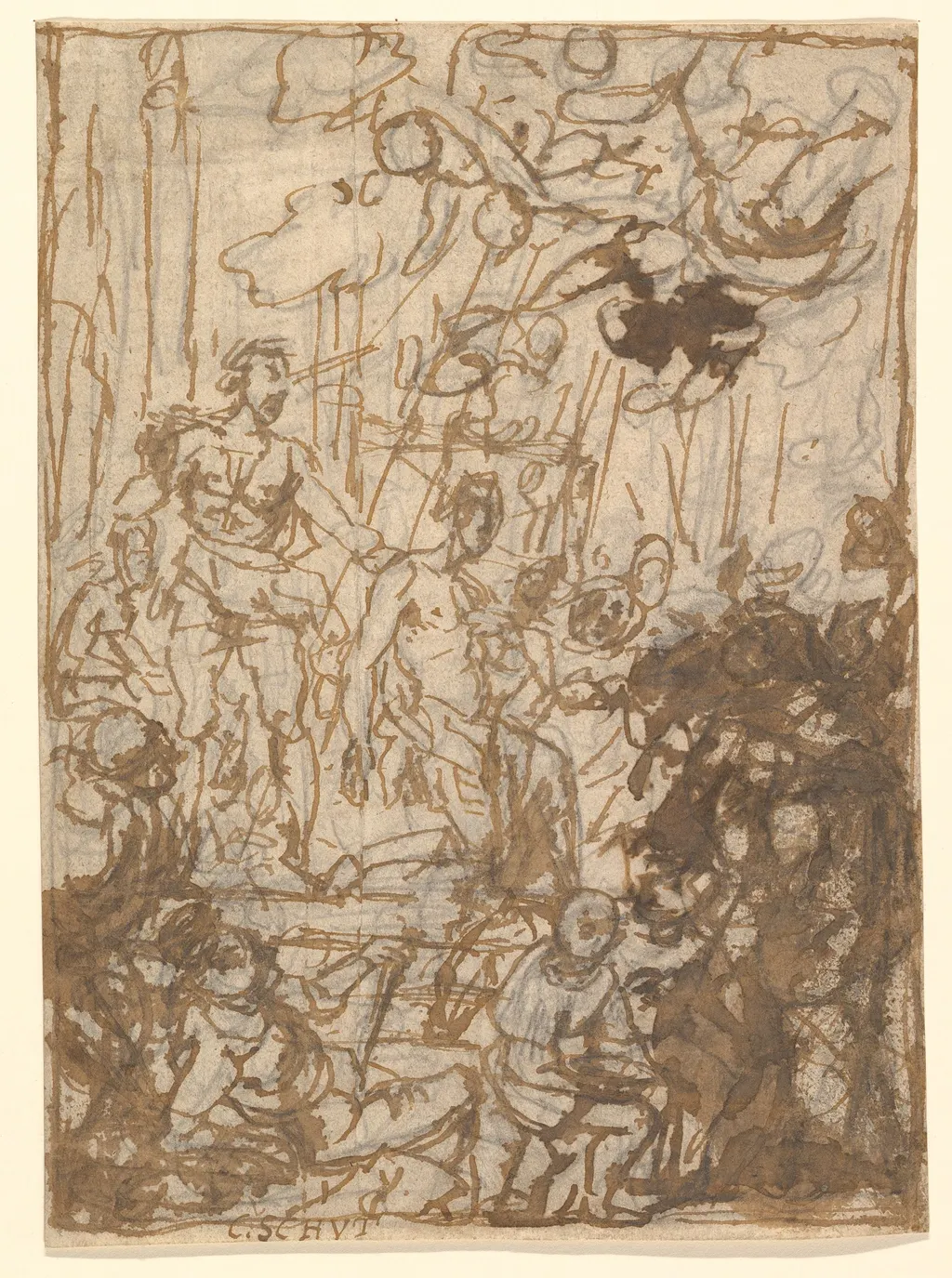
Cornelis SchutMartyrdom of Saint Gereon, early 17th–mid 17th centuryPen and brown ink, over graphite.The Metropolitan Museum of Art, collection record. CC0 1.0 (Public Domain)
Among the portraits of artists that Anthony van Dyck drew for his great print series, the Iconography, is one of a fellow Antwerp painter with a broad, alert face: Cornelis Schut. Engraved by Lucas Vorsterman, it places Schut in the company of Rubens, Jordaens and the other leading painters of the Southern Netherlands. Today his name is far less familiar than theirs, yet in the 1640s, after Rubens's death, Schut was one of the most sought-after history painters in Antwerp.
Like so many of his contemporaries, Schut was formed by Italy. This article follows him from Antwerp to Rome, where he helped found a notorious artists' fellowship, to the villas of Frascati and back home again, and sets his story against the wider pattern of Flemish painters who travelled south.
Training in Rubens's Antwerp
Cornelis Schut was born in Antwerp on 13 May 1597. Nothing certain is known of his training. He has long been described as a pupil of Rubens, a claim that goes back to an eighteenth-century biographer whose reliability is questioned. The idea remains plausible, because Rubens was exempt from registering his pupils with the city's Guild of St Luke, and Schut's later work is steeped in Rubens's example. But it is an assumption, not a documented fact.
Schut became a master in the Antwerp guild in 1618. Shortly afterwards he set out for Italy, as ambitious young Flemish painters had done for generations.
The Flemish road to Italy
By the early seventeenth century the journey south had become almost a rite of passage. A few examples show how varied the experience could be:
- Paul Bril (c. 1554–1626) settled in Rome as a young man and never came back, becoming a leading landscape painter there.
- Jan Brueghel the Elder worked in Italy in the 1590s, where Cardinal Federico Borromeo became a lifelong patron.
- Peter Paul Rubens spent 1600 to 1608 in Italy, much of it in the service of the Gonzaga court in Mantua.
- Anthony van Dyck was in Italy from 1621 to 1627, based mainly in Genoa, where he painted its patrician families.
Italy offered antiquities, the works of Raphael, Michelangelo and Titian, and the excitement of contemporary painters such as Caravaggio and the Carracci. It also offered commissions, though competition for them was fierce. For a later Flemish visitor whose Roman years were spent in quite a different way, see The Painted Secrets of Michael Sweerts.
Broodzak among the Bentvueghels
In Rome, Schut is recorded as one of the founding members of the Bentvueghels, an informal fellowship of mainly Dutch and Flemish artists that took shape in the early 1620s. The name means something like "birds of a feather". New members were given a nickname, the bentnaam, often a classical hero or a joke, at a raucous initiation feast paid for by the newcomer. The celebrations traditionally ended at the church of Santa Costanza, which the artists called the "Temple of Bacchus" because of the vine-harvest imagery on the porphyry sarcophagus once kept there. Schut's nickname was Broodzak, "bread bag".
The fellowship was both a social club and a support network for foreigners in a city whose official art institutions, notably the Accademia di San Luca, were dominated by Italians. Its excesses eventually wore out official patience, and Pope Clement XI banned it in 1720.
Early drawn portraits of Bentvueghels members, Schut among them, survive. Together with the members' names left at Santa Costanza, they are among the most vivid records of the northern artists' community in Rome, and they help scholars work out who was there and when.
Frescoes at Frascati
Schut's most important Italian commission came from outside the city. From January 1627 he worked on fresco decorations in the Casino Pescatore at Frascati, in the hills south-east of Rome, a villa belonging to the banker Pietro Pescatore. He worked alongside the Dutch painter Tyman Arentsz Cracht, a fellow member of the Bentvueghels.
For a painter trained in oil on panel and canvas, fresco was a demanding discipline: the pigments must be laid on wet plaster section by section, with little opportunity for correction. The experience of large-scale wall and ceiling painting, and of the Roman illusionism that went with it, would later set Schut apart from many of his Antwerp colleagues. He is also reported to have spent time in Florence around 1627–28, where he is said to have supplied designs for the Medici tapestry works.
Home to Antwerp
Schut reappears in Antwerp in September 1631, when he drew up a marriage contract; he married Catharina Gheenssins on 7 October that year. He quickly found work. In 1635 he contributed to the temporary decorations erected for the ceremonial entry of the new governor, the Cardinal-Infante Ferdinand, a festival on which much of the Antwerp art world laboured under Rubens's direction, and he made etchings of related decorations in Ghent.
After Rubens's death in 1640 and Van Dyck's in 1641, Schut's career reached its peak. Two works show why.
The Beheading of Saint George (1643)
The Young Archers' Guild of Antwerp had first approached Van Dyck for an altarpiece of their patron saint; his project was unfinished when he died. Schut won the commission in competition with Thomas Willeboirts Bosschaert, and the result, now in the Royal Museum of Fine Arts Antwerp (KMSKA), is a canvas nearly four metres high. George, his armour removed, kneels before the executioner while a pagan priest urges him to worship a statue of Apollo; above, an angel descends with the martyr's palm. The museum notes that Schut combined episodes the Golden Legend places at different moments, as Rubens had done in an earlier altarpiece of the same subject.
The cathedral Assumption
Schut's experience of ceiling painting brought him one of the most prominent commissions in the city: an Assumption of the Virgin for the ceiling of the crossing of Antwerp Cathedral, generally dated to the later 1640s. Seen from far below, the Virgin rises into a dome of light, a composition that owes much to the Italian tradition of painting di sotto in sù, "from below upwards".
Look closer: In Schut's altarpieces, compare the figures in the foreground with those in the sky. The earthly figures are weighty and Rubensian, but the heavenly ones are often lighter and more fluid, closer to Italian ceiling painting. That mixture of Antwerp substance and Roman movement is the key to his style.
Prints, garlands and tapestries
Schut was a prolific etcher. His prints of putti, allegories and religious subjects circulated widely; the Metropolitan Museum of Art owns an English-bound scrapbook of 176 etchings by or after him. He also collaborated with flower painters, supplying the figures at the centre of garland paintings framed by blooms from specialists such as Daniel Seghers, and he designed tapestry cartoons, including a series of the Seven Liberal Arts.
New discoveries continue to refine his oeuvre. In 2022 an exhibition in Antwerp presented a Virgin and Child with Saint John the Baptist and Angels on copper, previously attributed to Theodoor van Thulden and now given to Schut.
Schut died in Antwerp on 29 April 1655 and was buried in the church of St Willibrord. A younger relative of the same name, also a painter, made his career in Seville, which occasionally causes confusion in catalogues.
Where to see Cornelis Schut
- Royal Museum of Fine Arts Antwerp (KMSKA): The Beheading of Saint George (1643) and other works.
- Antwerp Cathedral (Cathedral of Our Lady): the Assumption on the crossing ceiling; bring binoculars.
- Print rooms: the Metropolitan Museum of Art, the British Museum and the Rijksmuseum hold his etchings, many viewable online.
To place Schut among his contemporaries, read What Was the Baroque? and Jacob Jordaens and His Classical Sources, or browse our art history topic page.
Sources
- The Beheading of Saint George (Cornelis Schut, 1643), Royal Museum of Fine Arts Antwerp (KMSKA)
- Portrait of Cornelis Schut (Lucas Vorsterman I after Anthony van Dyck), The Metropolitan Museum of Art
- Scrapbook of 176 etchings by or after Cornelis Schut, The Metropolitan Museum of Art
- A painting by Cornelis Schut (1597–1655) rediscovered, CODART