Ten Famous Paintings and the Stories Behind Them
From a Song dynasty scroll to Guernica, ten celebrated paintings and the documented stories of how they were made, lost, altered, stolen or rediscovered.
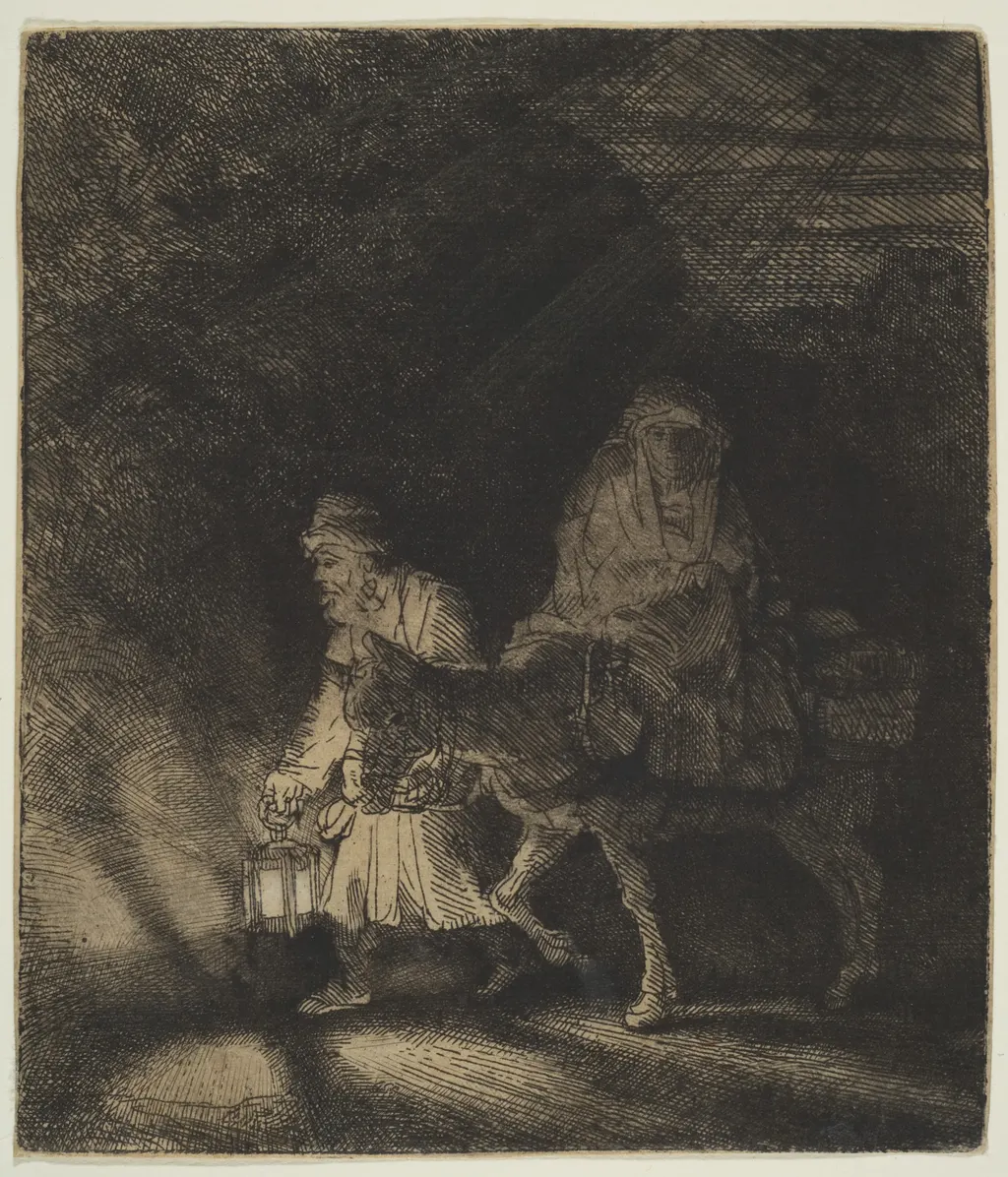
Rembrandt (Rembrandt van Rijn)The Flight into Egypt: a Night Piece, 1651Etching with plate tone; first stateThe Metropolitan Museum of Art, collection record. CC0 1.0 (Public Domain)
Every famous painting has two histories. One is the story of how it was made: who asked for it, what the artist intended, what materials went into it. The other is everything that happened afterwards: the fires and thefts, the trimming and repainting, the changing fame that turned some pictures into household images and left others in storage.
The ten paintings below span nine centuries and three continents. For each, we have kept to what is documented, and noted where scholars still disagree. Taken together, they show that a painting on a museum wall is not a fixed object but the survivor of a long and sometimes hazardous life.
1. Along the River During the Qingming Festival (early twelfth century)
A handscroll of ink and colour on silk, about 25 centimetres high and more than five metres long, this panoramic view of city life is traditionally attributed to Zhang Zeduan, a painter of the Northern Song dynasty. Unrolled from right to left, it takes the viewer from quiet countryside into a teeming riverside city, past boats negotiating a crowded bridge, shops, inns and hundreds of figures going about their business.
The story behind it is largely one of uncertainty. The earliest attribution to Zhang Zeduan is an inscription dated 1186, and almost nothing is known about him. Scholars still debate whether the city is the Song capital Bianjing (modern Kaifeng), whether "Qingming" refers to the spring festival or something else, and whether the scroll carries a hidden message about the state of the empire. It was copied and reimagined so often by later painters that "Qingming scroll" became almost a genre of its own. The original, now in the Palace Museum in Beijing, is so fragile that it is shown only rarely and briefly.
2. Mona Lisa, Leonardo da Vinci (c. 1503–19)
Leonardo's portrait in oil on poplar panel is traditionally identified as Lisa Gherardini, wife of the Florentine merchant Francesco del Giocondo. The Louvre dates it to about 1503–19: Leonardo seems to have kept the panel with him and continued working on it for years, rather than delivering it to the family.
Its modern celebrity owes a great deal to a crime. On 21 August 1911 the painting vanished from the Louvre. The thief, Vincenzo Peruggia, had worked at the museum and helped make the painting's protective glass case; he hid it for more than two years before trying to sell it in Florence in December 1913 to Giovanni Poggi, director of the Uffizi, who alerted the authorities. The painting returned to Paris in January 1914, by then front-page news around the world. For a related puzzle, see our article on the Prado's copy of the Mona Lisa.
3. Las Meninas, Diego Velázquez (1656)
In a high room of the royal palace in Madrid, the five-year-old Infanta Margarita Teresa stands among her attendants: two meninas (maids of honour), a chaperone and a bodyguard, two court dwarfs and a dog. At the left, Velázquez himself stands at a huge canvas, brush in hand. In the mirror on the back wall appear King Philip IV and Queen Mariana, apparently standing where we stand.
The most famous story attached to the painting concerns the red cross of the Order of Santiago on the painter's chest. Velázquez was admitted to the order only in 1659, three years after the painting was finished, so the cross was added later. The early biographer Antonio Palomino wrote that the king ordered it added after Velázquez's death in 1660, and repeated a story that Philip painted it himself; there is no way to confirm this. The painting also survived the fire that destroyed the old Alcázar palace in 1734, though not unscathed: the Infanta's cheek had to be largely repainted. It hangs today in the Museo del Prado.
Look closer: Stand in front of a reproduction of Las Meninas and ask who is looking at whom. The painter, the Infanta and several attendants look out towards the space occupied by the royal couple, and by you. Few paintings make the viewer so aware of their own position.
4. The Night Watch, Rembrandt (1642)
Its official title, Militia Company of District II under the Command of Captain Frans Banninck Cocq, explains what it is: a group portrait of members of an Amsterdam civic guard company, painted for the great hall of their headquarters, the Kloveniersdoelen. Rembrandt turned the conventional row of portraits into a burst of movement, with the captain in black giving the order to march, a drummer, a raised standard and a mysterious girl in gold with a dead chicken at her waist (the claws were the company's emblem).
The name "Night Watch" came only in the late eighteenth century, when darkened varnish made the daytime scene look nocturnal. In 1715 the canvas was moved to the Town Hall on Dam Square and cut down to fit its new position, losing strips from all four sides; a seventeenth-century copy shows what was lost. Since 1808 the city of Amsterdam has lent it to what is now the Rijksmuseum, where it remains the museum's centrepiece. To see Rembrandt in his own surroundings, read our piece on the Rembrandt House Museum.
5. Girl with a Pearl Earring, Johannes Vermeer (c. 1665)
This is not a portrait in the usual sense but a tronie, a Dutch term for a study of a face, a character or an expression, often in exotic costume. The girl's turban and the impossibly large pearl were part of that imaginative game.
For a picture now so famous, its modern history began modestly. In 1881 it was bought at auction in The Hague, in poor condition, by the collector Arnoldus Andries des Tombe for two guilders plus thirty cents in buyer's premium. He left it to the Mauritshuis on his death, and it entered the collection in 1902. A restoration in 1994 and a detailed technical study in 2018 revealed tiny eyelashes and traces of a green curtain in the now-dark background. On Vermeer's world more broadly, see Vermeer and His Milieu.
6. The Raft of the Medusa, Théodore Géricault (1818–19)
In July 1816 the French frigate Méduse ran aground off the coast of West Africa. More than 150 people were set adrift on a makeshift raft; after thirteen days, only fifteen were still alive when they were rescued. The scandal, which implicated an incompetent captain appointed through political favour, became a political embarrassment for the restored monarchy.
Géricault treated the disaster with the seriousness of a history painting. He interviewed two survivors, the surgeon Henri Savigny and the engineer Alexandre Corréard, had a scale model of the raft built, and studied the sick and the dead in Paris hospitals. The result, over seven metres wide, was shown at the Salon of 1819 and divided critics. Today it hangs in the Louvre, though Géricault's use of bitumen, a dark pigment that never fully dries, has darkened and cracked large areas. It is a cornerstone of Romanticism in art.
7. The Starry Night, Vincent van Gogh (1889)
Van Gogh painted it in June 1889 at the asylum of Saint-Paul-de-Mausole near Saint-Rémy-de-Provence, where he had admitted himself as a patient. The view combines what he saw from his east-facing bedroom window before dawn with an invented village and church spire, under a sky of swirling stars and a crescent moon.
The painting's later fame would have surprised its maker: in a letter to the painter Émile Bernard later that year, he counted it among his failures. The Museum of Modern Art in New York acquired it in 1941, and it has become one of the most reproduced images in the world.
8. The Scream, Edvard Munch (1893)
Munch described the experience behind it in his own writing: a walk at sunset when the sky turned blood red and he sensed a great scream passing through nature. The setting is traditionally identified as a road on the Ekeberg hill above the Oslofjord.
There is not one Scream but several: two paintings, two pastels and a lithograph. The 1893 painted version belongs to the National Museum of Norway in Oslo; a later painted version is in the Munch Museum. Both have been stolen. The National Gallery's version was taken in February 1994 and recovered undamaged three months later; the Munch Museum's version was seized by armed robbers in 2004 and recovered, damaged, in 2006.
9. Guernica, Pablo Picasso (1937)
On 26 April 1937, during the Spanish Civil War, aircraft of the German Condor Legion, supporting Franco's Nationalists alongside Italian forces, bombed the Basque town of Guernica. Picasso, who had already been commissioned to make a mural for the Spanish Republic's pavilion at the Paris International Exposition, completed his response in Paris in a matter of weeks. Painted in black, white and grey on a canvas nearly eight metres wide, it shows no aircraft and no specific place, only screaming women, a dying horse, a bull and a broken warrior.
Picasso insisted that the painting should not go to Spain until democracy returned. It spent decades on loan to the Museum of Modern Art in New York, arriving in Madrid only in 1981, after Franco's death. Since 1992 it has hung in the Museo Nacional Centro de Arte Reina Sofía.
10. The Two Fridas, Frida Kahlo (1939)
Two versions of Kahlo sit side by side, holding hands: one in a white European-style dress, one in Tehuana dress from Oaxaca. Their exposed hearts are joined by a single vein, which the European Frida has cut with surgical forceps, letting blood drip onto her skirt; the Mexican Frida holds a tiny portrait of Diego Rivera.
Kahlo painted it in the year she and Rivera divorced (they remarried in 1940), and it was shown at the International Surrealist Exhibition in Mexico City in January 1940. Interpretations vary: the two figures have been read as the woman Rivera loved and the woman he rejected, as Kahlo's mixed European and Mexican heritage, or as both. It belongs to the Museo de Arte Moderno in Mexico City.
Seeing these works for yourself
| Painting | Where to see it |
|---|---|
| Along the River During the Qingming Festival | Palace Museum, Beijing (displayed only occasionally) |
| Mona Lisa | Musée du Louvre, Paris |
| Las Meninas | Museo del Prado, Madrid |
| The Night Watch | Rijksmuseum, Amsterdam |
| Girl with a Pearl Earring | Mauritshuis, The Hague |
| The Raft of the Medusa | Musée du Louvre, Paris |
| The Starry Night | The Museum of Modern Art, New York |
| The Scream (1893 painting) | National Museum of Norway, Oslo |
| Guernica | Museo Reina Sofía, Madrid |
| The Two Fridas | Museo de Arte Moderno, Mexico City |
Famous paintings draw crowds, so check museum websites for timed tickets and quieter hours, and remember that loans and conservation work occasionally take a picture off view. More stories from the history of art are gathered under art history.
Sources
- Portrait of Lisa Gherardini, wife of Francesco del Giocondo, known as the Mona Lisa, Musée du Louvre
- The Night Watch, Rembrandt van Rijn, 1642, Rijksmuseum
- The Starry Night, Vincent van Gogh, 1889, The Museum of Modern Art
- Girl with a Pearl Earring, Johannes Vermeer, Mauritshuis