Romanticism in Art: Nature, Feeling and the Sublime
How Romantic painters from Friedrich and Turner to Géricault, Goya and Delacroix turned storms, mountains and suffering into art about feeling.
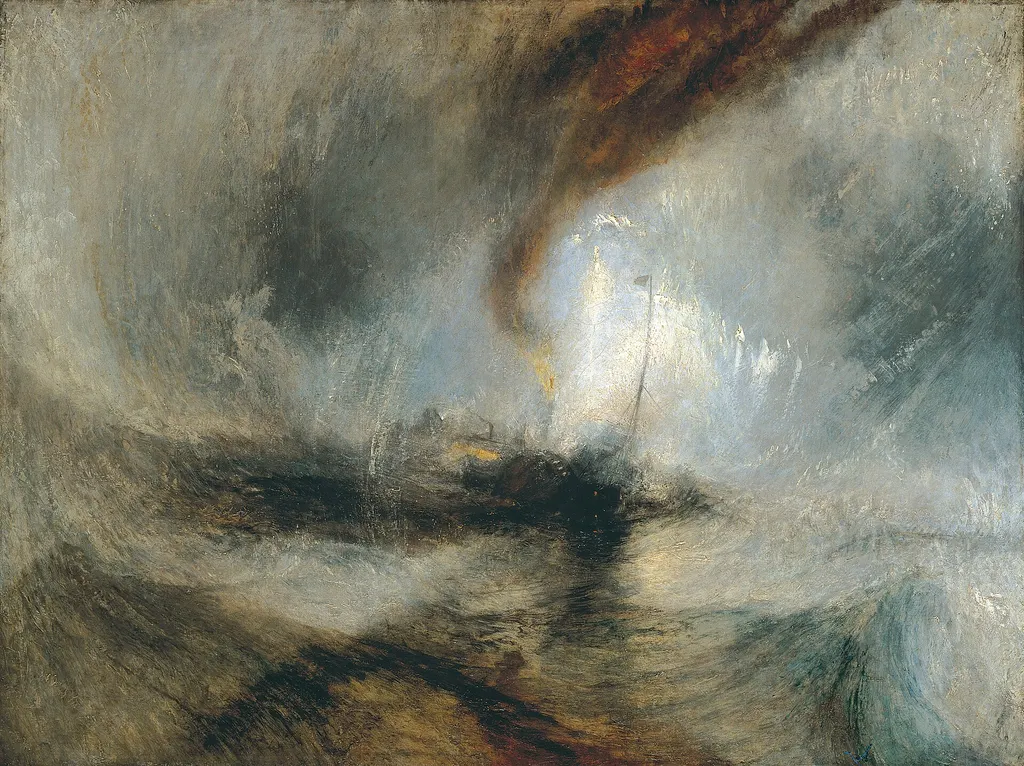
J. M. W. TurnerSnow Storm: Steam-Boat off a Harbour's Mouth, circa 1842Wikimedia Commons, collection record. Public domain
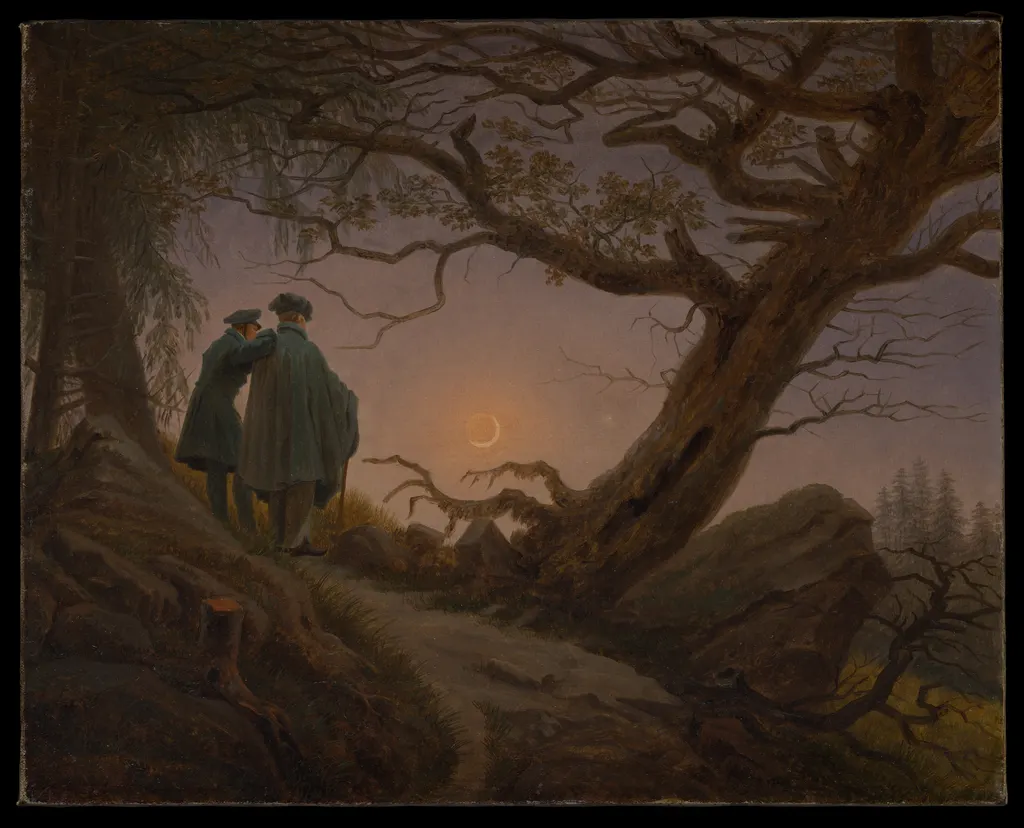
A man in a dark green coat stands on a rocky outcrop, his back turned to us, a walking stick in his hand. Below him a sea of mist fills the valleys, broken only by ridges and distant peaks. We never see his face. Caspar David Friedrich's Wanderer above the Sea of Fog, painted around 1817 and now in the Hamburger Kunsthalle, has become the emblem of an entire movement, and it is worth asking why. Nothing happens in it. There is no story, no saint, no battle. What the picture offers instead is a state of mind: solitude, awe, a sense of the self standing at the edge of something too large to understand.
That shift, from painting what happened to painting what it felt like, is the heart of Romanticism. Between roughly the 1780s and the 1840s, artists across Europe turned to storms, ruins, mountains, shipwrecks, revolutions and nightmares, and asked their viewers to respond with emotion rather than with reason alone.
This guide explains what the Romantics were reacting against, the key idea of the sublime, and how to recognise Romanticism in a gallery, with the paintings that best show it.
What the Romantics were reacting against
Romanticism is easiest to understand next to what came before it. The dominant style in the later eighteenth century was Neoclassicism: clear outlines, balanced compositions, subjects from ancient history, and a moral seriousness rooted in the Enlightenment's faith in reason. A Neoclassical painting asks you to admire virtue and to read a story correctly.
The Romantics did not reject all of this at once, and many of them trained in Neoclassical studios. But a series of upheavals changed what art seemed to be for. The French Revolution and the Napoleonic Wars made history feel violent and unpredictable. Industrialisation began to reshape the countryside. Poets such as Wordsworth, Byron and Goethe were writing about individual experience, memory and nature in new ways. Painters responded by valuing imagination, intuition and personal vision, and by treating the natural world as something with spiritual and emotional force.
It helps to remember that "Romanticism" is a label applied broadly. It was never a single school with a manifesto. A quiet English landscape by John Constable and a shrieking French revolutionary crowd by Eugène Delacroix both count, because both put feeling at the centre.
| Neoclassicism | Romanticism | |
|---|---|---|
| Typical subjects | Ancient history, myth, civic virtue | Nature, contemporary events, dreams, the exotic, the individual |
| Ideal response | Moral understanding, admiration | Awe, terror, pity, longing |
| Handling of paint | Smooth, controlled, crisp outlines | Often looser, more visible brushwork, dramatic light |
| Composition | Balanced, frieze-like, stable | Diagonals, turbulence, vast spaces, off-centre focus |
| Colour | Subordinate to line and drawing | Expressive, sometimes the main carrier of mood |
The sublime: beauty's frightening twin
The single most useful word for understanding Romantic art is "sublime". The Irish-born writer Edmund Burke set out the idea in A Philosophical Enquiry into the Origin of Our Ideas of the Sublime and Beautiful (1757). For Burke, beauty was associated with smallness, smoothness and pleasure. The sublime was something else: vastness, darkness, power, obscurity and danger. It produced a kind of delightful terror, the thrill of contemplating forces that could destroy us, experienced from a position of relative safety.
Painters found the sublime everywhere: in Alpine avalanches, erupting volcanoes, raging seas, endless skies. Look at J. M. W. Turner's Snow Storm: Hannibal and his Army Crossing the Alps, exhibited at the Royal Academy in 1812 and now at Tate. A black arc of storm cloud swings across the canvas like a wave about to break. Hannibal's army, a subject from ancient history that a Neoclassical painter might have treated as a heroic procession, is reduced to tiny, scrambling figures. The real protagonist is the weather. Painted while Napoleon was at war across Europe, the picture has often been read as a meditation on the fragility of empires, though Turner left that reading open.
Look closer: In a sublime landscape, find the human figures first. How large are they compared with the mountains, sea or sky? Where is the light coming from, and is any of the scene hidden in mist, smoke or darkness? Obscurity was part of the effect: what you cannot quite see, you imagine.
Landscape as a mirror of feeling
Landscape had long ranked low in the academic hierarchy of subjects, beneath history painting and portraiture. The Romantics transformed it into a vehicle for some of the most serious art of the age.
Friedrich and the figure seen from behind
Friedrich, working in Dresden, built his pictures around stillness and contemplation. His Monk by the Sea (1808–10, Alte Nationalgalerie, Berlin) shows a minute figure on a strip of dune before a dark sea and an immense, almost empty sky, a composition so stripped back it unsettled early viewers. Friedrich often placed figures with their backs to us (the German term is Rückenfigur), so that we look over their shoulders and share their view. The effect is to make the landscape feel like an inner experience. Artwis looks at his career in more depth in Caspar David Friedrich and the German Romantic landscape.
Constable and the poetry of the ordinary
John Constable found intensity in familiar places rather than in Alpine drama. The Hay Wain (1821, National Gallery, London) shows a cart crossing a shallow river in the Suffolk countryside where he grew up. Constable exhibited it at the Royal Academy as Landscape: Noon; it did not sell. Three years later it was shown at the Paris Salon of 1824, where it caused a sensation and won Constable a gold medal from Charles X. French painters noticed his fresh greens and the flecks of white paint that make light seem to sparkle on leaves and water. Constable's Romanticism is one of attachment: his oil sketches of clouds record specific skies at specific hours, observed with near-scientific attention but painted with obvious love.
Turner and the dissolving world
Turner went further than anyone in letting paint itself express energy. In later works such as Slave Ship (1840, Museum of Fine Arts, Boston), sea, sky and sunset melt into turbulent colour. The subject, enslaved people thrown overboard, is horrifying, and the painting's fury is inseparable from its moral charge.
History, suffering and the present day
Romantic artists also brought raw emotion to scenes of contemporary history, often choosing the victims rather than the victors.
Théodore Géricault, The Raft of the Medusa (1818–19, Musée du Louvre). In 1816 the French frigate Méduse ran aground off the coast of West Africa. Many of those set adrift on a makeshift raft died, and survivors' accounts of starvation and despair became a political scandal. Géricault painted the moment when survivors glimpse a distant ship. The canvas is enormous, almost five metres high and over seven metres wide, the scale traditionally reserved for heroic history painting. Here it is given to ordinary, dying people. The composition builds in a pyramid of bodies, from corpses at the bottom to a figure waving a cloth at the top.
Francisco de Goya, The Third of May 1808 (1814, Museo del Prado). Goya painted the executions of Madrid civilians by French troops after the uprising of 1808. The soldiers are a faceless row of rifles; the central victim, in a white shirt lit by a lantern, flings his arms wide. There is no glory here, only fear. Goya's late work, from his prints of the Disasters of War to the dark paintings he made for his own house, pushed Romantic feeling towards something close to despair. A different side of the painter, his work as a court artist, appears in the restored article on a painting of a giant anteater attributed to Goya.
Eugène Delacroix, Liberty Leading the People (1830, Musée du Louvre). Painted after the July Revolution of 1830 in Paris, the picture shows a bare-breasted allegorical figure of Liberty striding over a barricade with the tricolour, followed by a mixed crowd of workers, students and a boy brandishing pistols. Delacroix combined allegory with gritty, smoky reality, and his vigorous brushwork and saturated colour made him the leading French Romantic and the rival, in critical debate, of the Neoclassical Jean-Auguste-Dominique Ingres.
Dreams, nightmares and distant lands
Romanticism had an inward, irrational side too. Henry Fuseli's The Nightmare (1781, Detroit Institute of Arts) shows a sleeping woman sprawled across a bed while a demon squats on her chest and a wild-eyed horse peers through the curtains. It was a sensation and was widely reproduced in prints. William Blake, poet, painter and printmaker, built a private mythology in illuminated books that he wrote, etched and coloured himself.
Another strand was fascination with faraway places and the past: medieval ruins, Gothic cathedrals, and the landscapes and peoples of North Africa and the Middle East. Delacroix travelled to Morocco in 1832; the Scottish painter David Roberts toured Egypt and the Near East at the end of the 1830s and published his views as lithographs, as discussed in David Roberts and the picturing of Near Eastern antiquity. Today such images are studied critically as well as admired, because they often reflect European fantasies and colonial attitudes as much as observed reality.
How to recognise Romanticism in a gallery
Romanticism overlaps with what came before and after it, and you will see it shading into Realism and, later, into the open-air painting that led to Impressionism. For an overview of where it sits in the sequence of styles, see Understanding the major art movements. When you meet an unlabelled painting from the early nineteenth century, these questions will help:
- Is nature the main subject, or does it overwhelm the people? Tiny figures in vast landscapes are a strong Romantic signal.
- Is the weather doing emotional work? Storms, mist, moonlight and blazing sunsets usually carry meaning.
- Who is the focus? Victims, outsiders, solitary wanderers and anonymous crowds rather than kings and generals.
- Is the paint itself expressive? Look for visible, energetic brushwork and colour that sets the mood more than it describes.
- Does the picture leave things unresolved? Romantic paintings often withhold a clear story or a moral, inviting you to feel rather than conclude.
Where to see key works
- Hamburger Kunsthalle, Hamburg and Alte Nationalgalerie, Berlin: the core of Friedrich's work.
- Tate Britain, London: the largest collection of Turner's paintings, watercolours and sketchbooks.
- National Gallery and Victoria and Albert Museum, London: Constable's finished pictures and many of his oil sketches.
- Musée du Louvre, Paris: Géricault's Raft of the Medusa and Delacroix's Liberty Leading the People.
- Museo del Prado, Madrid: Goya's Second and Third of May 1808 and his Black Paintings.
Stand in front of any of them long enough and the Romantic proposition becomes clear: that a painting can be a way of feeling one's way into the world, not just a record of it.
Sources
- Snow Storm: Hannibal and his Army Crossing the Alps, exhibited 1812, Tate
- John Constable, The Hay Wain, 1821, The National Gallery, London
- Théodore Géricault, Le Radeau de la Méduse, Musée du Louvre
- Romanticism (Heilbrunn Timeline of Art History), The Metropolitan Museum of Art