His Majesty's Giant Anteater: A Painting Attributed to Goya
The life-size portrait of a giant anteater sent to Charles III in 1776, kept in Madrid's natural science museum, and the debate over whether Goya painted it.
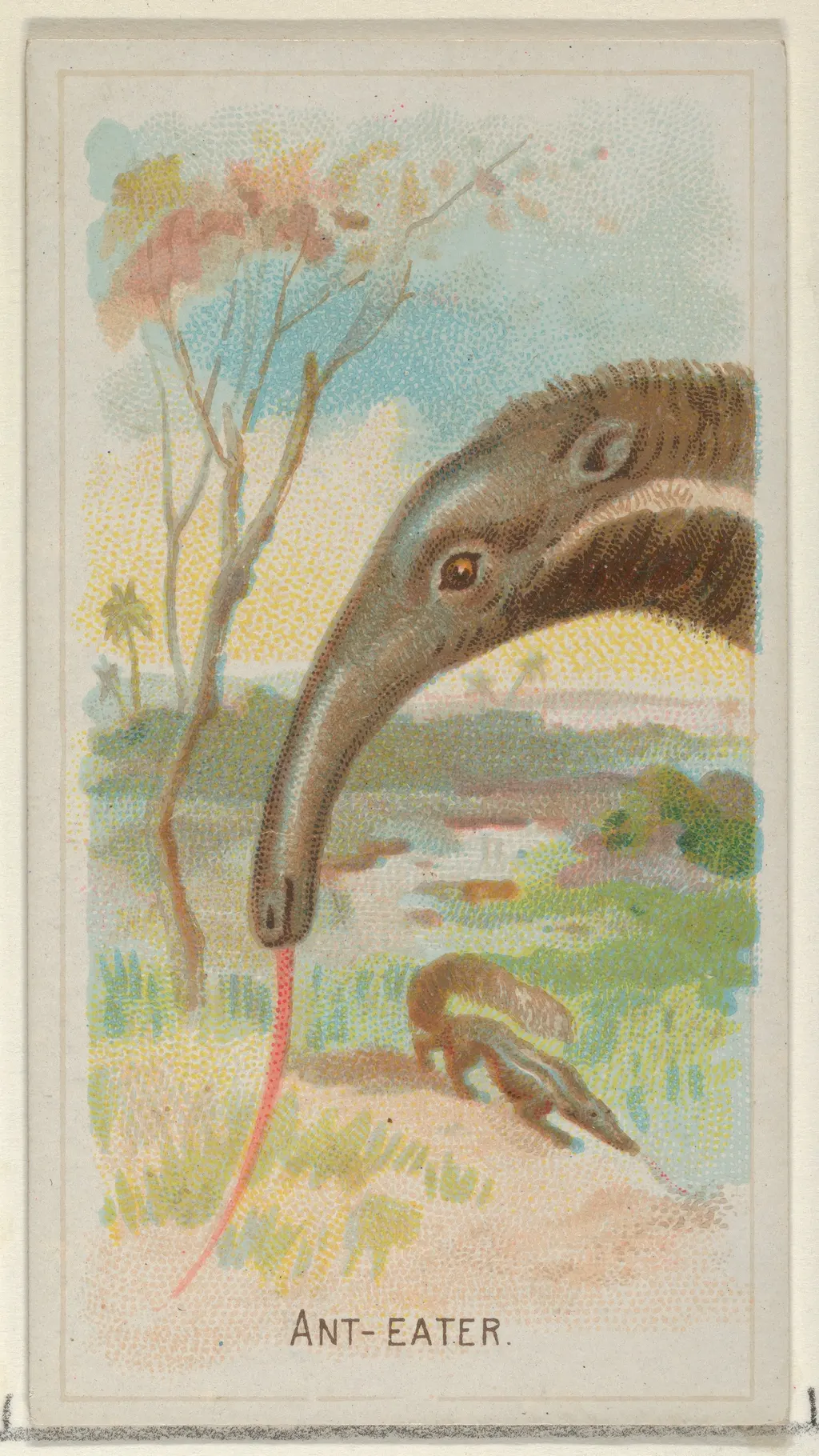
Allen & GinterAnteater, from the Wild Animals of the World series (N25) for Allen & Ginter Cigarettes, 1888Commercial color lithographThe Metropolitan Museum of Art, collection record. CC0 1.0 (Public Domain)
The canvas is more than two metres wide, and almost all of that width is animal. A giant anteater stands in profile against a low landscape, its long tubular snout reaching to one side, its great plume of a tail sweeping to the other, its coarse grey and black coat painted hair by hair. It is shown at life size. The picture, known in Spanish as La osa hormiguera de Su Majestad ("His Majesty's female anteater"), has hung in Madrid's natural history museum since the eighteenth century. In 2011 it became briefly famous when a Spanish art historian argued that it was painted, at least in part, by the young Francisco de Goya.
The story behind it is a good one: an exotic animal shipped across the Atlantic for a king, a royal commission routed through the most powerful painter at court, and a document recording payment to an artist whose name was never written down. It is also a useful case study in how attributions are made, and why they should be held with care.
An animal for a king
In the 1770s Charles III of Spain was building up the institutions of an enlightened monarchy, among them a royal cabinet of natural history. Specimens, minerals and curiosities arrived from across Spain's empire, and so, occasionally, did live animals.
According to the museum's research and later press accounts, a female giant anteater (Myrmecophaga tridactyla) was shipped from Buenos Aires and reached Cádiz on 7 June 1776, after about eighty days at sea. It then spent roughly a month travelling by cart to Madrid, and in early July 1776 it was presented to the king. The animal was kept in the royal menagerie at the Buen Retiro. Unable to feed on ants and termites, it was given a substitute diet that included meat, flour and milk. It survived for about seven months and died in January 1777.
Even before it died, the king wanted a record of it. The painting carries an inscription stating that the portrait was taken from the animal at the Retiro menagerie in July 1776.
A picture for a cabinet
The Real Gabinete de Historia Natural was founded by Charles III in 1771, built on the collection of the naturalist Pedro Franco Dávila (1711–1786), who became its first director. Its direct descendant is today's Museo Nacional de Ciencias Naturales (MNCN), part of Spain's national research council, the CSIC.
The anteater portrait has been in the museum's possession since the late eighteenth century. For much of its later history it hung in the director's office rather than in the galleries. It measures 105 x 209 centimetres, is painted in oil on canvas, and shows the animal in profile at natural size. It was put on public display for the first time on 23 November 2011, when the museum opened a new permanent display recreating the Real Gabinete, timed to mark the 240th anniversary of its founding and the three hundredth anniversary of Franco Dávila's birth.
The case for Goya
In 2011 the art historian Javier Jordán de Urríes y de la Colina, a specialist in eighteenth-century Spanish art, published an article titled "Un Goya exótico: la osa hormiguera de Su Majestad" in the Madrid art journal Goya (no. 336). His argument rests on two kinds of evidence.
Documents. Archival research at the museum showed that the commission was entrusted to Anton Raphael Mengs (1728–1779), Charles III's first court painter. A document dated 17 September 1776 records the payment of fifteen doblones to a painter who had portrayed the animal from life. The painter is not named. As first court painter, Mengs supervised the work of younger artists employed by the court.
Style and circumstance. Goya had arrived in Madrid at the beginning of 1775 to design cartoons for the Royal Tapestry Factory of Santa Barbara, a programme ultimately overseen by Mengs. His first cartoons were hunting scenes made in 1775 under the supervision of his brother-in-law Francisco Bayeu. Jordán de Urríes saw close similarities between the landscape in the anteater painting and those in Goya's early tapestry cartoons, and proposed that Mengs passed at least part of the work to the young painter from Aragon.
The MNCN itself has described the painting as a royal commission to Mengs that, according to Jordán de Urríes, was passed in part to Goya.
The case for caution
Several points keep this attribution in the category of "proposed" rather than "proven".
- No signature and no name. The payment document names no painter, and the canvas is unsigned.
- A workshop context. Mengs's circle included several capable painters. A picture made under his direction could have been painted by any of them, or by more than one.
- Limited comparison. The stylistic case rests largely on the landscape background, while the animal itself is painted as a precise natural-history record, a genre with few securely documented works by Goya to compare it with.
- Limited further study. The museum's own online description notes that the Goya proposal has not been supported by other published studies. The painting is catalogued by the Fundación Goya en Aragón as an attributed work.
None of this disproves the hypothesis. It means that "attributed to Goya" is the honest label, and that the picture's interest does not depend on the name.
Look closer: Compare the animal with the landscape. The anteater is painted with the precision of a scientific record: the stripe across the shoulder, the claws folded under the forefeet, the texture of the tail. The landscape is looser and more atmospheric. Contemporary natural-history painting often combined an exact specimen with a generalised setting, and the contrast is part of what scholars weigh when they ask whether one hand or two was at work.
Science, art and empire
Whoever held the brush, the painting belongs to a particular moment, when European courts used painters as recorders of the natural world. A life-size portrait could be studied after the animal had died, compared with descriptions by naturalists, and displayed as evidence of the reach of the Spanish crown. In 2016, for an exhibition marking 240 years of the museum, the MNCN displayed the painting beside a restored modern specimen of a giant anteater, donated that year, which allowed visitors to compare paint and fur side by side.
The animal's story is also a reminder of the cost of such collecting. Taken far from its habitat and fed an unsuitable diet, it lived only a few months in Madrid. Today the giant anteater is classed as Vulnerable on the IUCN Red List, and international trade in the species is regulated under CITES.
Seeing it for yourself
The painting is displayed in the Real Gabinete section of the Museo Nacional de Ciencias Naturales in Madrid. It makes an instructive contrast with the Prado's Goyas: look for the tapestry cartoons of the 1770s there, and judge the landscape comparison for yourself.
For more on how experts reach conclusions about authorship, see our guides to provenance and how to appreciate historical paintings. Other pictures with remarkable histories feature in famous paintings and their stories, and many museum images can be studied in detail through open-access collections. Browse more under art history.
Sources
- La Osa hormiguera de Su Majestad, Museo Nacional de Ciencias Naturales (MNCN-CSIC) on Google Arts & Culture
- Un óleo atribuido a Francisco de Goya se expone por primera vez en el Museo Nacional de Ciencias Naturales (press release, 23 November 2011), Consejo Superior de Investigaciones Científicas (CSIC)
- Un oso hormiguero para el Real Gabinete (Naturalmente, no. 12), Museo Nacional de Ciencias Naturales
- El triste viaje de un oso hormiguero en barco y un cuadro atribuido a Goya, La Nación