Provenance Explained: The Ownership History of a Work of Art
What provenance is, how museums and collectors trace it, how to read a provenance entry, and why gaps in ownership history can matter so much.
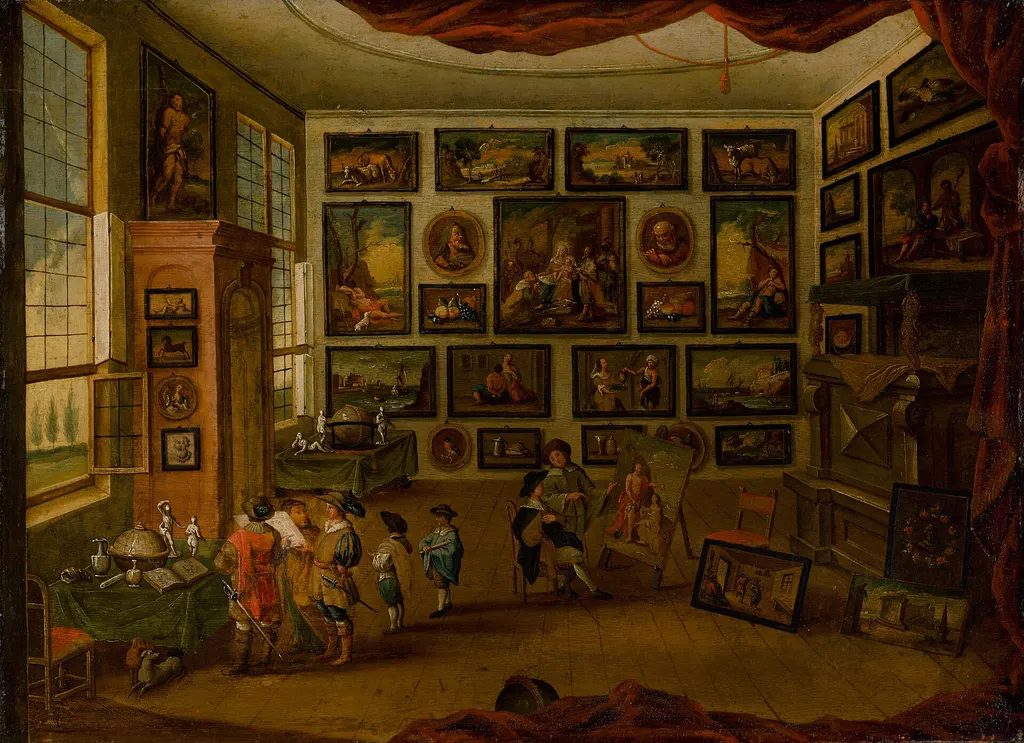
Hans Jordaens IIIKunstkammer, 1660Wikimedia Commons, collection record. Public domain
Turn an old painting round and you often find a second, hidden picture: the history of its travels. A faded paper label from an exhibition decades ago. A dealer's stock number in blue crayon. A chalked lot number from an auction. A wax seal, a customs stamp, an inventory number painted on the stretcher, perhaps a handwritten name. Each mark is a clue to someone who owned, sold, lent or moved the work.
That sequence of owners and transfers is called provenance, from the French provenir, "to come from". Museums describe provenance research as tracing the biography of an artwork from its creation to the present. It can help confirm an attribution, add to a work's historical interest, affect its value, and, most importantly, reveal whether it was ever stolen, looted or illegally exported.
This guide explains where provenance information comes from, how to read the shorthand museums use, why gaps matter, and what collectors can do themselves.
Why provenance matters
Provenance does several different jobs at once.
- Authenticity. A continuous history back to the artist's studio, a known patron or an early inventory supports an attribution. It does not prove it, since forgers have also forged documents, but a documented history is an important strand of evidence alongside connoisseurship and technical analysis. Restored Artwis articles such as copies, fakes and decorative miniatures show how often attribution and history go hand in hand.
- Historical meaning. Knowing that a work belonged to a particular collector, hung in a particular house or was exhibited at a famous exhibition tells us how it was valued and seen in the past.
- Value. Distinguished provenance can raise prices, and the absence of any history can depress them. Researching a work's history is part of understanding what it might be worth, as discussed in our guide to art price guides and valuation research.
- Legal and ethical title. Most seriously, provenance reveals whether a work may have been stolen, confiscated or taken unlawfully. A buyer cannot always acquire good title to stolen property, and museums now refuse to acquire works with problematic histories.
Where the evidence comes from
Provenance researchers combine physical evidence on the object with documents in archives and libraries.
On the object itself
- Labels from exhibitions, dealers, framers, auction houses, shippers and previous museum loans.
- Stamps and seals, including customs and export stamps, wax seals, and the stamps of famous collections.
- Collectors' marks. Collectors of drawings and prints often stamped their sheets with small personal marks. The standard reference is Frits Lugt's Les Marques de collections de dessins et d'estampes, first published in 1921 with a supplement in 1956, and now maintained online by the Fondation Custodia in Paris, where it has been revised and expanded since 2010.
- Inscriptions and numbers on stretchers, panels, frames or mounts: inventory numbers, lot numbers, stock numbers and owners' names.
Look closer: Never remove old labels or clean the back of a painting or frame to "tidy it up". Photograph everything first, front and back, with a scale, and keep the photographs with your records. Labels that look like scrap can be the most valuable evidence a work has.
In documents
- Auction and sale catalogues, especially annotated copies recording buyers and prices.
- Dealers' stock books and archives, which record purchases and sales.
- Inventories drawn up at death, marriage or bankruptcy.
- Exhibition catalogues, guidebooks and reviews.
- Photographic archives and earlier scholarly literature.
- Letters, diaries and wills.
The Getty Provenance Index, developed by the Getty Research Institute since the early 1980s, brings many such records together in searchable form. It includes European sale catalogues from 1650 to 1945, archival inventories from 1520 to 1880, and the stock books of major dealers such as Goupil & Cie (later Boussod, Valadon & Cie) in Paris and M. Knoedler & Co. in New York.
How to read a provenance entry
Museums publish provenance in a compact shorthand, usually listing owners chronologically from the earliest known. Conventions vary slightly between institutions, but many follow a common pattern. At the Yale University Art Gallery, for example, each entry gives, where known, the method of transfer, the owner's name and life dates, the place and the date. A semicolon between two entries indicates a direct transfer from one owner to the next; a full stop indicates that the transfer was not direct or is not known to have been. Words such as "possibly", "probably" and "reportedly" flag uncertainty. Many museums put dealers and auction houses in square brackets to distinguish them from private owners.
Here is an invented example, to show how the punctuation works:
The artist; sold to Jan de Vries, Amsterdam, by 1672; by inheritance to his daughter, Maria de Vries (d. 1710), Amsterdam. Possibly Pieter Smit, The Hague, c. 1750. [Dealer X, London], 1888; sold to Sir Y, London, 1888; by descent to his grandson; sold to the museum, 1961.
Reading it: the work passed directly from the artist to de Vries and then to his daughter. The full stop after 1710 marks a break, and the next owner is only "possibly" identified. After another break, the chain resumes with a dealer in 1888 and is continuous to the museum.
Gaps and red flags
Almost every older work has gaps in its history. Most are innocent: records were lost, a work stayed in a family for generations, or nobody thought to write anything down. But some gaps demand particular scrutiny.
| Period or category | Why it matters | Typical checks |
|---|---|---|
| Europe, 1933–1945 | Systematic confiscation, forced sales and looting of works owned by Jewish collectors and others persecuted under the Nazi regime | Wartime dealer records, confiscation and restitution databases, post-war claims |
| Archaeological material and antiquities | Looting from sites and illegal export; 1970 is widely used as a threshold date after the UNESCO Convention on illicit trafficking in cultural property | Documented export and ownership before 1970, excavation records, export licences |
| Objects from colonial contexts | Removal through military expeditions or under unequal conditions | Collection records, expedition histories, dialogue with communities of origin |
| Recently stolen works | Theft from homes, churches and museums | Stolen art registers and police databases |
In December 1998, delegates from forty-four governments at the Washington Conference on Holocaust-Era Assets endorsed the Washington Conference Principles on Nazi-Confiscated Art: eleven non-binding principles calling for confiscated art to be identified, records to be opened, and just and fair solutions to be reached with pre-war owners or their heirs. One of the best-known outcomes of this wider movement is the case of Gustav Klimt's 1907 portrait of Adele Bloch-Bauer, which was returned by Austria to Maria Altmann and other heirs of the Bloch-Bauer family in 2006 after years of litigation and arbitration; it is now in the Neue Galerie in New York.
For more on the ethics and law of cultural property, see protecting cultural heritage.
Researching the provenance of something you own
You do not need to be a museum curator to start. A practical sequence:
- Record the object. Photograph front, back, frame, marks and labels; measure it; note materials and condition.
- Gather family knowledge. Who bought it, when, where? Look for receipts, insurance schedules, letters, old photographs of rooms in which it hung.
- Transcribe every label and mark. Search dealer names, exhibition titles and collectors' marks online and in reference works such as Lugt.
- Check sale records. Auction house archives, annotated catalogues and price databases can reveal earlier sales.
- Check theft and loss databases before buying or selling; our guide to stolen art registers explains the main options.
- Ask specialists. Museum curators, university departments, specialist dealers and archives often help with specific questions, especially when you arrive with good photographs.
- Keep a provenance file. Store everything you find, with sources, so the next owner inherits the history rather than having to reconstruct it.
A buyer's checklist
Before acquiring a work of any significance, ask the seller:
- What is known about previous owners, and what documents support it?
- Are there gaps between 1933 and 1945, or for antiquities, before 1970?
- Has the work been checked against stolen and looted art databases?
- Are there export licences for objects that have crossed borders?
- Will the seller give a written warranty of title?
Clear answers do not guarantee a perfect history, but vague ones are a reason to pause. For a wider view of buying with care, read our guide to collecting art responsibly.
Sources
- About Provenance Research, Yale University Art Gallery
- Getty Provenance Index, Getty Research Institute
- Les Marques de collections de dessins et d'estampes (Lugt online), Fondation Custodia
- Washington Conference Principles on Nazi-Confiscated Art, U.S. Department of State