Protecting Cultural Heritage: Looting, Law and Repatriation
How the 1954 Hague, 1970 UNESCO and 1995 UNIDROIT Conventions and national laws tackle looting, with restitution cases from the Euphronios krater to Benin.
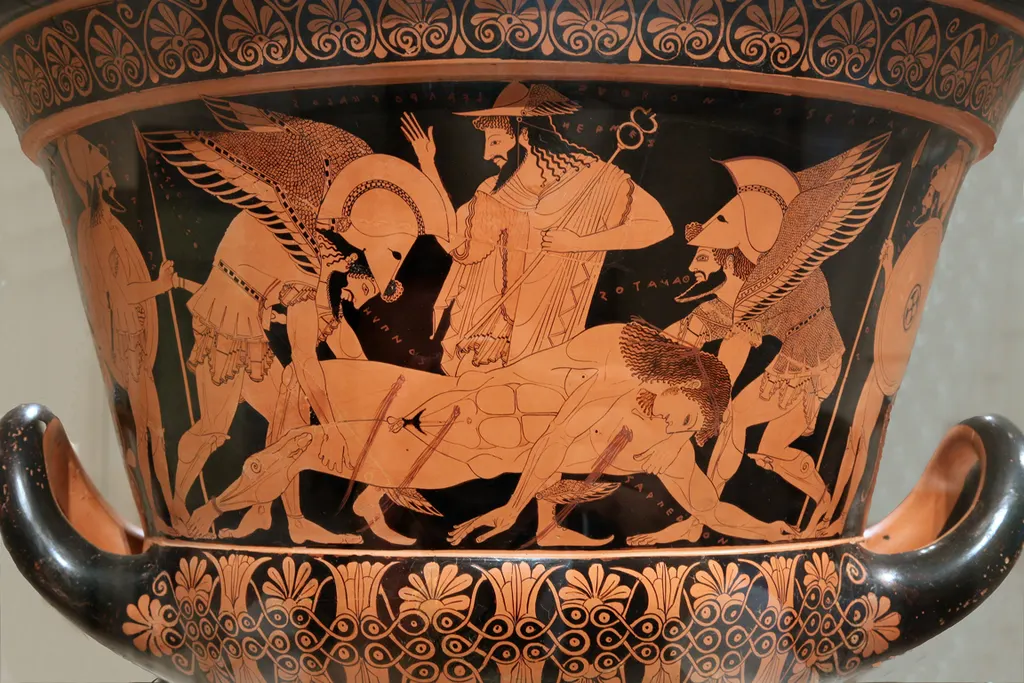
Jaime Ardiles-Arce (photographer). Krater by Euphronios (painter) and Euxitheos Euphronios krater side A MET L.2006.10, 2007-07-20 22:16:54Wikipedia:Contact us/Photo submission (via Wikimedia Commons), collection record. Public domain
In January 2008 a large Greek vase left the Metropolitan Museum of Art in New York and was flown to Rome. The Euphronios krater, a wine-mixing bowl painted in Athens in the late sixth century BC with the dead hero Sarpedon carried from the battlefield by Sleep and Death, had been one of the Met's most celebrated acquisitions since 1972. Italian investigators, however, had traced it to an illicit excavation of an Etruscan tomb. Under an agreement signed in Rome in 2006, the Met transferred title to the krater and five other antiquities to Italy, and Italy agreed to lend the museum other important works in return.
The krater's journey shows how the protection of cultural heritage works in practice: a patchwork of international conventions, national laws, investigation, negotiation and changing museum ethics. This article explains the main legal instruments, how they apply (and where they do not), and what some of the most important restitution cases have achieved. It is a general guide, not legal advice; anyone dealing with a specific object should consult a specialist lawyer.
Why looting matters
When an object is dug illegally from an archaeological site, two kinds of damage are done. The first is obvious: the object is stolen from the community or state to which it belongs. The second is less visible but often more serious. Archaeology depends on context: the layer in which an object lay, what was found beside it, the structure of the tomb or building. A vase with no findspot can still be beautiful, but it can no longer tell us much about the people who used it.
Looting increases in times of conflict, as the plundering of the Iraq Museum in Baghdad in April 2003 showed, and objects removed in such circumstances can surface on the market years later with invented histories. That is why provenance, the documented history of an object's ownership, has become central to the trade.
The international framework
The 1954 Hague Convention
The first major treaty devoted entirely to cultural property was the Convention for the Protection of Cultural Property in the Event of Armed Conflict, signed at The Hague on 14 May 1954 and in force from 7 August 1956. It obliges states to safeguard and respect cultural property during war, and introduced the distinctive blue-and-white shield emblem used to mark protected buildings and sites. A Second Protocol, adopted on 26 March 1999, strengthened the system, created a category of "enhanced protection" and extended its rules to non-international armed conflicts.
The 1970 UNESCO Convention
The cornerstone of the fight against peacetime trafficking is the UNESCO Convention on the Means of Prohibiting and Preventing the Illicit Import, Export and Transfer of Ownership of Cultural Property. It was adopted on 14 November 1970 and entered into force on 24 April 1972; UNESCO reports that some 150 states have ratified it.
The Convention works between governments. Among its key provisions:
- Export controls (Article 6): states agree to introduce export certificates and to prohibit the export of cultural property without one.
- Museums and stolen inventoried property (Article 7): states agree to take measures to prevent museums from acquiring illegally exported cultural property and, at the request of the state of origin, to recover and return property stolen from a museum, religious institution or public monument that is documented in its inventory.
- Cooperation (Article 9): a state whose heritage is in jeopardy from pillage may call on others to join in concerted action, including import controls.
- National measures (Article 13): states commit to prevent transfers of ownership likely to promote illicit trade and to admit actions for recovery of lost or stolen items.
Two limitations are crucial. First, the 1970 Convention is not retroactive: it applies to movements after it entered into force for the states concerned, so it offers no legal route for objects removed in, for example, the colonial period. Second, it relies on each state to implement it in national law, and implementation varies widely. Even so, 1970 has become a widely used benchmark: many museum associations and collectors treat an object with no documented history before 1970 as a serious warning sign.
The 1995 UNIDROIT Convention
Because the UNESCO Convention operates between governments, it left a gap in private law: what happens when a private owner, a museum or a dealer holds a stolen object? The UNIDROIT Convention on Stolen or Illegally Exported Cultural Objects, adopted in Rome on 24 June 1995 and in force from 1 July 1998, was designed to fill it. Its main rules:
- Stolen objects must be returned (Article 3). Objects that have been unlawfully excavated, or lawfully excavated but unlawfully retained, are treated as stolen where this is consistent with the law of the state in which they were excavated.
- Time limits. Claims must generally be brought within three years of the claimant learning where the object is and who holds it, and within fifty years of the theft. Objects from identified monuments, archaeological sites or public collections are subject only to the three-year limit, although a state may declare a longer period of seventy-five years.
- Compensation and due diligence (Article 4). A possessor who returns a stolen object is entitled to fair and reasonable compensation only if they neither knew nor ought reasonably to have known it was stolen and can show due diligence when acquiring it, for instance by checking the price paid and consulting registers of stolen objects.
- Illegally exported objects (Articles 5–7). A state may ask the courts of another contracting state to order the return of an illegally exported object if its removal significantly impairs interests such as the preservation of the object or its site, or the object is of significant cultural importance.
Like the UNESCO Convention, UNIDROIT is not retroactive. It has far fewer parties, and several of the largest art-market countries, including the United Kingdom and the United States, have not joined it.
National laws: two examples
International conventions only bite when states turn them into domestic law.
United States. The US implemented the 1970 Convention through the Convention on Cultural Property Implementation Act of 1983. It allows import restrictions on specific categories of archaeological and ethnological material, usually through bilateral agreements with the country of origin, and bars the import of stolen objects documented in the inventory of a museum, religious or secular public monument or similar institution. Federal prosecutors also use customs law and civil forfeiture to recover smuggled objects.
United Kingdom. The UK accepted the 1970 Convention in 2002 and passed the Dealing in Cultural Objects (Offences) Act 2003, which came into force on 30 December 2003. It makes it an offence to deal dishonestly in a "tainted" cultural object, knowing or believing it to be tainted. An object is tainted if it was removed from a building or monument of historical, architectural or archaeological interest, or excavated, after the Act came into force, in circumstances that amounted to an offence in the UK or abroad. The maximum penalty on indictment is seven years' imprisonment. The Act does not extend to Scotland.
Many source countries, including Italy, Greece and Egypt, vest ownership of undiscovered antiquities in the state. Under such laws a freshly dug object is legally stolen property even if no one knew it existed before it was found.
Cases that shaped the field
The Euphronios krater (Italy and the Metropolitan Museum)
The 2006 agreement, which also covered a group of Hellenistic silver, was a turning point: instead of litigation, it modelled a negotiated return combined with continuing loans and cooperation, and similar agreements between Italy and other American museums followed.
The Gilgamesh Dream Tablet (Iraq and the United States)
The Gilgamesh Dream Tablet, a cuneiform tablet about 3,500 years old inscribed with part of the Epic of Gilgamesh, was looted from Iraq and later sold by an international auction house to the Hobby Lobby company for display at the Museum of the Bible in Washington. Agents of US Homeland Security Investigations seized it in 2019; a federal court approved its forfeiture in July 2021, on the basis that it had been imported into the United States illegally, and it was formally returned to Iraq in September 2021. Customs and forfeiture law, not only cultural-property conventions, did the work.
The Benin Bronzes (Nigeria, Germany and the United States)
The thousands of brass, bronze, ivory and wooden works known collectively as the Benin Bronzes were taken from the royal palace of Benin City, in present-day Nigeria, by British forces during the military expedition of 1897, and were dispersed to museums and private collections around the world. Because the seizure long predates the 1970 Convention, no international treaty requires their return. The returns now under way rest on museum policy and political agreement.
On 1 July 2022 Germany and Nigeria signed a joint declaration providing a framework for returning Benin objects from German museums. On 25 August 2022 the Prussian Cultural Heritage Foundation signed a contract transferring ownership of 512 works in Berlin's Ethnologisches Museum to Nigeria's National Commission for Museums and Monuments, with about a third to remain in Berlin on loan. In the United States, the Smithsonian's National Museum of African Art transferred ownership of 29 Benin Bronzes to the same Nigerian commission in October 2022 under the Smithsonian's ethical returns policy. Other museums have made returns; some, including the British Museum, are bound by legislation that restricts disposals from their collections.
Ethics, codes and the limits of law
Many of the most public debates are not legal disputes at all. Requests for objects taken in colonial wars or acquired in ways now considered unacceptable, such as Greece's long-standing request for the Parthenon sculptures in the British Museum, are matters of ethics, diplomacy and museum governance as much as law. Museums increasingly publish return policies, research their collections' provenance and consult source communities.
A parallel framework deals with art looted by the Nazi regime between 1933 and 1945: the Washington Conference Principles of 1998 encourage the identification of such works and steps towards a "just and fair solution" with the pre-war owners or their heirs, and several countries, including the UK, have established advisory panels to hear claims.
A checklist for buyers, collectors and curious visitors
- Ask for provenance, in writing, and check that it covers the period before 1970 for antiquities and archaeological material.
- Be wary of vague histories such as "old European collection" or "by descent" without names, dates and documents.
- Check stolen-art databases. Interpol's Stolen Works of Art database and commercial registers can be searched; our guide to stolen art registers explains how they work.
- Know the high-risk categories. The International Council of Museums (ICOM) publishes Red Lists of categories of cultural objects at risk from particular regions, such as the Nok terracottas of Nigeria, discussed in our article on the Nok exhibition at the Liebieghaus.
- Get export documents for anything that has crossed borders, and keep them with the object.
- When in doubt, walk away. No object is worth contributing to the destruction of a site.
For the wider principles of buying ethically, see collecting art responsibly, and explore further in our cultural heritage section.
Sources
- About the 1970 Convention, UNESCO
- 1995 UNIDROIT Convention on Stolen or Illegally Exported Cultural Objects, UNIDROIT
- Dealing in Cultural Objects (Offences) Act 2003, legislation.gov.uk (The National Archives)
- Statement by the Metropolitan Museum of Art on its agreement with Italian Ministry of Culture (21 February 2006), The Metropolitan Museum of Art
- Return of the Berlin Benin Bronzes, Stiftung Preußischer Kulturbesitz
- United States Returns to Iraq Rare Tablet Bearing Portion of Epic of Gilgamesh, U.S. Department of Justice