Kaitag Embroideries of Daghestan and the Matisse Connection
The silk embroideries of Kaitag in southern Daghestan: how they were made, used and dated, and why their bold designs keep being compared to Matisse.
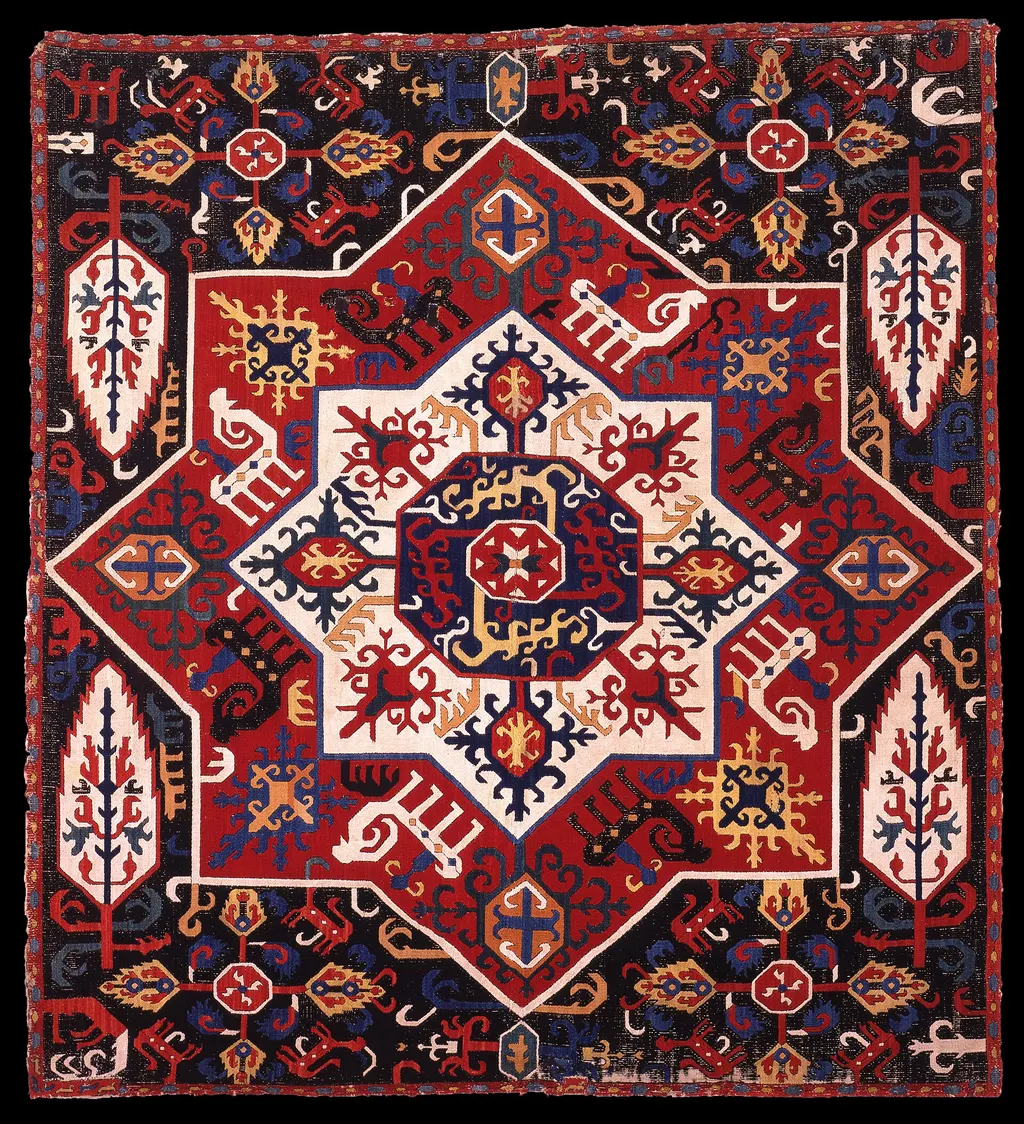
Unknown makerCover, silk embroidery on cotton, Iran or the Caucasus, 1st half of 18th centuryThe David Collection, Copenhagen (via Wikimedia Commons), collection record. Public domain
Imagine a rectangle of handwoven cotton, a little under a metre long, stitched almost edge to edge with floss silk. A great hooked shape in crimson sits against a field of saffron yellow; indigo spirals curl into the corners; small creatures, part horse and part pattern, march along the border. Seen across a room it looks startlingly modern, closer to a paper cut-out of the 1950s than to anything one expects of a village textile from the Caucasus.
Embroideries like this come from Kaitag, a district in the mountains and foothills of southern Daghestan, on the western shore of the Caspian Sea, now part of the Russian Federation. They were made by women for use at the great moments of family life, and for centuries they were scarcely known outside the region. Since the late twentieth century they have become prized by textile collectors and museums, and writers have repeatedly compared their colour and form to the work of Henri Matisse. This article explains what Kaitag embroideries are, how they were made and used, how they are dated, and what can and cannot be said about the Matisse connection.
A crossroads in the mountains
Daghestan, whose name means roughly "land of mountains", is one of the most linguistically diverse places on earth. The Kaitag area, today the Kaytagsky District, is inhabited mainly by Dargin and Kumyk communities. Over the centuries the region lay on routes between Iran, the steppe, the Ottoman world and Russia, and its art absorbed motifs from all of them. Researchers have pointed to echoes of Safavid Persian textiles and of Ottoman, Byzantine, Mongol and even Chinese ornament, transformed by local hands into something distinctive.
That mixture is visible in a panel in the Victoria and Albert Museum in London, bought in 1905 from a London dealer for £15. It shows rows of seated and standing figures, some with bows and arrows, trees and animals, and the museum's record notes that the design is based on Safavid textiles. The gallery label once called it Persian; the current record attributes it, cautiously, to Daghestan and possibly the Kaitag region, a small history of how these pieces have been reclassified as knowledge improved.
How Kaitag embroideries were made
Kaitag embroideries share a simple and efficient construction:
- The ground. Most are worked on handwoven cotton, often made up from three or four narrow strips sewn together before embroidery began. A few use thin silk.
- The thread. The embroiderer used floss silk, frequently twisted by hand.
- The stitch. The dominant technique is laid and couched work: long threads are laid across the surface and then tied down at intervals by small stitches. This covers large areas with strong colour while using little silk. Running, stem, chain, cross, herringbone and feather stitches also appear.
- The colours. Natural dyes gave a rich but limited palette: yellows from local plants such as weld, reds from madder (which grew in the area) and from cochineal, blues from imported indigo, together with browns, greens and black. One study of a single collection distinguished eleven shades of yellow alone.
Because laid and couched work leaves the long floats of silk on the front, a fine Kaitag piece has an almost lacquered surface that catches the light. Our survey of embroidery traditions of the world sets this technique alongside other couched-work traditions.
Made for birth, marriage and death
These were not decorations for the wall. Kaitag embroideries were made for ritual occasions in the life of a family. Cradle covers carried protective symbols intended to guard a newborn against the evil eye. Finely embroidered cloths formed part of a bride's dowry and were used in wedding ceremonies. At funerals, embroidered cloths were laid over the face of the dead. Because so many pieces were made for a single occasion and then kept, buried or given away, survival is a matter of chance.
A note on names and context: Kaitag embroideries are often discussed in the market alongside Caucasian rugs. They are a distinct tradition, made by women for domestic and ritual use rather than for trade. When describing them, it is better to use the community's own terms and functions (cradle cover, dowry cloth, funeral cloth) than generic labels such as "tribal" or "folk", and to ask how a piece left its community, a question explored in [protecting cultural heritage](/articles/protecting-cultural-heritage/).
How old are they?
Dating is difficult. Kaitag embroideries are almost never inscribed, and the motifs were copied over generations. Most surviving examples are thought to date from the seventeenth and eighteenth centuries, with others from the nineteenth; the Philadelphia Museum of Art, for example, catalogues an embroidered Kaitag cover to the second half of the nineteenth century. Local tradition places the origins earlier still, and some collectors and dealers date individual pieces to the sixteenth century, but such early dates rest largely on style and should be treated with caution. Analysis of materials, particularly dyes, offers firmer clues: the arrival of synthetic dyes in the later nineteenth century gives a useful lower boundary for pieces dyed entirely with natural colours.
Much of what is known in English derives from the fieldwork of the British researcher Robert Chenciner, whose book Kaitag: Textile Art from Daghestan (1993) drew on six years of research into the region's history and ethnography. Exhibitions followed: in 1994, for instance, thirty-five embroideries were shown at Christinehof in Skåne, southern Sweden.
The Matisse comparison
Why Matisse? Look at a Kaitag cloth beside one of Matisse's late paper cut-outs or his decorative interiors and the kinship seems obvious: flat areas of saturated colour, forms simplified to a few confident curves, figure and ground playing against each other so that it is hard to say which is which. Some writers have made the same comparison with Paul Klee.
It is important to be clear about what this comparison means. There is no evidence that Matisse ever saw a Kaitag embroidery, and it is generally considered unlikely. The connection is one of visual affinity, not influence. It is nevertheless a revealing one, because textiles mattered deeply to Matisse. He was born in 1869 in Le Cateau-Cambrésis and grew up in Bohain-en-Vermandois, a town of weavers in north-eastern France, and he came from a family of weavers. Throughout his life he collected fabrics: tapestry fragments, printed cottons, embroideries from North Africa, African hangings, costumes and remnants from Paris couture houses. He called this collection his "working library", and pieces from it reappear in his paintings. The 2005 exhibition Matisse: His Art and His Textiles, shown at the Royal Academy in London and the Metropolitan Museum in New York, made that debt plain.
So the comparison works in both directions. It helps a modern viewer see the boldness of Kaitag design, and it reminds us that the "decorative" vocabulary Matisse admired had long been developed by makers, often anonymous women, in many parts of the world.
Look closer: Stand back from a Kaitag piece until the motifs dissolve into colour, then walk slowly towards it. Notice where the embroiderer let the cotton ground show and where she covered it completely, and how the direction of the laid silk changes from one area to the next, catching light differently. Those decisions are as important to the design as the outline of the motifs.
Seeing and collecting Kaitag embroidery
- Museums: examples are held by the Victoria and Albert Museum, the Philadelphia Museum of Art and the State Museum of Oriental Art in Moscow, among others, and Daghestani museums preserve important local collections.
- Condition: silk floss is fragile and light-sensitive. Fading of yellows and reds, and losses in the laid silk, are common; look for areas of colour preserved where a piece was folded.
- Dyes: strident, uniform colours that bleed or have faded unevenly may suggest synthetic dyes and a later date.
- Provenance: ask how and when a piece left Daghestan. Many appear to have reached the Western market only from the late twentieth century onwards.
Readers who enjoy reading the structure of a textile may also like how to read an oriental rug and our article on attributing Armenian rugs without inscriptions, where similar problems of dating and origin arise. More on living and historic traditions is gathered under cultural heritage.
Sources
- Panel, couched silk, embroidered, depicting human figures (museum no. 1206-1905), Victoria and Albert Museum
- Embroidered Cover (Kaitag), Philadelphia Museum of Art
- Kaitag: textile art from Daghestan (exhibition at Christinehof, 1994), The IK Foundation
- Matisse: His Art and His Textiles – The Fabric of Dreams, Studio International
- Matisse: The Fabric of Dreams – His Art and His Textiles (exhibition, 2005), The Metropolitan Museum of Art