Embroidery Traditions of the World
A guide to great embroidery traditions, from the Bayeux Tapestry and opus anglicanum to suzani, kantha, phulkari, sashiko and Palestinian tatreez.
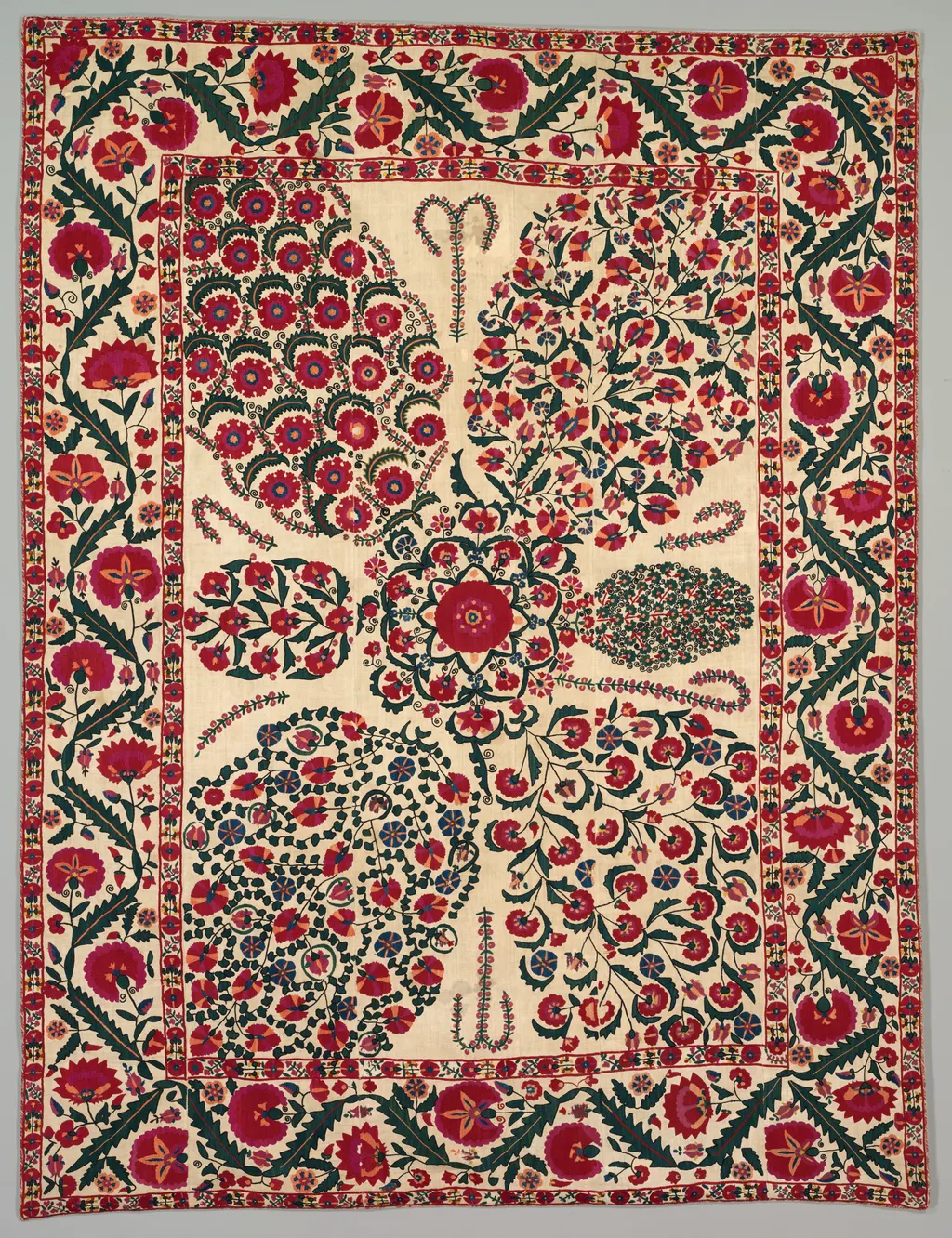
Central Asia, South West Uzbekistan, ShakhrisyabzSuzani with floral sprays, 1800–1850Cotton: plain weave, 6 strips; silk: embroidery; filling stitch: kanda xajol, occasionally bosma; outlining stitch: ilmoqCleveland Museum of Art, collection record. CC0 1.0 (Public Domain)
The most famous "tapestry" in the world is not a tapestry at all. The long strip of linen kept in Bayeux, Normandy, which tells the story of the Norman Conquest of England in 1066, is embroidered: its figures were stitched in coloured wools onto a woven linen ground, not woven into the cloth. Look closely and you can see two techniques at work. Outlines and lettering run in fine lines of stem stitch, while horses, shields and tunics are filled with long threads laid side by side and held down by short couching stitches, a method so closely associated with the piece that embroiderers call it Bayeux stitch.
That distinction, between decorating a finished cloth with a needle and building pattern into the weave, is the starting point for understanding embroidery. Almost every culture that makes textiles has embroidered them, for display, for status, for weddings and for mending. This article visits some of the great traditions, explains the stitches that define them and suggests what to look for when you meet them in a museum.
The basic vocabulary
Nearly all embroidery, however complex, is built from a handful of stitch families. Knowing them turns a dazzling textile into something you can read.
| Stitch family | How it is made | Where you will see it |
|---|---|---|
| Running and darning | Needle passes in and out in a line; darning lays long parallel runs | Kantha, sashiko, phulkari |
| Chain | Each stitch loops through the one before, forming a chain | Suzani, much Indian and Chinese work |
| Laid and couched | Long threads laid on the surface, tied down by small stitches | Bayeux Tapestry, suzani, Kaitag work |
| Satin | Close parallel stitches cover an area smoothly | Chinese silk embroidery, many floral styles |
| Cross | Two diagonal stitches cross to form an X | Palestinian tatreez, European samplers |
| Split | Needle pierces the previous stitch, giving a fine line | Medieval English faces and draperies |
Medieval Europe: Bayeux and opus anglicanum
The Bayeux Tapestry is about 70 metres long and half a metre high. It is generally thought to have been made in England in the decade or so after the Conquest, quite possibly for Bishop Odo of Bayeux, William the Conqueror's half-brother, and it is now displayed in the Bayeux Museum.
Two centuries later, English embroidery had become a luxury export. Opus anglicanum, "English work", was embroidery in silk and gold and silver-gilt thread on linen or velvet, produced in professional workshops, many of them in London, and sought after by popes and princes across Europe. Faces and draperies were worked in tiny split stitches that follow the contours of the form, and metal threads were secured with a technique called underside couching, which pulled loops of the linen couching thread to the back so that the gold surface stayed flexible. The Syon Cope in the Victoria and Albert Museum, made in the early fourteenth century, is a celebrated survivor.
Central Asia and the Caucasus: suzani and Kaitag
In Uzbekistan and neighbouring regions, large embroidered hangings and covers called suzani (from the Persian word for needle) were traditionally made by women and associated with marriage and the dowry. Their bold designs of rosettes, blossoms and curling vines are worked mainly in chain stitch and couching, in silk on a cotton or linen ground.
Suzani are made in an ingenious way. Several narrow strips of cloth are joined and the design is drawn across the whole surface by an experienced draughtswoman. The strips are then separated so that different women can embroider them at the same time, and finally sewn together again. Slight mismatches in colour or alignment at the seams are often the clearest evidence of this shared labour, and they are part of the object's history rather than a flaw.
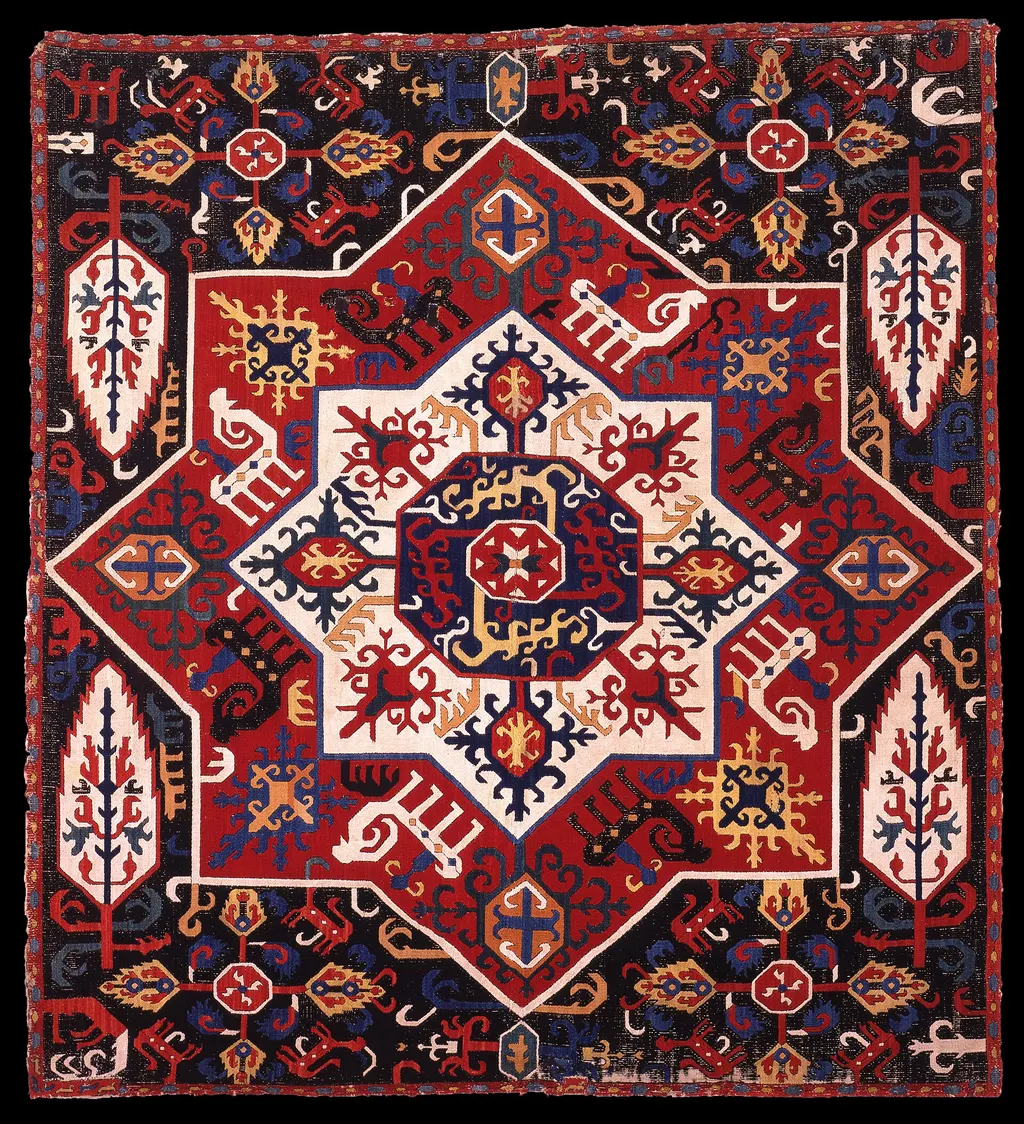
Further west, in the mountains of Daghestan, the Kaitag embroideries combine silk laid-and-couched work with startlingly bold, almost abstract designs; read more in our article on Daghestan's Kaitag embroideries.
South Asia: kantha and phulkari
Kantha
In Bengal, now divided between Bangladesh and the Indian state of West Bengal, women have long layered worn cotton saris and dhotis and quilted them together with lines of running stitch to make kantha. The stitches hold the layers firm, and threads pulled from the coloured borders of old saris were used to embroider lotus flowers, animals, scenes of daily life and mythological figures. Kantha is a tradition of thrift as much as art: old cloth made into something warm, useful and often deeply personal.
Look closer: The surface of a kantha ripples gently between rows of stitches, and the running stitches show on both sides. Where the ground is densely covered with running stitch, it can look almost like a woven texture.
Phulkari
In Punjab, divided between India and Pakistan in 1947, phulkari ("flower work") was embroidered in floss silk, traditionally untwisted, on hand-spun, hand-woven cotton cloth called khaddar. The main stitch is the darning stitch, worked from the back of the cloth by counting threads, so that long, glossy floats appear on the front. Changing the direction of the stitches makes the silk catch the light differently, so a single colour can appear to shift as the cloth moves. When the embroidery covers the whole ground, the piece is called a bagh ("garden"). Phulkari were made by women for their own families and were especially important at weddings.
The V&A's overview of Indian embroidery is a good starting point for the many other regional traditions of South Asia, from the mirror work of Gujarat to the white-on-white chikankari of Lucknow.
East Asia: sashiko and Chinese silk embroidery
Sashiko (roughly "little stabs") is a Japanese tradition of running stitch, classically in white cotton thread on indigo-dyed cloth. It developed as a practical way to reinforce and layer fabric for warmth and durability, particularly in rural communities, and grew into a decorative repertoire of geometric patterns with names such as asanoha (hemp leaf) and seigaiha (overlapping waves). Its regular, even stitches make it one of the most approachable traditions for a beginner.
China has one of the oldest and most refined embroidery cultures in the world. Silk embroidery was practised at a very high level for court robes, temple hangings and pictures; Suzhou embroidery is known for its delicacy and for double-sided pieces that look finished from both faces. Its smooth satin and long-and-short stitches, worked in split silk filaments finer than a hair, can imitate the soft gradations of ink painting.
Try it: a sashiko-style sampler
Running stitch is the root of several of the traditions above, and a small sampler teaches more about them than any amount of reading.
- Gather materials: a 20 cm square of medium-weight cotton (dark blue shows white thread well), a long sharp needle, thick cotton embroidery thread, a ruler and a water-soluble or chalk fabric marker.
- Draw a grid of 1 cm squares lightly on the fabric.
- Stitch straight lines along the grid in running stitch, aiming for stitches slightly longer on the front than the gaps between them. Load several stitches onto the needle before pulling through, as sashiko stitchers do.
- Leave a little slack at each turn so the fabric does not pucker.
- Add diagonals across the squares to make simple patterns, and notice how the eye begins to see stars and diamonds.
- Compare your stitches with photographs of kantha and sashiko in museum collections. You will suddenly see the rhythm of the maker's hand.
Safety: Children using sharp needles and scissors should be supervised. Younger children can practise running stitch with a blunt plastic or large-eyed tapestry needle on loosely woven fabric or punched card.
The Mediterranean and Middle East: Palestinian tatreez
Tatreez is the Arabic word for embroidery, and in Palestine it refers above all to the cross-stitch decoration of women's dresses (thobes), with dense panels on the chest, sleeves and sides. Historically, colour schemes and motifs could indicate a woman's village or region and her marital status. In 2021 UNESCO inscribed "The art of embroidery in Palestine, practices, skills, knowledge and rituals" on its Representative List of the Intangible Cultural Heritage of Humanity, noting that women gather in each other's homes to embroider, often with their daughters, and that the craft is transmitted both within families and through formal courses.
Where to look and what to notice
- Check the back. Where you are allowed to see it, the reverse of an embroidery reveals how it was made: darning worked from the back, couching, knots and joins.
- Follow the thread. Twisted or untwisted silk, wool, cotton, metal thread: each reflects light differently and tells you about cost and purpose.
- Find the hands. Changes in stitch size or colour between sections can show where different makers worked.
- Read the wear. Mends, patches and faded areas are part of a textile's life story. Our guide to caring for art at home explains why textiles should be kept out of direct light.
- Think about who made it. Most historic embroidery was made by women whose names were not recorded. Museum labels increasingly acknowledge this, and it is worth asking about.
Major textile collections include the V&A in London, the Metropolitan Museum of Art in New York, and the Textile Museum at George Washington University in Washington, D.C. For woven and printed traditions, read our companion guide to traditional crafts from around the world, see how embroidery was revived by May Morris and others in the Arts and Crafts Movement, and browse more in arts and crafts.
Sources
- Indian embroidery, Victoria and Albert Museum
- The art of embroidery in Palestine, practices, skills, knowledge and rituals, UNESCO Intangible Cultural Heritage
- Embroidered hanging or cover (suzani), Fine Arts Museums of San Francisco
- The Bayeux Tapestry, Bayeux Museum