Caring for Paintings, Prints and Objects at Home
Conservation advice for art at home: light, humidity, hanging, framing works on paper, handling ceramics and silver, pests and when to call a conservator.
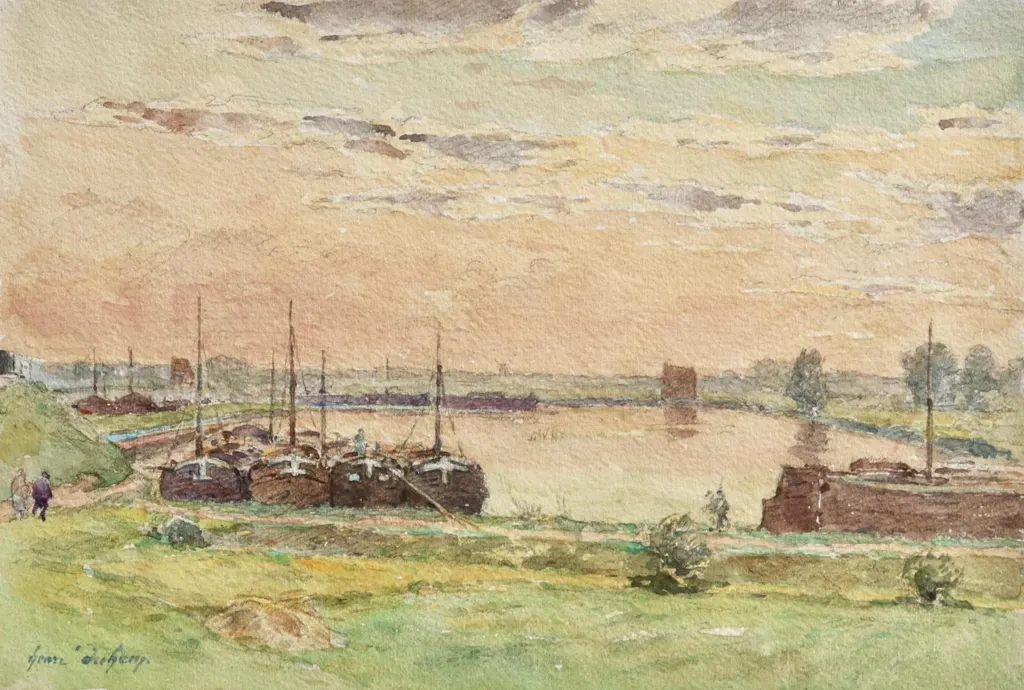
Henri Duhem (1860 - 1941, French)Fishing boats moored - Impressionist Watercolour, Landscape by Henri Duhem c1910, 1860-1941Wikimedia Commons, collection record. Public domain
Imagine taking down a watercolour that has hung opposite a sunny window for twenty years. Where the mount covered the edges, the sky is still a clear blue. Everywhere else it has faded to a pale grey-green, and the paper has turned the colour of weak tea. Nothing dramatic happened; the damage simply accumulated, a little every day, until it could not be reversed.
Most harm to art at home is slow and preventable. Museums call the discipline of avoiding it preventive conservation, and the good news is that its principles translate easily to an ordinary house. You do not need special equipment or climate control. You need to know what causes damage, where in your home it is most likely, and which well-meant habits (cleaning, polishing, taping) do more harm than good. This guide covers paintings, works on paper and the most common decorative objects, and ends with a room-by-room checklist.
What damages art
The Canadian Conservation Institute (CCI) groups the causes of damage into ten "agents of deterioration": physical forces, thieves and vandals, fire, water, pests, pollutants, light and ultraviolet and infrared radiation, incorrect temperature, incorrect relative humidity, and dissociation, meaning the loss of objects or of the information about them. At home, four do most of the damage: light, unstable humidity, careless handling and pests.
The environment: light, humidity and heat
Light: damage that adds up
Light fades pigments and dyes, yellows and weakens paper, and degrades textiles. Ultraviolet (UV) and infrared radiation are invisible and contribute nothing to seeing an object, so the CCI treats them as purely harmful. Visible light is harder to avoid, because without it we cannot see the work at all.
The crucial idea is that light damage is cumulative. A CCI note on textiles explains that exposure at 100 lux for 400 hours does the same damage as 50 lux for 800 hours. Dimmer light for longer is no safer than brighter light for less time; only the total dose counts.
Practical steps:
- Never hang sensitive works in direct sunlight. Watercolours, prints, drawings, photographs, textiles and anything with dyes are the most vulnerable. The CCI uses 50 lux, roughly the light of a dim room, as its reference level for viewing light-sensitive objects.
- Use UV-filtering glazing for framed works on paper, and consider UV-filtering film on windows. Remember that it reduces only part of the risk: the Library of Congress stresses that all light damages paper, not just UV.
- Rotate. Show a print or a textile for a season, then rest it in a dark drawer or box. For a treasured work on paper, the Library of Congress suggests framing a good facsimile and storing the original.
- Avoid picture lights clamped to frames and spotlights trained closely on a painting; the CCI warns that they add heat as well as light.
Humidity and temperature: aim for stability
Wood, canvas, paper, ivory and parchment absorb and release moisture from the air, swelling and shrinking as they do. Rapid or repeated changes in relative humidity (RH) cause paint to crack and flake, veneers to lift, panels to split and paper to cockle. Very damp conditions encourage mould and corrosion; very dry ones make materials brittle.
Stability matters more than any precise figure. For works on paper the Library of Congress recommends a cool environment of about 35–50% RH. In practice:
- Avoid hanging or storing art above radiators, beside heaters, air vents or open fires, and near kitchens and bathrooms.
- Be cautious with cold exterior walls, where condensation can form behind a frame; small spacers or cork bumpers on the back of a frame allow air to circulate.
- Do not store art in attics, basements, garages or garden buildings, where temperature and humidity swing widely and leaks are more likely.
Paintings: hanging, handling and leaving well alone
The CCI's guidance on paintings is admirably practical:
- Hang securely. Use D-rings screwed into the frame, picture wire rated for the weight of the frame and painting, and two hooks in the wall rather than one, so a single failure does not bring the painting down. Use fixings suitable for your wall; for very heavy works, a French cleat.
- Protect the back. A rigid backing board fixed to the reverse of the frame guards the canvas against knocks, dust and rapid humidity changes.
- Carry with care. Plan the route, clear obstacles, and use two people for anything larger than a small easel painting. Hold the frame, never the canvas or the stretcher.
- Do not clean or "freshen" the surface. The CCI cautions that even dusting can harm a fragile surface, and that cleaning with water or solvents without training can cause serious damage. Never try to remove discoloured varnish yourself.
- Do not write on or attach labels to the back of the canvas, and do not hang decorations from the frame.
Look closer: Shine a torch across the surface of a painting at a low angle. Raised flakes, tenting (small tent-shaped ridges of paint), cupping and bulges in the canvas all show up in raking light. If you see paint lifting, keep the painting flat and still and contact a conservator; do not try to press flakes down.
Prints, drawings, maps and photographs
Works on paper are among the most vulnerable things in any collection.
- Frame with conservation materials: mounts and backing boards that are acid- and lignin-free, and hinges that can be removed safely. Ask your framer which materials they use. The Library of Congress notes that some media are sensitive to alkaline (buffered) boards, so specialist advice is worthwhile for important works.
- Never use self-adhesive tape, even if it is sold as "archival". Avoid rubber bands, paper clips and glue too.
- Keep pastels and charcoal away from plastic glazing and polyester sleeves, which can build up static that lifts loose particles of powdery media off the paper.
- Store flat in acid-free folders and boxes, and separate acidic papers such as old newspaper cuttings from everything else.
- Handle with clean, dry hands, supporting the sheet from beneath, and write any notes in pencil, never ink.
Antique maps and prints are often hand-coloured with pigments that are sensitive to light; our guide on how to read an antique map explains what that colour can tell you, which is all the more reason to protect it.
Ceramics, glass, silver, furniture and textiles
| Material | Do | Avoid |
|---|---|---|
| Ceramics and glass | Lift by the body with both hands; carry one item at a time; pad shelves | Lifting by handles, spouts or rims; dishwashers for old, gilded or repaired pieces |
| Silver | Wear clean cotton or nitrile gloves; store wrapped in tarnish-resistant cloth; polish rarely and gently | Rubber bands and rubber mats, which contain sulphur and cause tarnish; abrasive dips |
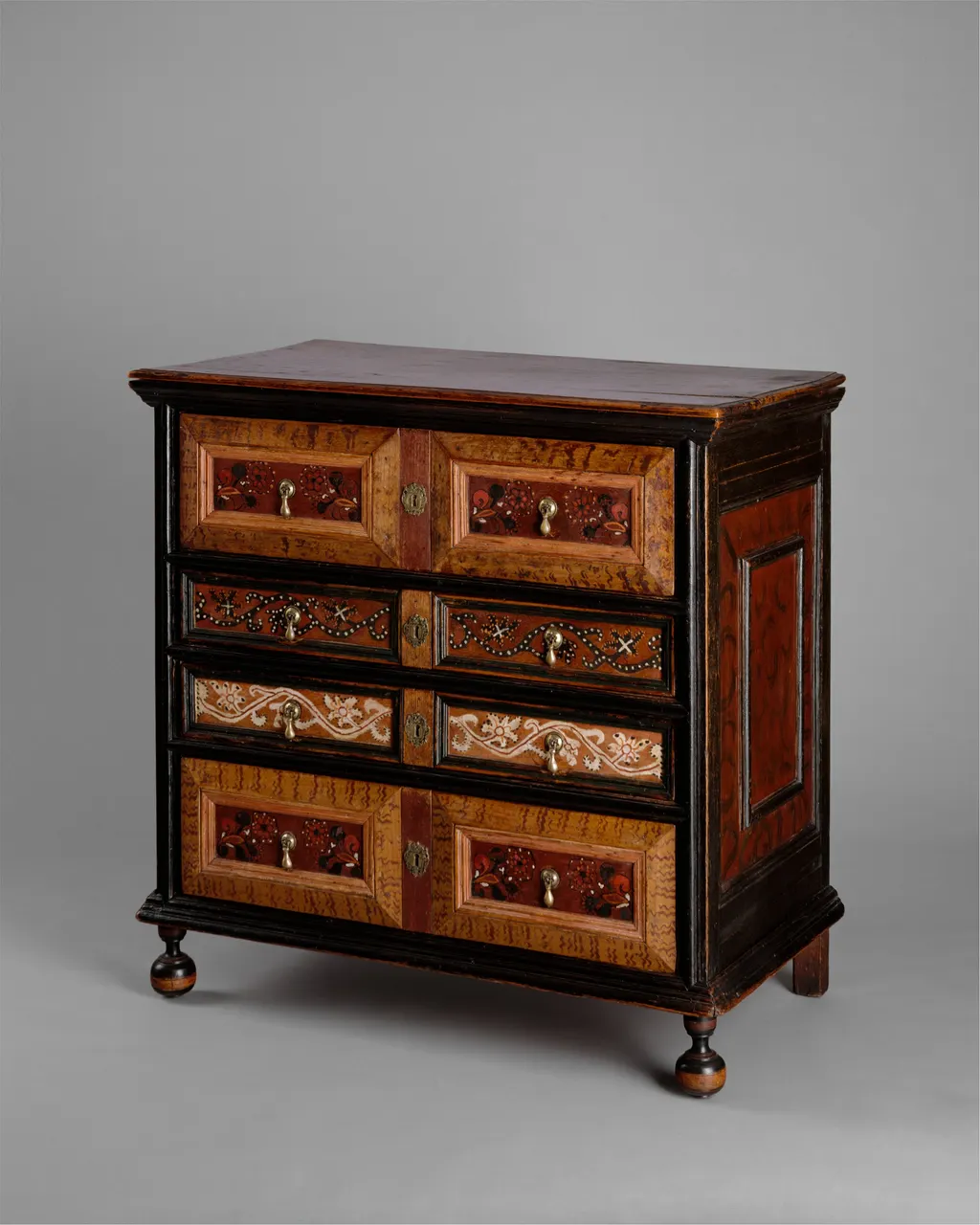
| Furniture | Keep out of direct sun and away from heat; use coasters and mats; lift chairs by the seat rail | Silicone sprays; dragging pieces by their tops or arms; over-waxing |
| Textiles and rugs | Rotate rugs to even out wear and light; vacuum gently; check undersides for moths | Folding along the same creases; storing in plastic bags in damp places |
| Portrait miniatures | Keep in their cases away from light and heat | Hanging near fireplaces or in sun; opening sealed cases |
Owners of portrait miniatures should take particular care: those painted on ivory are highly sensitive to humidity and light. For furniture, our guide on how to identify antique furniture explains why hidden surfaces and original finishes matter so much to value. For carpets, see How to Read an Oriental Rug.
Pests, and when to call for help
Four groups of insects cause most domestic damage to collections:
- Clothes moths and carpet beetles feed on wool, silk, fur and feathers. Look for small holes, grazed patches, silky tubes or larvae, especially in dark places under furniture.
- Silverfish graze on paper, glue and photographs in damp conditions.
- Wood-boring beetles (woodworm) leave small round exit holes and fine powder (frass). Fresh, pale frass beneath a piece suggests active infestation; old holes with dark edges may be historic.
Good housekeeping is the best defence: regular, gentle cleaning, especially in corners and under furniture, and inspecting anything new before it joins your collection.
When to call a conservator
Call a professional for any structural damage, flaking paint, mould, insect activity in a valuable object, or after a leak or fire. Do not attempt repairs with household glues, which can be very difficult to remove. In the United States, the American Institute for Conservation maintains a directory of conservators searchable by specialty and location; in the UK, the Institute of Conservation (Icon) runs the Conservation Register. Ask about qualifications, request a written condition report and treatment proposal, and keep copies with your records.
A room-by-room checklist
- Sunny rooms: Are any watercolours, prints, photographs or textiles in direct light? Move or rotate them.
- Fireplaces and radiators: Is anything hanging above or beside a heat source?
- Kitchens and bathrooms: Any art exposed to steam or grease?
- Exterior walls: Is there air space behind frames?
- Hanging hardware: Two hooks, sound wire, secure D-rings?
- Shelves and cabinets: Are ceramics and glass stable, padded and out of reach of slamming doors?
- Storage: Is anything in the attic, basement or garage that should be brought indoors?
- Records: Do you have photographs and descriptions of each object, kept somewhere safe?
More guidance for owners and collectors is gathered under antiques and collectibles.
Sources
- Caring for paintings, Canadian Conservation Institute
- Agent of Deterioration: Light, Ultraviolet and Infrared, Canadian Conservation Institute
- Care, Handling and Storage of Works on Paper, Library of Congress
- Caring for Your Treasures, American Institute for Conservation