How to Identify Antique Furniture
Read old furniture like a cabinetmaker: woods, dovetails, saw and plane marks, nails and screws, shrinkage, wear and style, plus signs of marriages.
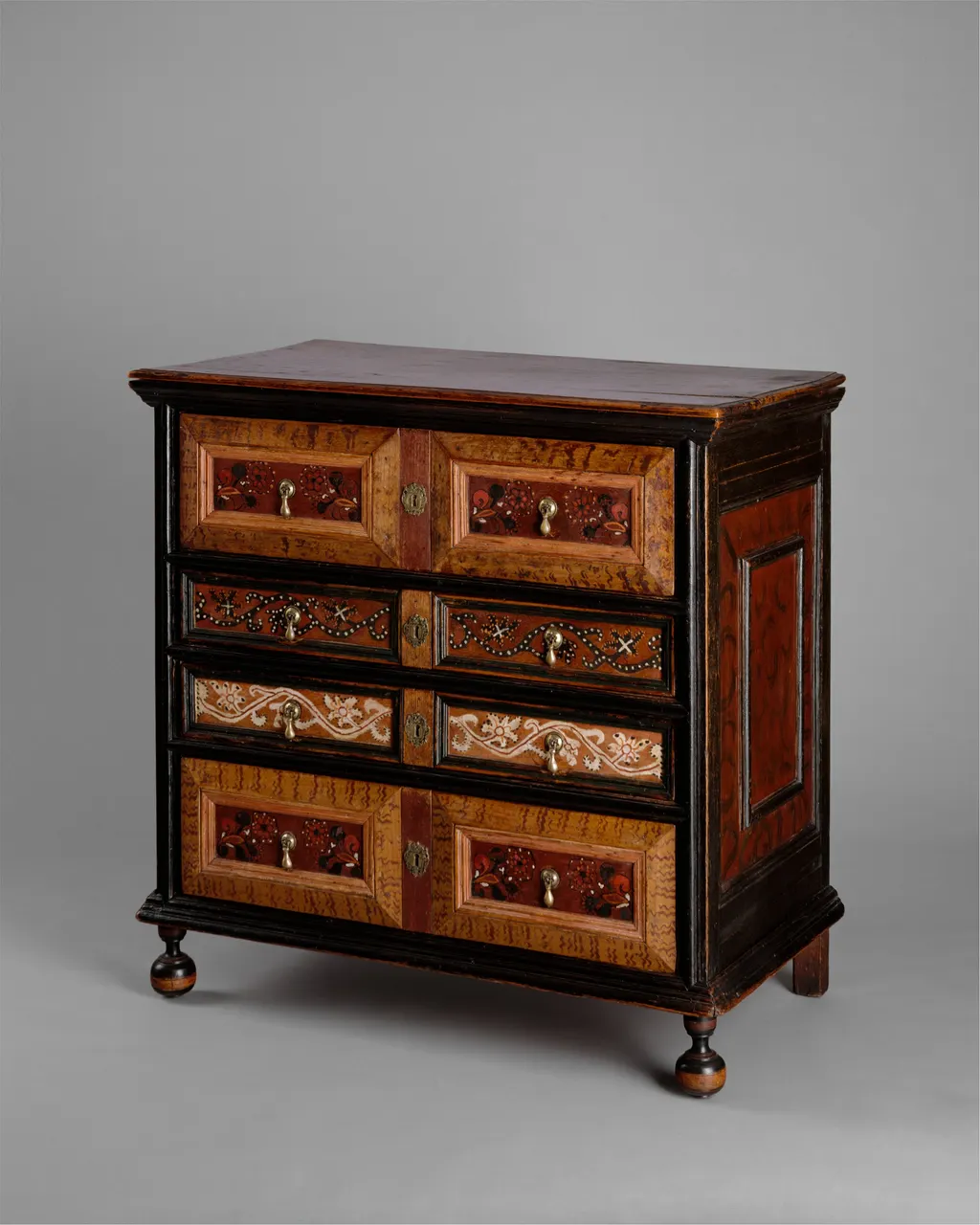
AmericanChest of Drawers, 1700–1720Painted red oak, white oak, white pine, yellow pineThe Metropolitan Museum of Art, collection record. CC0 1.0 (Public Domain)
Pull out the top drawer of an old chest and turn it towards the light. At the front corners, the sides are locked to the drawer front with fan-shaped dovetail joints. On a hand-made drawer they are often few, slightly irregular, and accompanied by a faint line scratched across the wood where the cabinetmaker marked how deep to cut. Turn the drawer over and you may see the shallow scallops of a hand plane on the underside, or the rough marks of a saw. Run a finger along the bottom edges of the sides and feel how they have been worn smooth by decades of sliding in and out.
None of these details is visible when the drawer is closed, and that is the point. Restorers and fakers concentrate on the parts everyone sees. The parts nobody looks at are where furniture tells the truth about its age. This guide explains how to examine a piece systematically, from the choice of wood to the last screw, and how to spot the most common problems: marriages, alterations and reproductions.
Think like a cabinetmaker
Every piece of furniture records the tools and materials available when it was made. Before the nineteenth century, timber was converted by hand or with water-powered saws, surfaces were finished with hand planes, joints were cut with saws and chisels, and nails and screws were made individually. Industrialisation changed each of these steps, and each change leaves evidence.
No single clue dates a piece. Country makers kept old methods long after city workshops abandoned them, fine makers still cut dovetails by hand in the age of machinery, and repairs introduce later hardware into early pieces. Look for consistency: a genuine piece shows a coherent set of clues that all point to the same period.
The wood
The early twentieth-century historian Percy Macquoid divided English furniture into "ages" of oak, walnut, mahogany and satinwood. The scheme is a simplification, but it still captures broad shifts in fashionable timber in England.
- Oak dominated English joined furniture of the sixteenth and seventeenth centuries, and remained in use for country furniture and for the hidden carcases of finer pieces long afterwards.
- Walnut, often used as veneer over a cheaper carcase, became fashionable in the later seventeenth and early eighteenth centuries.
- Mahogany began to be imported into Britain in significant amounts during the early 1720s, according to the V&A, overwhelmingly from Jamaica. The removal of import duties on timber from British colonies in the early 1720s made it worth shipping. The V&A also notes that mahogany was a plantation product tied to the transatlantic slave trade, often felled by enslaved labourers, a history that belongs in any honest description of Georgian furniture.
- Satinwood and other pale exotic woods were fashionable for veneers and inlay in the late eighteenth century.
Elsewhere, local woods tell regional stories: fruitwoods and elm in country chairs, pine painted to imitate grander timbers, cherry and maple in North America.
Look closer: On a veneered piece, find an edge where the veneer has chipped. Hand-sawn veneers of the eighteenth century are relatively thick and slightly uneven; machine-cut veneers of the later nineteenth and twentieth centuries are typically thin and very uniform. Also look at the secondary woods, the drawer linings and backboards. Oak, pine or deal used there can help indicate where a piece was made.
Construction clues
Joints and drawers
Dovetails are the most famous dating clue. Hand-cut dovetails tend to be fewer, with narrow pins between wider tails, slight irregularities in spacing and angle, and scribe lines marking their depth. Machine-cut dovetails, which became common in factory furniture from the later nineteenth century, are evenly spaced and identical, often with pins and tails of similar width.
Other joints matter too. Early joined furniture was held together with mortise-and-tenon joints secured by wooden pegs; the pegs were often riven by hand and are slightly irregular, standing just proud of the surface after centuries of shrinkage. Perfectly round, flush dowels suggest machine work.
Saw and plane marks
Look at backboards, drawer bottoms and the undersides of tops. Straight, slightly irregular saw marks are consistent with hand sawing or reciprocating mill saws. Regular curved arcs are the signature of a circular saw, which spread through timber-working during the nineteenth century. Shallow, wide scallops across a surface show the work of a hand plane, usually left on hidden parts.
Nails
The sequence of nail types is well established, although the dates come largely from studies of North American buildings and vary by region:
- Hand-wrought nails, made individually by blacksmiths from square iron rod, taper on all four sides and have irregular, hammered heads.
- Machine-cut nails, made from the late 1790s by machines that cut them from sheets of iron, taper on only two sides.
- Wire nails, round in section and uniform, came into general use at the end of the nineteenth century.
Screws
Early handmade screws have irregular, shallow threads, blunt ends and slots that are often slightly off-centre. Machine-made screws with sharp points and regular threads became standard in the mid-nineteenth century. Phillips and other cross-head screws are twentieth-century and indicate replacement or later work.
Shrinkage, wear and patina
Wood shrinks across its grain over time but hardly at all along it. A circular table top made from solid boards will eventually measure slightly less across the grain than along it; in other words, it becomes subtly oval. Panels shrink in their frames, and old boards may split where they were fixed too tightly to allow movement.
Genuine wear appears where people and objects actually made contact: the front stretchers of chairs scuffed by feet, the edges of drawer runners, the area around handles darkened by hands. Exposed surfaces develop a mellow colour and soft sheen known as patina, while unpolished interior surfaces oxidise to a dry, darkened tone. Bright, fresh wood in a hidden area deserves an explanation.
Style and the pattern books
Style gives the earliest possible date for a design, not the date of manufacture. Eighteenth-century designers published influential books of designs: Thomas Chippendale's The Gentleman and Cabinet-Maker's Director (1754), George Hepplewhite's The Cabinet-Maker and Upholsterer's Guide (published by his widow in 1788) and Thomas Sheraton's The Cabinet-Maker and Upholsterer's Drawing-Book (1791–94). Furniture in these styles was made for decades after publication, and was revived and reproduced on a large scale in the late nineteenth and twentieth centuries.
That is why construction evidence matters more than appearance. A chair may look perfectly Georgian but have machine-cut joints and wire nails throughout. Reproductions are not fakes if sold honestly, and many are fine furniture in their own right; the problem arises only when they are described as something they are not.
Warning signs
- Marriages: the top and bottom of a bureau-bookcase or chest-on-chest from two different pieces. Compare the woods, colour, backboards and construction of the two halves; check that the top sits neatly on the base, and look for different styles of dovetailing.
- Replaced handles: extra holes or patches inside a drawer front show where earlier handles were fixed. Replacement is common and not necessarily a problem, but it should be declared.
- Reduced or altered pieces: a large chest cut down to a more saleable size, or a plain piece later carved or inlaid "to improve it". Look for disrupted proportions, newly cut joints and carving that stands below the original surface line.
- Artificial distressing: regular, evenly spaced dents, or wear in places that would never have been touched.
A quick examination checklist
| Area to check | What suggests age | What deserves questions |
|---|---|---|
| Drawer dovetails | Few, irregular, scribe lines | Evenly spaced, identical |
| Hidden surfaces | Hand-plane scallops, dry oxidised wood | Circular saw arcs (on supposedly early pieces), fresh bright wood |
| Nails and screws | Wrought or cut nails; handmade screws | Wire nails, cross-head screws (unless clearly repairs) |
| Shape | Slight shrinkage, oval round tops | Perfectly dimensioned solid boards |
| Wear | In logical places, softened edges | Random or regular "distressing" |
| Overall | All clues consistent | Halves or parts that disagree |
Going further
Handling is the best teacher. Auction previews let you open drawers and look underneath without obligation, and some museums offer opportunities to see furniture up close. For the specialist field of clock cases and movements, see The Earliest Dutch and French Pendulum Clocks; for a very different kind of craftsmanship, A Practical Guide to Gallé Furniture explores French Art Nouveau marquetry. Understanding the Decorative Arts puts furniture in its wider context, and once you own an old piece, Caring for Paintings, Prints and Objects at Home explains how to keep it stable, polished sparingly and away from radiators and strong sun.
Sources
- Tea table, Great Britain, 1725–1750, Victoria and Albert Museum
- Hand-wrought nails, Fairfax County Park Authority
- Mahogany and the Naval Stores Act (Regional Furniture Society Newsletter), Regional Furniture Society