A Practical Guide to Gallé Furniture
Émile Gallé's Art Nouveau marquetry furniture from Nancy: its plants, woods and inscriptions, how it was made, and how to tell period pieces from later work.
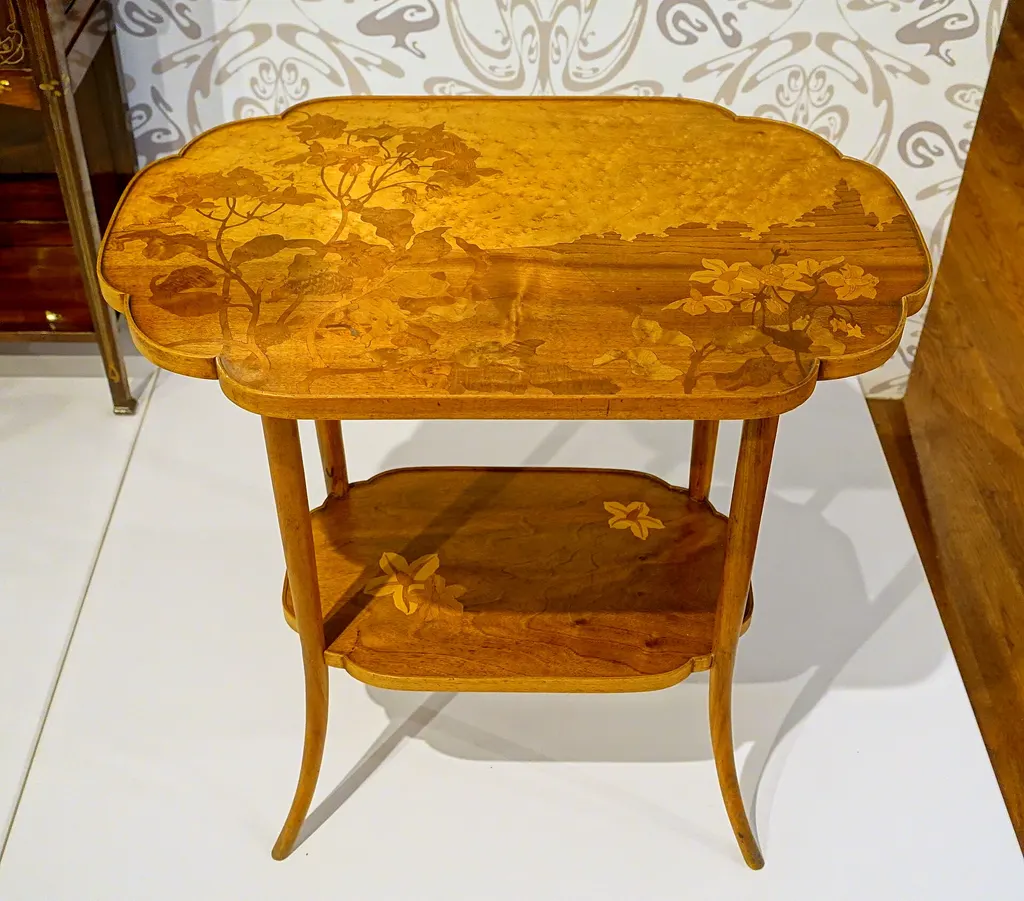
DaderotTable by Emile Galle, France, c, 2016-09-28 12:27:29Wikimedia Commons, collection record. Public domain
A chest of drawers stands on four tall, slender legs. Across its front, one continuous marquetry panel ignores the division between the two drawers: tendrils of morning glory climb and trail in pale and dark woods, their trumpet flowers opening across oak, walnut, Hungarian ash, kingwood, maple and harewood, with touches of mother-of-pearl. Émile Gallé showed this commode at the Paris Exposition Universelle of 1900, and it was bought straight from the exhibition for the Victoria and Albert Museum. He named it Ipomoea, after the botanical name of the flower.
Gallé is famous above all for his glass, but from the mid-1880s until his death in 1904 his workshops in Nancy also produced furniture that brought the same passion for plants into the home. Pieces bearing his name are still widely bought and sold, from grand cabinets to small nesting tables. This guide explains what made Gallé furniture distinctive, how to look at it, and how to approach the question every buyer should ask: is this a piece from Gallé's lifetime, a later product of the firm, or something else entirely?
A botanist in the workshop
Émile Gallé was born in Nancy, in Lorraine, in 1846. His father ran a business making and decorating glass and faience, and by 1874 the son had taken over the firm. Gallé had studied botany as a young man and remained a serious amateur botanist all his life; in 1877 he was one of the founders of a horticultural society in Nancy. He believed that nature was the proper source of inspiration for designers, and he set out the idea in an article on furniture decorated after nature, published in 1900 in La Revue des Arts décoratifs.
The V&A dates the opening of his furniture workshop to 1884. Within a few years he was showing furniture at exhibitions alongside his glass. At the Paris Exposition Universelle of 1889, where Gallé won the grand prix for glass, his furniture also reached a wide public, and at the 1900 exhibition he presented a substantial group.
In 1901 he became the first president of the École de Nancy, formally the Alliance provinciale des industries d'art, which brought together the city's designers and manufacturers. Among the figures associated with it were the furniture maker Louis Majorelle, the Daum glassworks, the cabinetmaker and architect Eugène Vallin and the artist Victor Prouvé.
What Gallé furniture looks like
Gallé's furniture combines fairly traditional forms with surfaces transformed by marquetry and carving.
- Marquetry pictures. Panels of contrasting veneers depict flowers, leaves, insects, landscapes and sometimes lines of verse. The V&A's 1900 fire screen shows wild clematis, known in English as traveller's joy, in elm, burr elm, walnut, amboyna, sabicu and mahogany on an ash ground.
- Carved plant forms. Legs, brackets and stretchers are carved as stems, roots, umbels or dragonflies. On the V&A fire screen, high-relief carving is combined with subtle low-relief carving of fronds and leaves.
- Inscriptions. Gallé liked to add words. A work table in the V&A, shown in 1900, is inscribed Travail est Joie ("work is joy") together with Chez Gallé. Quotations from poets also appear in marquetry.
- Native and exotic woods. He used local Lorraine timbers, such as oak, walnut, ash and fruitwoods, alongside imported woods for colour and figure.
- Grain as design. The direction of the grain is often chosen to suggest water, sky or a field, so that the veneer itself becomes part of the picture.
Look closer: Follow a single flower across a Gallé marquetry panel. In good work, each petal and leaf is cut from a wood chosen for its colour and grain, and the joins between pieces are fine and tight. The design often runs continuously across drawer fronts and divisions, as on the V&A commode, rather than being framed neatly within each panel.
Production: from showpieces to nesting tables
Gallé's furniture workshop worked on two levels. Major exhibition pieces, such as the Ipomoea commode or the celebrated bed Aube et Crépuscule ("Dawn and Dusk"), made in 1904 and now in the Musée de l'École de Nancy, were individually designed and lavishly executed. At the same time the workshop produced a much larger range of smaller, more affordable furniture: occasional tables, sets of nesting tables, trays, étagères, fire screens and small cabinets, often with repeated or adapted marquetry designs.
Pieces in this commercial range are the ones most often encountered on the market today. They were made by skilled workshop craftsmen rather than by Gallé's own hand, as was normal for a firm of this size; what makes them "Gallé" is his design, his workshop and his name.
After Gallé's death in September 1904 the firm continued under his family. Glass production went on into the 1930s, and furniture also continued to be made for a time. Furniture made after 1904 is still Gallé workshop furniture, but it is a different thing from pieces made during his lifetime, and it is fair to expect a buyer or catalogue to distinguish between them.
Signatures and marks
Most Gallé furniture is signed, usually in marquetry, with the name Gallé worked into a panel in a contrasting wood, often in a flowing script that may itself be decorated with plant forms. Some pieces add Nancy or an inscription.
A marquetry signature is better evidence than a painted or stamped one, because it was made at the same time as the panel. It is still not proof on its own:
- Check that the signature belongs to the panel. Look for the same quality of cutting, the same veneers and the same ageing as the rest of the marquetry.
- Check the style of the signature against documented pieces in museum collections and reliable catalogues.
- Check the rest of the piece. Construction, timber and wear should all agree with a date of around 1890–1914.
Period piece, later piece or reproduction?
Gallé furniture has been admired, copied and reproduced, especially since Art Nouveau returned to fashion in the 1960s. Small marquetry tables with "Gallé" signatures have been made in quantity in recent decades. The following checklist helps separate the categories.
| Feature | Period Gallé workshop | Typical later reproduction |
|---|---|---|
| Veneers | Saw-cut, relatively thick, varied natural colours with some fading | Very thin, often uniform, sometimes dyed in strong colours |
| Cutting | Tight joins, precise shapes, fine detail in stems and tendrils | Simplified shapes, gaps filled with dark filler, blurred detail |
| Carving | Crisp, confident plant forms integrated with the structure | Shallow or rounded carving, sometimes applied mouldings |
| Construction | Traditional joinery, hand-finished drawers, period screws | Machine-made joints, modern screws, plywood or particle board in hidden areas |
| Finish and wear | Wax or shellac with wear where hands and feet touch | Thick, glossy modern lacquer; artificial "distressing" in unlikely places |
No single feature settles the question. Restoration, replaced veneers and refinishing are common on genuine pieces, and some later reproductions are well made. Look at the whole object, inside and out, and ask for a written description that states what the seller believes the piece to be.
Buying and caring for marquetry furniture
- Open everything. Remove drawers, look underneath and examine the backs. Unpolished surfaces tell you more about age than show surfaces.
- Check for lifting veneer. Small blisters and lifting edges are common and repairable, but should be reflected in the price.
- Avoid harsh cleaning. Never use water, silicone sprays or abrasive polishes on marquetry. A conservator or experienced restorer should deal with loose pieces.
- Control light and humidity. Direct sunlight fades veneers and destroys the contrasts the design depends on; very dry or damp air causes splitting and lifting.
- Ask about history. An exhibition label, an old invoice or a family record can be valuable evidence. Our guide to provenance explains what to ask for.
Where to see Gallé furniture
The Musée de l'École de Nancy in Nancy has the most comprehensive collection of Gallé furniture, shown alongside work by Majorelle, Vallin and their contemporaries. In London, the V&A holds the pieces George Donaldson bought at the 1900 exhibition and presented to the museum, including the Ipomoea commode, the clematis fire screen and the Travail est Joie work table. The Musée d'Orsay in Paris also has important Art Nouveau furniture from Nancy.
To place Gallé in the wider movement, read Art Nouveau and Art Deco compared. His glass, and the problems of judging it, are covered in Right or wrong? Judging Art Nouveau and Art Deco glass, and general advice on construction and dating is in identifying antique furniture. Browse more under decorative arts.
Sources
- Commode 'Morning Glory', Émile Gallé, 1900, Victoria and Albert Museum
- Fire screen, Émile Gallé, 1900, Victoria and Albert Museum
- Work table, Émile Gallé, 1899–1900, Victoria and Albert Museum
- L'École de Nancy, Musée de l'École de Nancy
- Art Nouveau (Heilbrunn Timeline of Art History), The Metropolitan Museum of Art