A Short History of Art Glass
From core-formed vessels and Roman cameo glass to Venetian cristallo, Gallé, Tiffany and studio glass: how glass became an art, and what to look for.
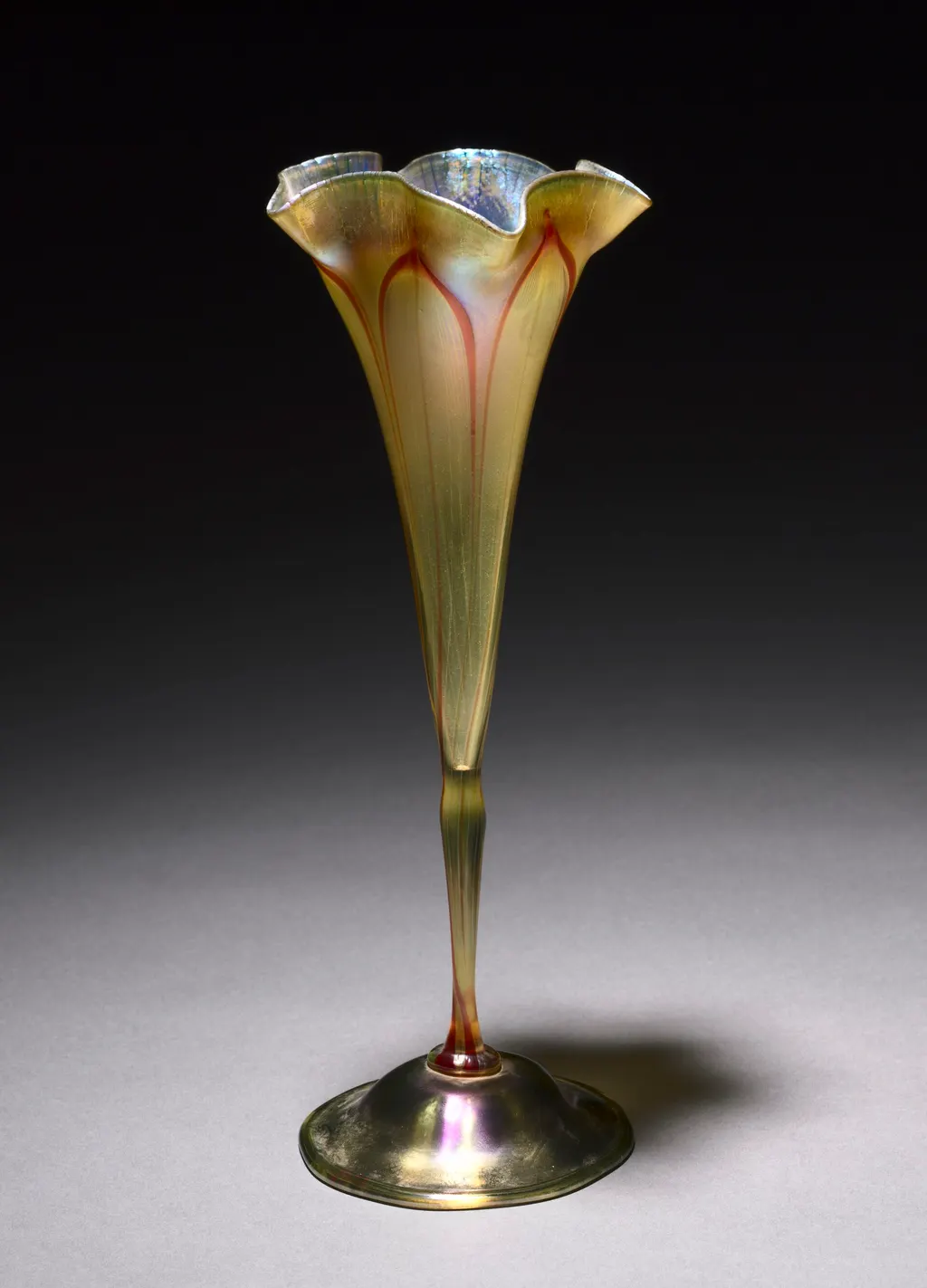
Louis Comfort TiffanyGoblet-Shaped Stemmed Vase, circa 1895Wikimedia Commons, collection record. CC0 1.0 (Public Domain)
In a darkened case at the British Museum sits a Roman cup carved with the story of King Lycurgus, trapped by writhing vines. Lit from the front, the glass looks a dull jade green. Lit from behind, it glows a deep translucent red. The Lycurgus Cup was made in the fourth century AD, and its colour change comes from tiny particles of metal dispersed through the glass, an effect its makers achieved without any modern understanding of why it worked.
Glass has always invited that kind of magic. It is made from some of the commonest substances on earth, chiefly sand, heated with a flux until it melts, yet in skilled hands it can imitate precious stones, hold light like water or be blown thinner than paper. This article traces the main chapters in the history of glass as an art, from the first vessels to the studio movement of the 1960s, and ends with practical tips for looking at glass in a museum or a shop.
Beads, cores and moulds: the first glass
The Getty Museum's survey of ancient glass places the first glass production in the third millennium BCE, most likely in Mesopotamia. The earliest objects were small: beads, inlays and amulets, often coloured to imitate lapis lazuli or turquoise.
Vessels followed. In core-forming, recorded in Mesopotamia in the fifteenth century BCE and in Egypt later in the second millennium, a core of clay and dung was built on a rod, and hot glass was wound or trailed around it. Coloured threads were combed into zigzags and feathers, the vessel was cooled, and the core was scraped out. Core-formed perfume bottles are small, brightly coloured and still slightly rough inside, a clue to their making.
The Roman revolution: blowing
Everything changed in the first century BCE, when craftsmen in the eastern Mediterranean discovered that a gather of molten glass on the end of a hollow pipe could be inflated. Glassblowing was fast and cheap. Within a few generations, glass bottles, cups and jars were everyday objects across the Roman world.
Luxury glass flourished too. The most famous example is the Portland Vase in the British Museum, a dark blue vessel overlaid with white glass that was carved away, like a cameo, to leave figures in relief. The museum dates it to about AD 1–25. Cameo glass was extraordinarily difficult to make, and the Portland Vase became an obsession for later craftsmen: Josiah Wedgwood spent years reproducing it in jasper stoneware in the late eighteenth century.
Enamel and gold: glass in the Islamic world
Glassmaking continued to thrive in the eastern Mediterranean and the Islamic world after the fall of Rome. Among its high points are the enamelled and gilded lamps made for mosques, madrasas and tombs in Mamluk Cairo in the fourteenth century. Hung in large numbers and lit from within, they made the bold inscriptions painted on their surfaces, often including the Qur'anic Verse of Light, glow above worshippers. The V&A holds a lamp made around 1309–10 for the tomb of Sultan Baybars II, whose inscriptions name the sultan. Whether a given lamp was made in Egypt or in Syria is often uncertain, and museum records are usually careful to say so.
Venice and the ideal of clear glass
In 1291 Venice's glassmaking was largely confined to the island of Murano, partly because furnaces posed a fire risk to the city. Murano became the most celebrated glassmaking centre in Europe. In the mid-fifteenth century, glassmakers there developed cristallo, a soda glass of unprecedented clarity, traditionally credited to Angelo Barovier. Venetian glassblowers exploited it with impossibly thin, lightweight goblets, winged stems and filigrana, glass with embedded threads of white or coloured canes.
Venetian styles were so admired that glass "in the Venetian manner" (façon de Venise) was made across Europe, often by Italian craftsmen working abroad.
In England, the glass merchant George Ravenscroft obtained a patent in 1674 for a new glass. He is usually credited with introducing lead glass, in which lead oxide in the batch produces a heavier, more brilliant material that is ideal for cutting. Historians debate how much of the invention was his own, but English lead glass, sometimes called lead crystal, became the basis of the cut-glass tradition of the eighteenth and nineteenth centuries. In central Europe, meanwhile, Bohemian and German glassmakers made a hard potash glass well suited to deep engraving and wheel-cutting.
Art Nouveau, Tiffany and the glass artist
In the late nineteenth century, glass became a medium for individual artistic expression rather than only skilled manufacture.
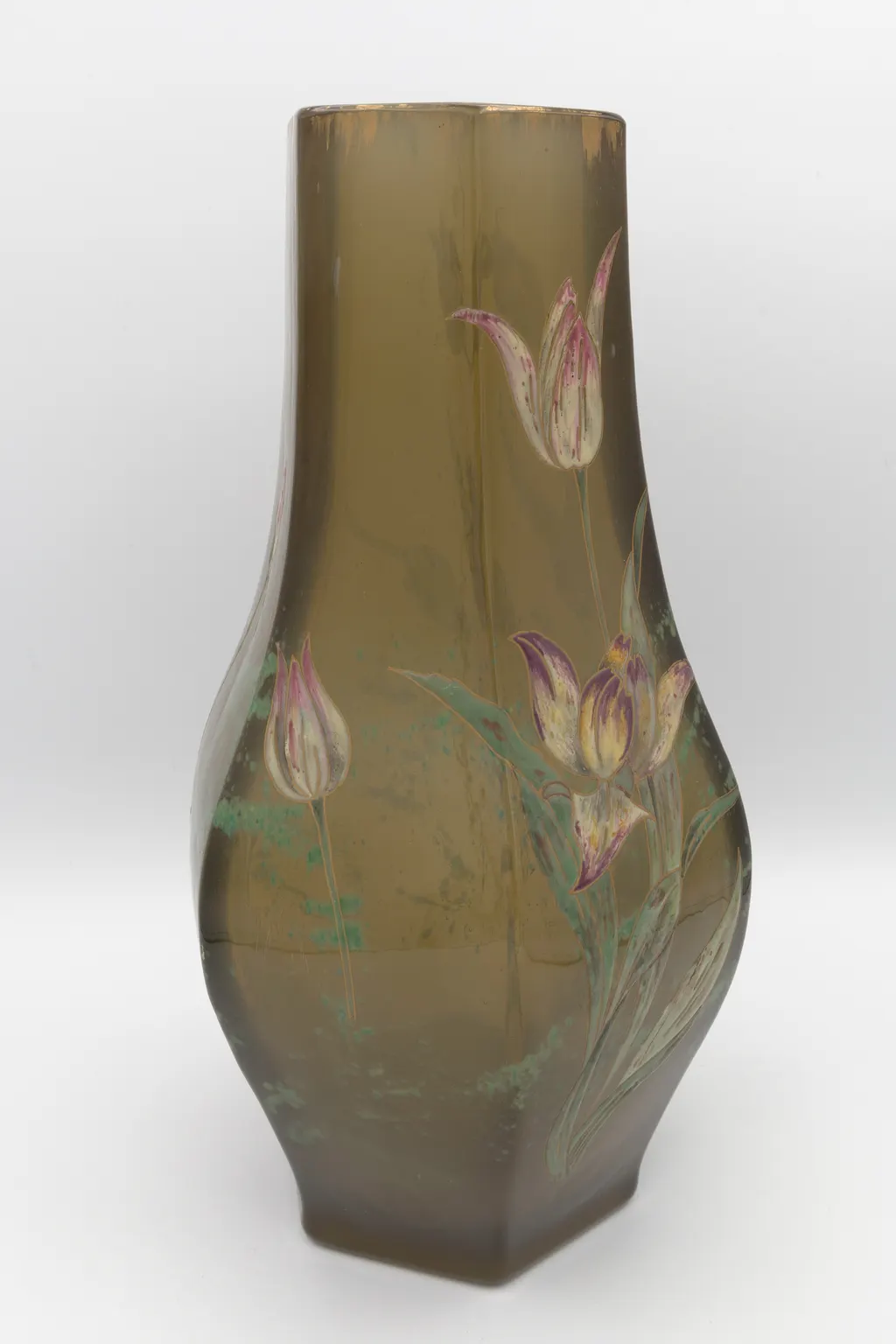
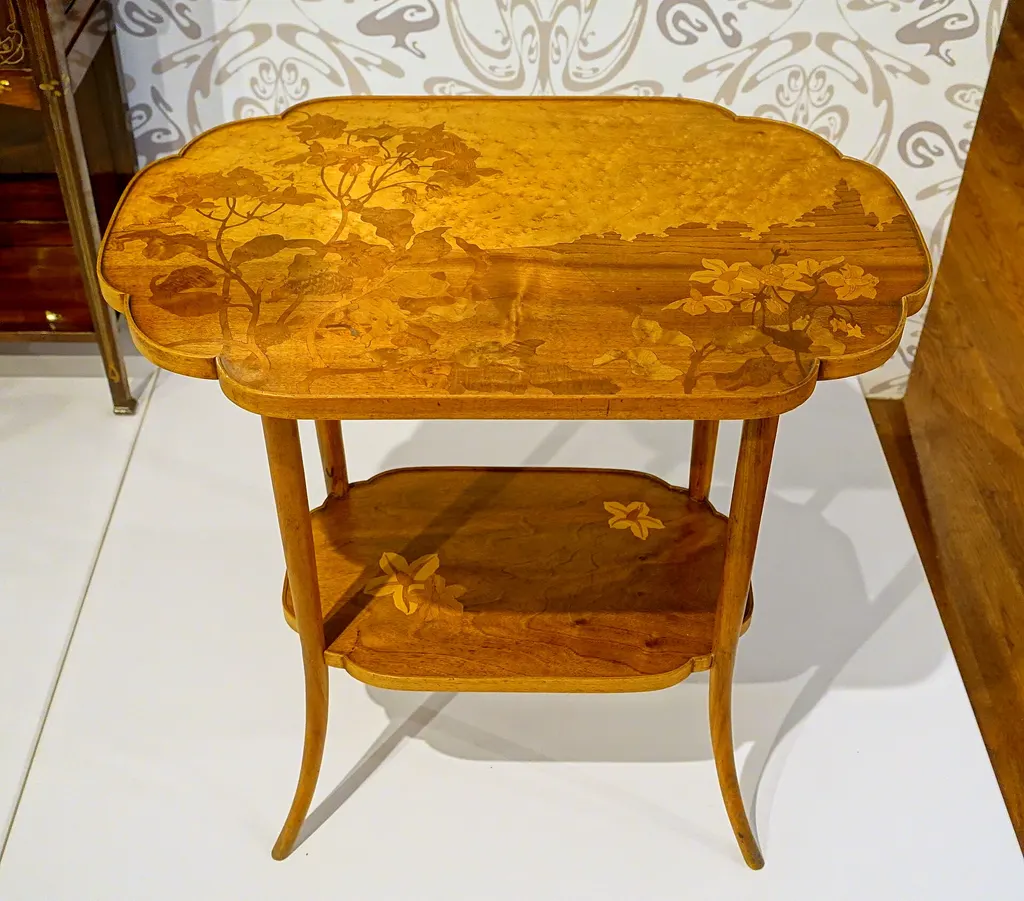
In Nancy, in eastern France, Émile Gallé (1846–1904) made vases layered with coloured glass and etched or carved into flowers, insects and lines of poetry. He was the founder and first president of the École de Nancy, an alliance of artists and industrialists established in 1901. The Daum glassworks in the same city worked in a related style. Today the Musée de l'École de Nancy holds more than 900 pieces of glass, mainly by Gallé but also by Daum and other glassmakers of Lorraine. Our article on Gallé's furniture shows the same naturalism at work in wood.
In New York, Louis Comfort Tiffany named the blown glass from his furnaces Favrile, recalling an Old English word for "hand-wrought". The Met's Heilbrunn Timeline notes that Favrile glass let his craftsmen use the material's own colour variations and textures instead of painted detail. Iridescent surfaces, created with metallic compounds, became a Tiffany signature.
In the early twentieth century the Paris jeweller René Lalique turned increasingly to glass, producing moulded vases, perfume bottles and car mascots whose frosted and polished surfaces became defining images of Art Deco. If you are unsure where the boundary between these two movements lies, see Art Nouveau and Art Deco: How to Tell Them Apart. Their popularity has made both Gallé and Lalique heavily copied; Right or Wrong? Judging Art Nouveau and Art Deco Glass explains what experts look for.
The studio glass movement
For most of its history, hot glass needed a factory: large furnaces, teams of workers and industrial supplies of raw material. In 1962 the Toledo Museum of Art in Ohio hosted two workshops that changed this. The ceramicist Harvey Littleton set out to prove that an artist could melt and blow glass in a small furnace in an individual studio, and the glass scientist Dominick Labino provided a glass formula that melted at a workable temperature. Within a decade, around fifty studio glass programmes had been established in the United States, and artists around the world began treating glass as a medium like clay or paint.
A timeline of art glass
- Third millennium BCE: first glass objects, probably in Mesopotamia
- Fifteenth century BCE: core-formed vessels in Mesopotamia, later in Egypt
- First century BCE: glassblowing invented in the eastern Mediterranean
- c. AD 1–25: Portland Vase (British Museum)
- Fourth century AD: Lycurgus Cup (British Museum)
- Fourteenth century: enamelled and gilded mosque lamps in Mamluk Egypt and Syria
- 1291: Venetian glassmaking concentrated on Murano
- Mid-fifteenth century: cristallo developed on Murano
- 1674: Ravenscroft's glass patent in England
- 1901: École de Nancy founded, with Gallé as president
- 1962: Toledo workshops launch the studio glass movement
How to look at a glass object
- Turn it over. A rough or ground scar on the base, the pontil mark, shows where a rod held the vessel while the rim was finished. Its absence may mean the vessel was mould-made or the scar was polished away.
- Look for seams. Faint vertical ridges suggest the glass was blown or pressed into a mould.
- Hold it to the light. Tiny bubbles (seeds), streaks and slight tints are normal in old glass and are produced by the melt; perfectly flawless glass is more typical of modern manufacture.
- Feel the weight. Lead glass feels noticeably heavier than soda glass of the same size and, when cut, shows more sparkle.
- Check the foot for wear. Centuries of being set down leave fine random scratches on the base. Uniform, parallel scratches can indicate artificial ageing.
- Read signatures sceptically. Signatures on Art Nouveau and Art Deco glass were frequently added to later copies.
For the wider family of materials and crafts that glass belongs to, see Understanding the Decorative Arts.
Sources
- Ancient Glass in the J. Paul Getty Museum: Introduction, J. Paul Getty Museum
- The Portland Vase, British Museum
- The Lycurgus Cup, British Museum
- Louis Comfort Tiffany (1848–1933), The Metropolitan Museum of Art, Heilbrunn Timeline of Art History
- The glass collection, a reference collection, Musée de l'École de Nancy