Art Nouveau and Art Deco: How to Tell Them Apart
Whiplash curves or crisp zigzags? A practical guide to telling Art Nouveau from Art Deco in buildings, furniture, glass, jewellery and posters.
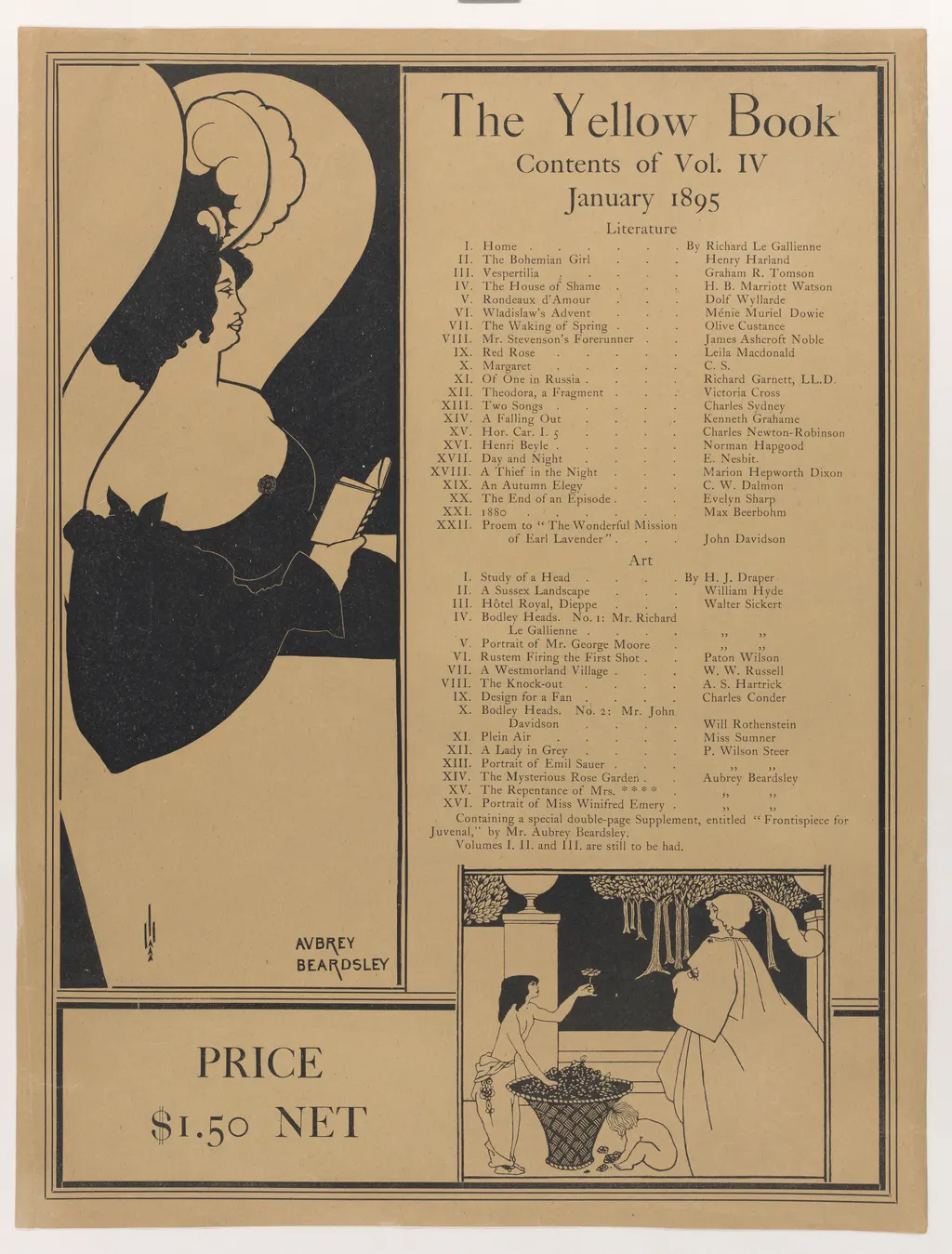
Aubrey Vincent BeardsleyPoster for The Yellow Book, Volume IV, January 1895Lithograph and relief processThe Metropolitan Museum of Art, collection record. CC0 1.0 (Public Domain)
Walk down into the Paris Métro at certain stations and you pass under a cast-iron entrance that seems to have grown rather than been built: green stems curve upwards and bend over like plant stalks, holding up glowing lamps shaped like buds. These are Hector Guimard's entrances, designed around 1900. Now picture the spire of the Chrysler Building in New York, completed in 1930: stacked stainless-steel arches studded with triangular windows, rising in sharp, shining tiers like a sunburst made by a machine.
Both are celebrated landmarks of decorative modernity, separated by only three decades, and people mix the two styles up constantly. The names sound alike, both are associated with glamour, glass and posters, and dealers sometimes blur them. Yet they come from almost opposite instincts. Art Nouveau looks to nature and the hand; Art Deco looks to geometry, speed and the machine.
This guide sets out where each style came from, the clues that separate them, and the grey areas where they overlap.
Two styles, two moments
Art Nouveau, c. 1890–1910
Art Nouveau was a deliberate attempt to invent a new style, free of the historical revivals (Gothic, Renaissance, Rococo) that dominated nineteenth-century design. Its name comes from a shop: in December 1895 the dealer Siegfried Bing opened the Maison de l'Art Nouveau in Paris, selling furniture, glass, ceramics and prints by modern designers.
The style flourished across Europe under different names: Jugendstil in Germany (after the Munich magazine Jugend), Secession style in Vienna, Modernisme in Barcelona, Stile Liberty in Italy (after the London shop). One of its founding buildings is Victor Horta's Hôtel Tassel in Brussels, built in 1892–93, whose staircase hall dissolves iron columns into tendrils and paints the walls with matching curling lines. It is now part of a UNESCO World Heritage Site with three other Horta town houses.
Art Nouveau grew partly from the British Arts and Crafts belief that everyday objects deserve the same care as fine art, discussed in the Arts and Crafts movement, and partly from the European craze for Japanese prints, with their flat colour and asymmetry.
Art Deco, c. 1920–1940
Art Deco takes its name from the 1925 Exposition Internationale des Arts Décoratifs et Industriels Modernes in Paris, a vast showcase of luxury modern design. Nobody at the time called it "Art Deco", though. The term became widely used only in the 1960s, popularised by the British historian Bevis Hillier's book Art Deco of the 20s and 30s (1968). Contemporaries spoke of style moderne or simply "modern".
The style had been forming before the First World War (the Théâtre des Champs-Élysées in Paris, opened in 1913, is often cited as an early example) and it absorbed a magpie's range of influences: Cubist fragmentation, the colours of the Ballets Russes, Egyptian motifs (especially after the discovery of Tutankhamun's tomb in 1922), Aztec and Maya stepped forms, and the sleek lines of cars, liners and aeroplanes. In the 1930s, especially in America, it slimmed down into Streamline Moderne, all horizontal speed lines and rounded corners.
The quickest way to tell them apart
If you remember one thing, make it this: Art Nouveau curves, Art Deco angles. But the differences run deeper than line.
| Clue | Art Nouveau | Art Deco |
|---|---|---|
| Dates | c. 1890–1910 | c. 1920–1940 |
| Line | Long, sinuous "whiplash" curves; asymmetry | Straight lines, zigzags, chevrons, stepped forms; symmetry |
| Inspiration | Plants, flowers, insects, water, flowing hair | Geometry, machines, speed, skyscrapers, ancient Egypt |
| Typical motifs | Lilies, irises, dragonflies, peacocks, women with streaming hair | Sunbursts, fountains, fans, leaping gazelles, lightning bolts |
| Female figure | Languid, dreamy, wrapped in tendrils | Athletic, sleek, stylised, often with bobbed hair |
| Colour | Soft, naturalistic: greens, lilacs, amber, opalescent effects | High contrast: black and white, silver and gold, jade, coral, chrome |
| Materials | Carved wood, wrought iron, enamel, horn, opalescent and cameo glass | Lacquer, chrome, Bakelite, exotic veneers, shagreen, frosted and moulded glass |
| Making | Emphasis on the hand-made and unique | Ranges from unique luxury pieces to mass production |
Look closer: Cover the object with your hand except for one edge or outline. If the edge ripples, swells and tapers like a plant stem, think Art Nouveau. If it steps, folds or snaps at right angles, or repeats a motif in strict symmetry, think Art Deco.
Object by object
Glass
This is where confusion is most common, and where the money is. Art Nouveau glass, by makers such as Émile Gallé and the Daum workshop in Nancy and Louis Comfort Tiffany in New York, uses layered and carved coloured glass to depict flowers, landscapes and insects, or iridescent surfaces that mimic shells and butterfly wings. Art Deco glass tends towards moulded, pressed or frosted forms with geometric or stylised figures, often in clear and satin finishes.
René Lalique is the classic bridge between them: celebrated as an Art Nouveau jeweller around 1900, he became the leading Art Deco glassmaker in the 1920s. The restored Artwis article Right or wrong? Judging Art Nouveau and Art Deco glass looks at quality, condition and later copies, and A short history of art glass puts both periods into the longer story.
Furniture
Art Nouveau furniture is sculptural. Gallé, who worked in wood as well as glass, inlaid his cabinets and tables with marquetry plants and insects and carved legs into stems and dragonflies (see a practical guide to Gallé furniture). Louis Majorelle, also in Nancy, used flowing gilt-bronze mounts shaped like water lilies.
Art Deco furniture is architectural. The Parisian designer Émile-Jacques Ruhlmann made pieces of restrained shape in rare veneers such as macassar ebony, with slender tapering legs and small ivory details. Jean Dunand revived lacquer with geometric designs. By the 1930s chrome tubing and mirrored glass appear in more affordable furniture.
Posters and graphics
Alphonse Mucha's poster for Sarah Bernhardt in Gismonda (1894–95) launched a whole graphic language: an elongated vertical format, a woman framed by a halo-like arch, hair in decorative coils, muted colours and ornamental lettering. Art Deco posters, such as those by A. M. Cassandre for railways and ocean liners, use bold flat shapes, dramatic perspective, airbrushed gradients and clean, often capitalised sans-serif lettering.
Architecture
In Art Nouveau buildings, ornament seems to grow out of the structure: iron that bends like vines (Horta, Guimard), façades that ripple (Antoni Gaudí in Barcelona), or the restrained, geometric variant of Charles Rennie Mackintosh in Glasgow and the Viennese Secession. Art Deco buildings emphasise verticality and setbacks, with ornament in panels of chevrons, sunbursts and stylised figures, often in metal, faience or coloured stone, from New York skyscrapers to cinemas, apartment blocks and the seafront architecture of Miami Beach and Napier in New Zealand.
The grey zone between them
Real objects do not always obey the table. Several kinds of design sit awkwardly between the two:
- Glasgow and Vienna, c. 1900–1910. Mackintosh's high-backed chairs and the work of Josef Hoffmann and the Wiener Werkstätte use grids, squares and straight lines. Officially they belong to the Art Nouveau era, but they look forward to Deco and to modernism. Many historians see them as a geometric branch of Art Nouveau.
- Late, stylised floral work. Some 1910s design flattens flowers into tight, repeated patterns, such as the stylised rose associated with Mackintosh and later French designers. When a flower becomes a geometric emblem rather than a living plant, the object is moving towards Deco.
- Revivals and reproductions. Both styles were revived from the 1960s onwards, and both have been heavily reproduced. A Tiffany-style lamp or a Mucha print may be decades or a century later than it looks. Weight, tooling marks, signatures, wear and provenance matter more than style alone.
A checklist for your next museum visit or antiques fair
Next time you see an object labelled with either style, test it against these questions, and for wider context read Understanding the decorative arts.
- What does the outline do? Flowing and asymmetrical, or stepped and symmetrical?
- Is the motif alive or stylised? A recognisable iris with drooping petals, or a fan of identical rays?
- What is it made of? Carved wood, wrought iron and enamel lean Nouveau; chrome, Bakelite, lacquer and exotic veneers lean Deco.
- How was it made? Visible handwork and one-off decoration, or moulding and repetition designed for production?
- What does the woman look like? If there is a female figure, is she dreamy and swathed in hair, or sleek, sporty and bob-haired?
- Could it be a revival? Check marks, materials and condition before trusting a date.
Where to see the best examples: the Musée d'Orsay and the Musée des Arts Décoratifs in Paris; the Musée de l'École de Nancy; the Horta Museum in Brussels; the Victoria and Albert Museum in London; the Metropolitan Museum of Art in New York; and, for Deco architecture, a walk through midtown Manhattan or Miami Beach's historic district.
Sources
- Art Nouveau (Heilbrunn Timeline of Art History), The Metropolitan Museum of Art
- Major Town Houses of the Architect Victor Horta (Brussels), UNESCO World Heritage Centre
- Art Deco, Encyclopaedia Britannica
- Art Nouveau, Encyclopaedia Britannica