Right or Wrong? Judging Art Nouveau and Art Deco Glass
How to judge cameo and moulded glass by Gallé, Daum, Schneider and Lalique: making techniques, what signatures do and do not prove, reproductions and condition.
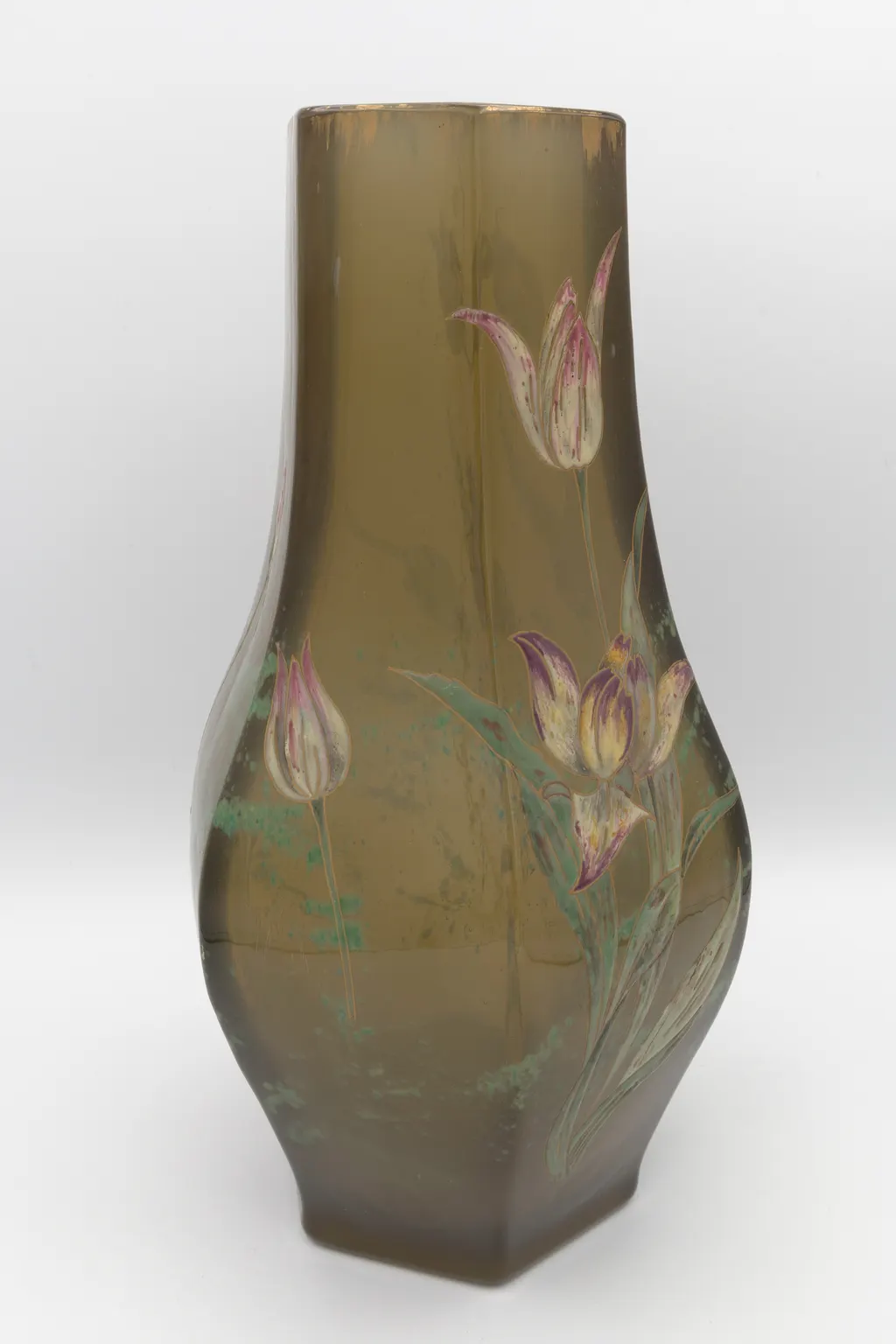
Emile GalléVase, ca. 1890Glass, enamelThe Metropolitan Museum of Art, collection record. CC0 1.0 (Public Domain)
A vase in the Victoria and Albert Museum, made around 1900, is carved with day lilies that rise through layers of coloured glass. Near its foot, cut into the glass with a wheel, is the signature Gallé, and beside it the word for day lilies written in Greek. On the base, a small paper label survives: "Emile Gallé Nancy-Paris", followed by a stock number, 17496. Few pieces of French art glass come with such a complete set of clues. Most of what reaches the market has lost its label, may have lost its history and sometimes was never what it claims to be.
Art Nouveau and Art Deco glass is beautiful, widely collected and widely reproduced. Judging it well means understanding how it was made, what the main makers' marks actually tell you, and how condition affects both meaning and value. This guide focuses on four names that dominate the field: Gallé, Daum, Schneider and Lalique.
The four makers at a glance
| Maker | Active (art glass) | Characteristic work | Typical marks |
|---|---|---|---|
| Émile Gallé and the Gallé firm, Nancy | c. 1870s–1936 | Cameo glass with plants and insects, enamelled glass, glass marquetry | Gallé in many forms: cameo, wheel-cut, engraved or enamelled |
| Daum, Nancy | from the early 1890s | Cameo and enamelled glass with landscapes and flowers; later Art Deco acid-etched forms | Daum Nancy with the Cross of Lorraine |
| Schneider, Épinay-sur-Seine | from 1913 | Brightly coloured cameo glass, often sold as Le Verre Français or Charder; mottled Art Deco glass | Schneider, Le Verre Français, Charder, sometimes a striped cane |
| René Lalique, later Lalique | glass from c. 1907 | Press-moulded and blown-moulded glass, often frosted or opalescent; perfume bottles, vases, car mascots | R. Lalique (to 1945), Lalique France afterwards, in several forms |
The Gallé and Daum firms both belonged to the flowering of the decorative arts in Nancy that culminated in the École de Nancy, founded in 1901 with Gallé as its first president. Charles Schneider and his brother Ernest had both worked at Daum before founding their own glassworks near Paris. Lalique came to glass from jewellery, and his firm made glass on an industrial scale, especially after opening a factory at Wingen-sur-Moder in Alsace in the early 1920s.
How cameo glass was made
Most Art Nouveau "cameo" glass from Nancy was built up in layers and then cut back.
- Layering. A glassblower gathered glass of one colour and then cased it with one or more layers of contrasting colours, sometimes adding powdered colour or metallic foils between them.
- Design and resist. A design was painted onto the cooled vessel in an acid-resistant material, such as a wax or bituminous varnish.
- Acid etching. The vessel was exposed to hydrofluoric acid, which ate away the unprotected glass and left the design standing in relief. Repeating this with different resists produced several levels of relief and colour.
- Finishing. The best pieces were then wheel-cut and engraved by hand to sharpen details, model petals and texture surfaces. A faceted, hammered-looking finish produced on the wheel is known as martelé.
The V&A describes its Gallé day-lily vase as opaque glass worked in the molten state and wheel-cut, and its Daum vase of 1900–05 as cased, acid- and wheel-cut. Gallé also developed and patented marqueterie de verre in 1898, in which hot pieces of coloured glass were pressed into the surface of the vessel like inlay.
Lalique's glass is quite different. Much of it was press-moulded or blown into moulds, then frosted, polished or stained. The V&A's Bacchantes vase, designed in 1927, is press-moulded, with the dancing figures standing out in relief from the frosted ground.
Look closer: Run a finger (gently) over the decoration of a cameo vase. Acid-etched relief has a slightly soft, granular feel; wheel-cut areas feel crisper, with clear facets. On the finest pieces you will feel both. On many cheaper or later pieces, the relief is shallow, even and entirely acid-etched, with no wheel work at all.
What signatures can and cannot tell you
A signature is the first thing most buyers look for, and the easiest thing to fake. Treat it as one piece of evidence among many.
Gallé
Gallé signatures vary enormously: cameo-cut in relief, wheel-engraved, needle-engraved, enamelled or painted in gold, in plain capitals or in flowing Japanese-inspired scripts. This variety is genuine, but it also gives forgers latitude. Pieces made by the firm in the years immediately after Gallé's death in 1904 are generally said to bear a small star before the signature. Industrially produced cameo glass from the firm continued to be made until it closed in 1936; it is genuine "Gallé", but not from Gallé's lifetime.
Daum
Daum pieces are usually marked Daum Nancy with the Cross of Lorraine, as on the V&A's vase, which carries an incised mark. The firm continued after the Second World War and still operates, so marks need to be read with the style and technique of the piece.
Schneider
Schneider marked its cameo wares variously, including Le Verre Français and Charder; some carry a small striped glass cane. Because these marks were used on commercial lines, the quality of cutting and colour is often a better guide to desirability than the name alone.
Lalique
As a rule of thumb, glass made in René Lalique's lifetime is marked R. Lalique, often with France, while glass made after his death in 1945 is marked Lalique or Lalique France without the initial. But popular models stayed in production for decades. The V&A dates its Bacchantes vase, marked "R. LALIQUE FRANCE", only to "before about 1970", a useful reminder that the mark, the model and the date of manufacture are three different questions.
A signature that is crisper, deeper or fresher than the surrounding decoration; a signature in a place where the maker did not usually sign; or a signature on glass whose technique belongs to another decade are all reasons to look again.
Reproductions and "in the style of"
Art Nouveau cameo glass has been reproduced in quantity since the late twentieth century. Some modern pieces are sold openly as decorative reproductions, and some are marked with variants such as Tip Gallé, the "tip" signalling a type or style rather than the original maker. Once such marks are ground away or overlooked, the pieces can be misdescribed. Typical signs include:
- Uniform, shallow acid relief with no wheel finishing.
- Harsh or garish colour combinations and casing layers that are too thin or too even.
- Pristine bases with no wear at all on the footrim, or artificial abrasion scratched in a single direction.
- Generic designs that repeat exactly across many examples.
- Signatures in large, regular script prominently placed on the side.
Moulded glass in the Lalique manner was also widely made by other firms in the 1920s and 1930s, honestly and often well. These pieces are collectable in their own right but should not carry a Lalique mark.
Condition: the quiet value factor
Glass cannot be invisibly mended, so condition matters greatly.
- Ground rims and feet. Chips are often polished away, leaving a rim slightly lower, flatter or more angular than intended. Compare with known examples and look for a glossy band where there should be a fire-polished edge.
- Cracks. Hold the glass to a strong light and turn it slowly; internal cracks catch the light as bright lines.
- Drilled holes. Vases converted into lamps may have a drilled base.
- Interior staining. Water stains inside narrow-necked vases can be very hard to remove safely.
- Replaced or missing parts. Stoppers, metal mounts and lamp fittings may be later.
A buyer's checklist
- Identify the technique first: cameo, enamelled, moulded, marquetry.
- Ask whether the technique, style and colour fit the maker and date claimed.
- Examine the signature last, with a loupe, and compare it with documented examples.
- Check the base and rim for wear, grinding and drilling.
- Look for labels, receipts and provenance; our guide to provenance explains what to ask.
- Ask the seller to put their description in writing, including whether the piece is from the maker's lifetime.
To understand the wider story, read our history of art glass and Art Nouveau and Art Deco compared. Gallé's work in wood is the subject of a practical guide to Gallé furniture, and you will find more under decorative arts.
Sources
- Vase, Émile Gallé, c. 1900 (signed 'Gallé', day-lilies inscription in Greek), Victoria and Albert Museum
- Vase, Daum, 1900–1905 (incised 'Daum Nancy' with the Cross of Lorraine), Victoria and Albert Museum
- Bacchantes vase, René Lalique, designed 1927, Victoria and Albert Museum
- Art Nouveau (Heilbrunn Timeline of Art History), The Metropolitan Museum of Art
- L'École de Nancy, Musée de l'École de Nancy