Armenian Rugs: Attribution Without Inscriptions
Inscribed Armenian rugs give firm anchors, but most Caucasian rugs carry no words. What structure, dyes and history can and cannot tell us about their weavers.
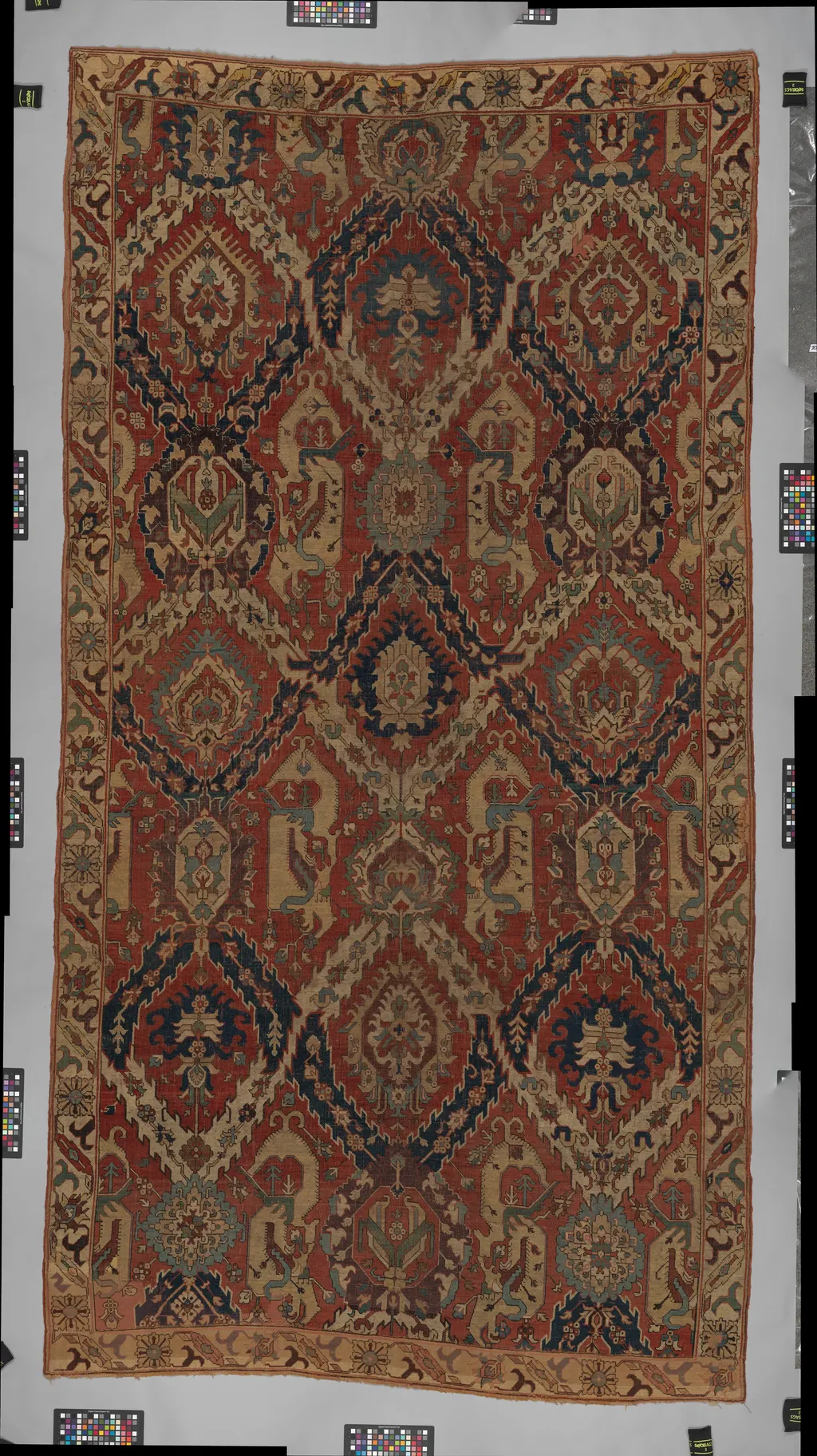
Unknown makerDragon Carpet, 17th centuryWool (weft and pile); cotton (warp); symmetrically knotted pileThe Metropolitan Museum of Art, collection record. CC0 1.0 (Public Domain)
In the Metropolitan Museum of Art are two long seventeenth-century carpets, each with a lattice of stylised beasts and blossoms that has given the type its name: dragon carpets. Both came to the museum in 1922 as gifts of the collector James F. Ballard, and both are woven with symmetrical knots. Yet their catalogue entries differ. One is attributed to "Caucasus". The other is attributed to "present-day Azerbaijan". In Armenian scholarship, carpets of this family are known as vishapagorgs, "dragon carpets", and are claimed as Armenian work.
None of these labels is careless. They reflect the real difficulty of deciding where, and by whom, a rug was made when it carries no words. A rug woven with an Armenian inscription gives the historian a firm anchor. Most rugs from the Caucasus and eastern Anatolia have none.
This article looks at what inscriptions do and do not prove, what other evidence can help, and why attribution in this field remains a matter of balanced judgement, and sometimes of politics.
What an inscription can tell you
A number of rugs carry inscriptions in Armenian script. They may name a weaver, a patron or a person being commemorated, give a dedication to a church, or record a date. Dates often follow the Armenian calendar, whose era begins in AD 552, and are written with letters of the Armenian alphabet used as numerals, so they must be converted. A frequently cited example is a rug associated with the name Gohar, dated 1700 and attributed to Karabakh (Artsakh), which bears an Armenian inscription.
Inscriptions are precious, but they need careful reading:
- They show who commissioned or wove a particular rug, not necessarily who wove every rug of the same design.
- They can be added later. Inscriptions woven into the original pile are one thing; anything stitched on, repiled or restored needs close examination.
- They can be faked. Because an inscription raises interest and value, false ones have been introduced. Script, spelling and the integration of the lettering into the weave all need checking.
- Other scripts appear too. Rugs from the same regions also carry Arabic-script inscriptions, reflecting the mixed populations of the Caucasus.
The most important study of inscribed rugs remains Weavers, Merchants and Kings: The Inscribed Rugs of Armenia by Lucy Der Manuelian and Murray L. Eiland, published for an exhibition at the Kimbell Art Museum in Fort Worth in 1984.
The uninscribed majority
The great majority of nineteenth-century rugs from the Caucasus have no inscriptions at all. They were woven in a region where Armenians, Azerbaijanis, Kurds, Georgians, the peoples of Daghestan and others lived side by side, often in the same districts and sometimes in the same villages. Weavers saw each other's work, and designs travelled through markets and dowries.
The trade names used by dealers and collectors, such as Kazak, Karabagh, Shirvan or Kuba, are mostly regional or market names. They describe groups of rugs with shared technical and design features, not the ethnicity of the weavers. A "Kazak" rug might have been woven by Armenian, Azerbaijani or other hands.
That is the core of the problem. Design alone cannot reliably identify a weaver's people, and claims that a particular motif is uniquely Armenian, or uniquely anything else, should be treated with caution unless supported by documented examples.
Evidence beyond the design
Specialists combine several kinds of evidence. None is decisive on its own.
| Evidence | What it can show | Limits |
|---|---|---|
| Knot type | Symmetrical knots are usual in Caucasian rugs | Shared by many weaving groups across the region |
| Foundation materials | Wool or cotton warps and wefts can point to a region or period; one Met dragon carpet has a cotton warp | Materials changed with trade and availability |
| Warp depression, selvedges, end finishes | Local weaving habits, sometimes very characteristic | Habits spread between neighbouring communities |
| Dyes | Analysis can identify insect reds, madder, indigo and synthetic dyes, and so help with dating | A dye reveals sources and dates, not a weaver's identity |
| Comparison with inscribed rugs | Technical matches with documented pieces strengthen an attribution | Inscribed rugs are few and may themselves be atypical |
| Provenance and oral history | Where and from whom a rug was acquired | Dealers' stories are often embellished |
Dyes deserve a special note. The Armenian cochineal (Porphyrophora hamelii), an insect of the Ararat plain and the Aras valley, produced a famous red known in Armenian as vordan karmir, "worm's red". Dye analysis has identified it in historic textiles from many places. Its use in Armenian rugs is often asserted, and is likely in some cases, but the presence of an insect red in a rug does not by itself prove Armenian manufacture: other insect dyes, including American cochineal from the sixteenth century onward, were widely traded.
Look closer: Turn a rug over. The back often tells you more than the front: the regularity of the knots, whether alternate warps sit on two levels, the colour and twist of the wefts, and how the sides and ends were finished. These are the details that specialists compare with documented pieces.
Dragon carpets: a case study
The dragon carpets of the seventeenth and eighteenth centuries show how much is at stake. Their large-scale lattices of stylised dragons, other beasts and palmettes are among the most powerful designs in carpet history, and their origins are contested.
Many Western museums and scholars attribute them broadly to the Caucasus, often to areas now in Azerbaijan, as the Met's labels show. Armenian scholars and others have argued for Armenian weaving centres, pointing to Armenian-inscribed rugs from the same regions and to Armenian names for the designs. The German scholar Volkmar Gantzhorn went further in Der christlich-orientalische Teppich (1990), arguing that many carpet traditions had Armenian Christian roots; his conclusions have been much debated and are not generally accepted in full. Other researchers have stressed Persian design sources for the dragon lattice.
The honest position is that dragon carpets were woven in the southern Caucasus, that more than one community may have been involved, and that the evidence does not yet allow a single ethnic attribution to be proved.
The politics of labels
Rug attribution is not only an academic matter. In the Caucasus, carpets are national symbols, and competing claims over particular designs and regions are bound up with the history of conflict between Armenia and Azerbaijan. Labels in museums, auction catalogues and books are read in that light.
Phrases like "present-day Azerbaijan" in a museum record usually indicate a modern geographical location, not a claim about the ethnicity of the weavers. Equally, the description "Armenian" on a rug without an inscription or a documented history is an interpretation, not a fact. Good catalogues say which evidence supports an attribution and acknowledge alternatives.
A checklist for attribution
- Is there an inscription? If so, is it original to the weave, and what exactly does it say?
- What do the structure and materials indicate about region and date?
- Have the dyes been analysed, and what do they show about date?
- Which documented rugs is it being compared with?
- What is known of its ownership history?
- Does the label distinguish between a place, a market name and a people?
For the basics of structure and design, start with how to read an oriental rug. For another textile tradition from the region, see Kaitag embroideries of Daghestan, and for the value of documented history, provenance explained. More in decorative arts.
Sources
- Dragon Carpet, 17th century (22.100.119), The Metropolitan Museum of Art
- Dragon Carpet, 17th century (22.100.122), The Metropolitan Museum of Art
- Armenian cochineal, Wikipedia