Tajik Jewellery: Gold, Silver and Symbol
From the Oxus Treasure to Bukharan silver set with turquoise and coral: the layered history of jewellery in the Tajik lands, its birds and its uncertain labels.
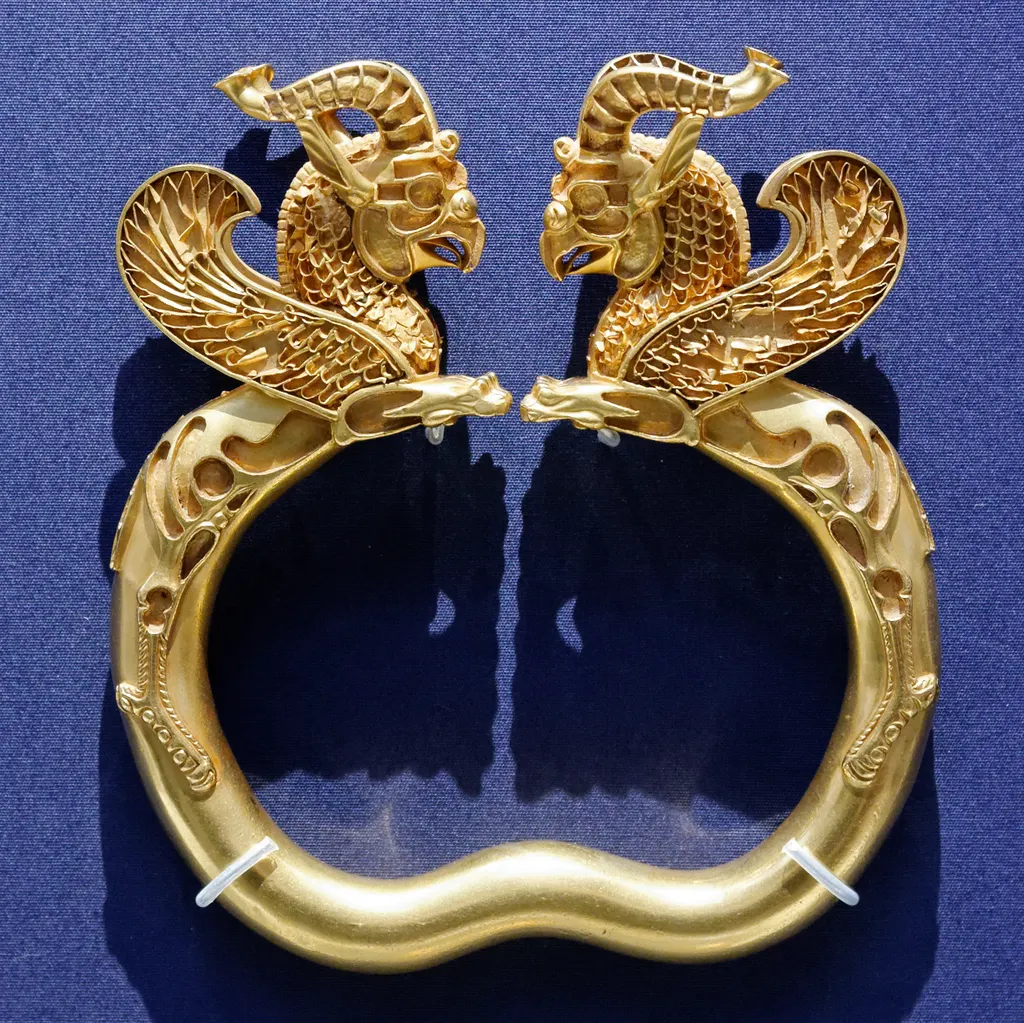
Marie-Lan NguyenArmlet from the Oxus Treasure BM 1897.12-31.116, 2012-02-11Wikimedia Commons, collection record. Public domain
In the Victoria and Albert Museum there is a small silver clasp in two parts, one with a hook and one with a loop. Each half is paved with tiny cabochon turquoises around a raised, drop-shaped centre worked in repoussé flowers. Pendants of coral beads and silver wire hang from the lower edge, and a piece of yellow glass is set over the hook. When the museum acquired it in 1910, it was described as coming from Yemen. Today the V&A attributes it to Bukhara and dates it to the nineteenth century, noting that its shape, its floral repoussé and its pavé-set turquoises are characteristic of the jewellery of the region.
That small correction tells us much about the jewellery of the Tajik lands. Objects have travelled, labels have shifted, and the boundaries drawn on modern maps rarely match the workshops and markets in which jewellery was made and worn.
This article traces some of the layers in that history: ancient gold from the banks of the Oxus, the Sogdian and Buddhist past of the region, the birds that recur in its art, and the materials and questions that matter when looking at a piece today.
Whose jewellery?
"Tajik" refers broadly to the Persian-speaking peoples of Central Asia. Their homelands extend well beyond the borders of present-day Tajikistan, which took shape as a Soviet republic in 1929. For centuries Persian, in its Tajik form, was widely spoken in the great oasis cities of Bukhara and Samarkand, now in Uzbekistan, and Tajik communities also live in northern Afghanistan. In the high Pamirs of Badakhshan, in eastern Tajikistan, communities speak distinct Pamiri languages and have their own traditions.
Jewellers in the cities served customers of many backgrounds, and styles moved along trade routes. Museum labels such as "Uzbek", "Tajik" or "Bukharan" therefore describe a region and a shared urban tradition as much as any single people. A careful description gives the place and date of manufacture where they are known, and treats ethnic labels with caution.
Gold from the Oxus
The most famous ancient jewellery from the region is the Oxus Treasure, found between about 1877 and 1880 on the north bank of the Oxus (Amu Darya), in what is now southern Tajikistan. The exact findspot is uncertain. It passed through the hands of traders before about 180 pieces of gold and silver metalwork, together with coins, reached the British Museum, much of it through the bequest of Augustus Wollaston Franks.
Most of the metalwork dates from the sixth to fourth centuries BC, when the region lay within the Persian Achaemenid empire. Its finest pieces are a pair of gold armlets with griffin-headed terminals, once set with coloured inlay; one of the pair belongs to the Victoria and Albert Museum and is on loan to the British Museum. Bracelets with terminals in the form of goats, ibex, rams, lions and ducks show how animals dominated the jeweller's vocabulary.
The treasure has also raised questions. Its troubled path through the market led to early doubts, and in 2003 the archaeologist Oscar Muscarella questioned both its unity and the authenticity of some pieces. Others, notably John Curtis of the British Museum, have argued that most or all of the objects are genuine. The debate is a useful reminder that even celebrated hoards deserve scrutiny of their provenance.
Sogdian and Buddhist layers
Later centuries added new layers. The Sogdians, merchants of the Silk Road, built cities such as ancient Panjakent in the Zarafshan valley of north-western Tajikistan. Its wall paintings, made from the fifth century until the town fell to Arab forces in 722, show feasts, combats, epic stories and the dress of the day. Many are now in the State Hermitage Museum in St Petersburg and the National Museum of Antiquities of Tajikistan in Dushanbe.
Buddhism, too, flourished in the south of the country. At Ajina Tepe, near Bokhtar, a Buddhist monastery of the seventh and eighth centuries yielded a reclining Buddha in Nirvana about 13 metres long, now displayed in the National Museum of Antiquities in Dushanbe.
It is tempting to trace a direct line from such art to the motifs of later folk jewellery: a lotus here, a protective eye or a sacred bird there. Some writers have proposed such continuities. The evidence, however, is thin. Centuries of Islamic culture, Persian poetry and new trade goods lie between the monasteries and the silversmiths of the nineteenth century, and similar motifs can arise independently. Such links are best treated as possibilities to be tested, not facts.
Birds in the art of the region
Birds are among the most persistent images in Central Asian art. The Oxus Treasure includes a stylised bird's-head ornament and bracelets with duck-headed terminals. In Persian literature the Huma, a mythical bird of fortune whose shadow was said to bring luck or even kingship, became a familiar symbol. In Bukhara, the seventeenth-century Nadir Divan-Begi madrasa displays great birds in tilework on its portal, an unusual sight on an Islamic religious building.
When birds appear on jewellery, as pendants, finials or engraved motifs, they plausibly draw on this long tradition of auspicious and royal imagery. It is wise, though, to avoid assigning a fixed meaning to each bird. A dove, a peacock or a generic bird may have meant protection, love, beauty or simply decoration, depending on the maker, the wearer and the occasion.
Materials and stones
| Material | Notes |
|---|---|
| Silver | The everyday metal of much nineteenth- and twentieth-century jewellery, often partly gilded |
| Gold | Prized in antiquity and among wealthy urban patrons; rarer in village jewellery |
| Turquoise | Pavé-set in small cabochons, especially in urban Bukharan work |
| Coral | Imported from distant seas; used in pendants and strings for its red colour |
| Spinel | Red and pink spinels from Badakhshan, the "balas rubies" of medieval trade |
| Coloured glass | Used alongside or in place of stones, as on the V&A clasp |
Badakhshan holds a special place in the history of gems. The old name "balas ruby" for red spinel derives from Balascia, a medieval name for Badakhshan, and mines in the Gorno-Badakhshan region of Tajikistan were for centuries the main source of red and pink spinels. Some of the most famous "rubies" in royal treasuries, including the Black Prince's Ruby in the British Crown Jewels, are in fact spinels.
Looking at a piece
Look closer: Turn a piece over. Hand-raised silver, soldered loops and slight irregularities in the settings suggest handwork. Check whether "turquoise" is stone, paste or dyed material, whether "coral" is coral or glass, and whether pendants are original or later replacements.
When describing or buying Central Asian jewellery, a short checklist helps:
- Record what is known: the city or region of manufacture, the date range and the materials.
- Treat ethnic labels as provisional unless backed by documentation.
- Ask for ownership history, especially for archaeological gold, which should never be bought without secure, lawful provenance.
- Be cautious of romantic claims about ancient or Buddhist "origins" for later motifs.
Where to see it
The Oxus Treasure is displayed at the British Museum in London. The National Museum of Antiquities of Tajikistan in Dushanbe shows Sogdian painting and the Ajina Tepe Buddha, and the V&A's online collection includes Bukharan silver and many pieces of Central Asian dress and ornament.
For related reading, see our articles on Central Asian jewellery and ancient symbols, on the frog motif in Bukharan Jewish jewellery, and on silver filigree and Peter the Great. More in decorative arts.
Sources
- Clasp, Bukhara, 1800–1900 (museum no. O79328), Victoria and Albert Museum
- Oxus Treasure, Wikipedia
- Ajina Tepe, Wikipedia
- Spinel, Wikipedia