Central Asian Jewellery and the Symbols of the Ancient World
How Turkmen, Uzbek and Tajik jewellery uses moons, birds, horns and amulet cases, and what the ancient gold of Bactria can and cannot tell us about them.
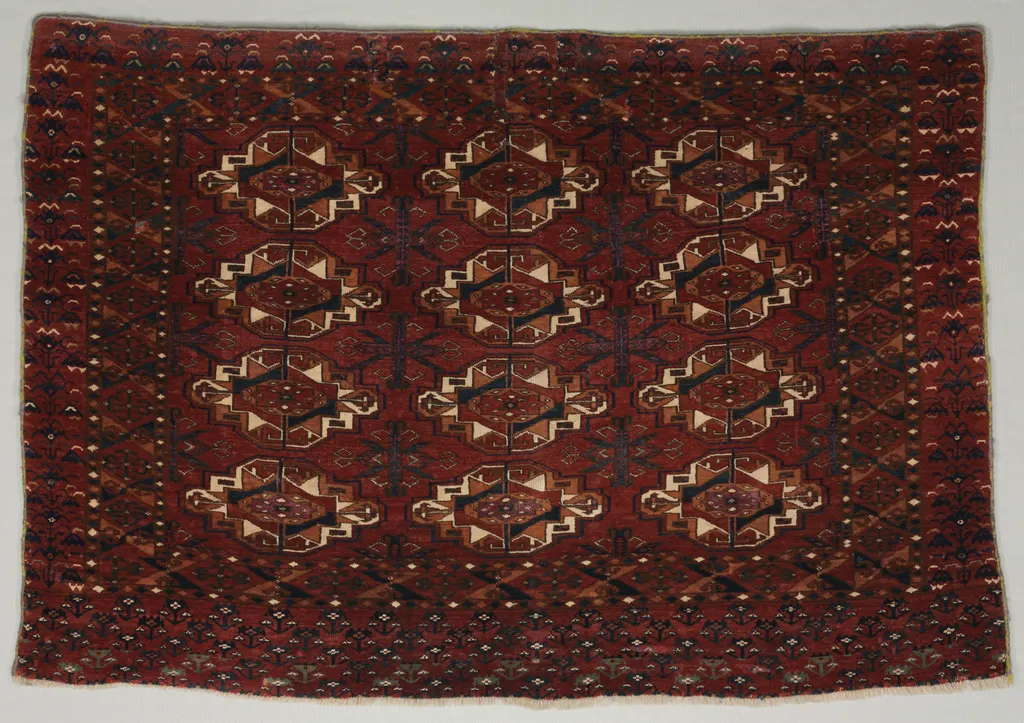
Turkmenistan, Saryk tribe of the Turkmen peopleTurkmen Bag Face, 1800sWool, silk, cotton; 252 symmetrical rug knots per square inchCleveland Museum of Art, collection record. CC0 1.0 (Public Domain)
Picture a heart-shaped plaque of silver about the size of a hand, its surface washed with gold, its centre set with a polished red carnelian and its lower edge fringed with small pendants. A Teke Turkmen woman would have worn something like it not on her chest but on her back, hanging from her braids so that it swung as she walked. The Metropolitan Museum of Art in New York catalogues one such piece, made in the mid to late nineteenth century, simply as a "cordiform pendant". To the women who wore these ornaments they were something more: wealth that could be carried, a sign of family and status, and a shield against misfortune.
Central Asian jewellery is full of shapes that look ancient: crescent moons, radiating suns, birds facing one another, horned animal heads, triangles stuffed with written prayers. It is tempting to read every one of them as a message from the deep past. This article looks at the main jewellery traditions of the region in the nineteenth and early twentieth centuries, the motifs that recur in them, and the archaeological finds that suggest some of these ideas are very old, while being honest about where evidence ends and interpretation begins.
A crossroads of metalwork
The lands between the Caspian Sea and the Pamirs, today Turkmenistan, Uzbekistan, Tajikistan and northern Afghanistan, sat on the overland routes linking China, India, Iran and the Mediterranean. Goldsmiths here absorbed ideas from all directions for more than two thousand years.
The most spectacular evidence came to light in 1978, when a Soviet–Afghan team led by the archaeologist Viktor Sarianidi excavated a group of burials at Tillya Tepe ("Golden Hill") near Sheberghan in northern Afghanistan. Six graves, five of women and one of a man, contained many thousands of gold ornaments dating to around the first century BC to the first century AD. Among them is a gold crown from the burial known as Tomb VI, built up from stylised trees on whose branches small birds perch. The hoard mixes Hellenistic figures, steppe animal styles, Indian and Chinese objects, and Iranian imagery, which is exactly why it is so often quoted in discussions of later Central Asian ornament. After years hidden in the vaults of the National Museum of Afghanistan in Kabul, the collection was confirmed intact in 2003 and has since toured internationally.
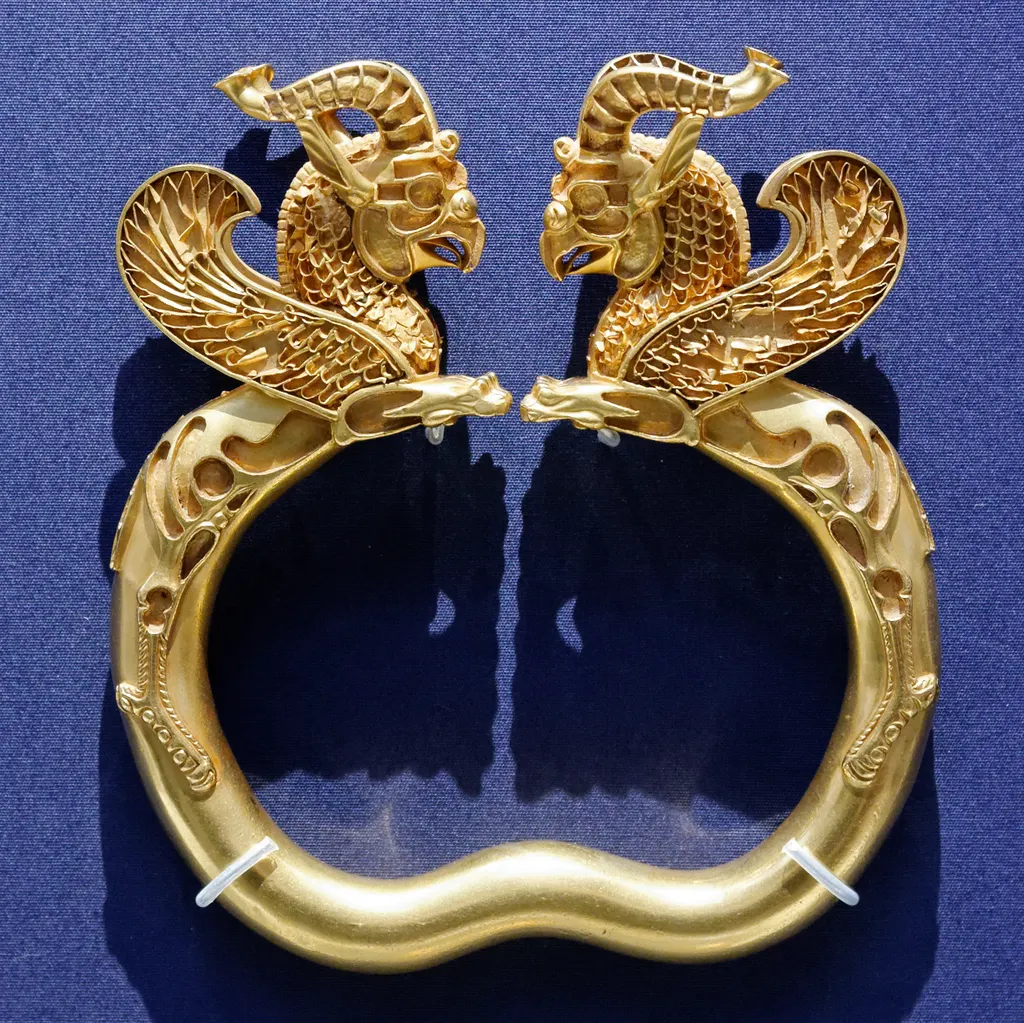
The gap between a first-century crown and a nineteenth-century Turkmen pendant is enormous, and no unbroken workshop tradition links them. What the early finds do show is that birds, trees, horned animals and celestial signs were already part of the visual language of the region's elites long before Islam arrived in the seventh and eighth centuries.
The main traditions at a glance
By the nineteenth century, when most surviving pieces were made, several distinct jewellery cultures existed side by side. Broadly, the semi-nomadic and settled Turkmen tribes favoured large silver ornaments, while the old cities of the Bukhara emirate and the Ferghana valley produced finer gold work.
| Tradition | Typical metal and stones | Characteristic forms |
|---|---|---|
| Turkmen (Teke, Yomut, Ersari and others) | Silver, often fire-gilded in patches; carnelian, glass, turquoise | Heart-shaped back pendants, large pectorals, triangular amulet holders, temple pendants, tall headdress plaques |
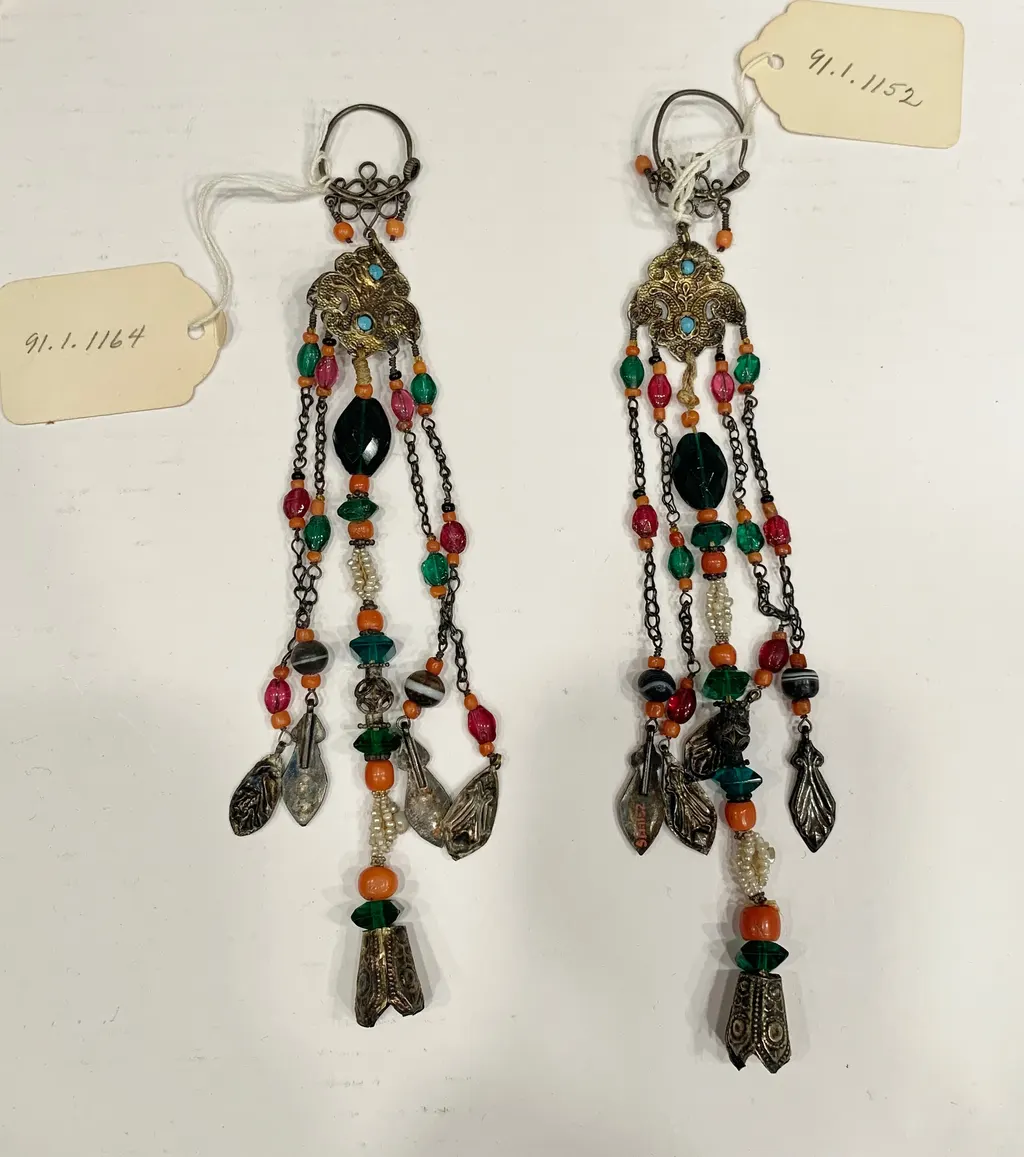
| Bukhara and Samarqand (urban) | Gold or gilt silver; turquoise, coral, pearls, glass | Forehead and head ornaments, plait ornaments, earrings, amulet cases |
| Tajik and mountain regions | Silver and gilt silver; coral, glass, beads | Necklaces, temple ornaments, amulets, chains of pendants |
Turkmen smiths often gilded selected areas of a silver ornament by fire-gilding, applying an amalgam of gold and mercury and then driving off the mercury with heat. Contrasting gilt and plain silver, punched and engraved patterns, and the warm red of carnelian give these pieces their unmistakable look. The Met's head ornament from Samarqand, made in the first half of the nineteenth century from gold leaf with turquoise, coral and glass, shows the very different, jewel-box brilliance of urban work.
Reading the symbols
Moon and sun
Crescents appear on temple pendants, forehead ornaments and the edges of pectorals. The crescent was a familiar Islamic emblem by the nineteenth century, but crescent and disc forms also occur in much earlier Central Asian and Iranian art. Round, radiating plaques are commonly described as solar. The safest way to put it is that celestial shapes carried associations with light, fertility and protection for many wearers, without assuming one fixed meaning across centuries and peoples.
Birds and trees
Paired birds, sometimes flanking a stylised tree or plant, are among the most widespread motifs in the region's jewellery and textiles. In the Tillya Tepe crown the birds sit on trees; in later silver they are often reduced to small cut or cast silhouettes at the edges of a plaque. Writers on the subject frequently link them with ideas of the soul, of the heavens, or of marriage and abundance. These readings are plausible and sometimes supported by folklore recorded in the nineteenth and twentieth centuries, but they are interpretations rather than labels the makers left behind.
Horns and ram's heads
Spiralling horn shapes and small ram's heads appear as terminals on amulet holders and bracelets. The Met records a Central Asian silver triangular amulet holder of the late nineteenth or early twentieth century finished with ram's-head terminals. In pastoral societies, the ram stood for strength and prosperity, and its horns are often read as protective.
Triangles and written prayers
The triangular amulet holder, known in many local languages by variants of the word tumar, is one of the most characteristic Central Asian ornaments. It was made to hold a folded paper bearing a prayer or Qur'anic verse, so that the wearer carried protective words against the body. Many examples, such as an early twentieth-century gilt silver holder from present-day Uzbekistan in the Met, have cylindrical tubes along the top and fringes of pendants below.
Look closer: Turn an amulet holder over or look at its sides. Many are true boxes, with a lid or opening at one end. Small bells and loose pendants are not only decorative: in several Central Asian traditions the sound of jewellery was itself believed to deter harm, and it also announced the wearer's presence.
Red stones and silver
Carnelian, the translucent red quartz so common in Turkmen work, was widely believed to protect health and to ward off misfortune, and silver itself carried protective associations. The Met's essay on Turkmen jewellery notes that the type and amount of jewellery a woman wore changed over her life: young women and brides wore the most, while older women gradually wore less.
Jewellery as a life story
A Turkmen bride could wear a remarkable weight of silver at her wedding: headdress plaques, temple pendants, a pectoral, bracelets, rings, and the heart-shaped pendant on her back. Much of this was her own portable property. In Bukhara and Samarqand, gold forehead ornaments and plait ornaments marked brides and married women on festive occasions. Seen this way, jewellery records a woman's progress from girlhood to marriage and motherhood, and its symbols of fertility, light and protection make particular sense.
Because so much of what we "know" about the meaning of these motifs comes from nineteenth- and twentieth-century ethnographers, and from later collectors and dealers, it is wise to separate three things when you read about them:
- What the object is: its form, materials, technique and, where known, its place and date of making.
- What its users said about it: meanings recorded from wearers, makers or communities, ideally with a date and place.
- What scholars propose: links to ancient art or mythology, which may be persuasive but remain hypotheses.
Collecting with care
Central Asian silver has been collected in Europe and North America since the late nineteenth century, and large numbers of pieces left the region in the twentieth. A few practical points help:
- Check construction. Older Turkmen pieces are usually built from sheet silver with soldered wire, punched decoration and set stones. Cast copies tend to have soft detail and uniform surfaces.
- Expect repairs. Jewellery that was worn daily has replaced stones, re-soldered loops and missing pendants. Honest wear is normal; heavy, shiny re-gilding is a warning sign.
- Ask about provenance. Archaeological gold such as that from Tillya Tepe belongs to national collections, and objects from recent conflict zones need particular care. Our guide to collecting art responsibly explains what to ask a seller.
- Compare with museum pieces. Open-access collections let you study well-documented examples before buying.
Where to see Central Asian jewellery
The Metropolitan Museum of Art holds an important group of Turkmen silver, much of it given by Marshall and Marilyn R. Wolf, as well as gold and gilt ornaments from Bukhara and Samarqand. The British Museum's Oxus Treasure shows Achaemenid-period gold from the region, and touring exhibitions of the Bactrian gold from Tillya Tepe have brought the crown from Tomb VI to audiences far from Kabul.
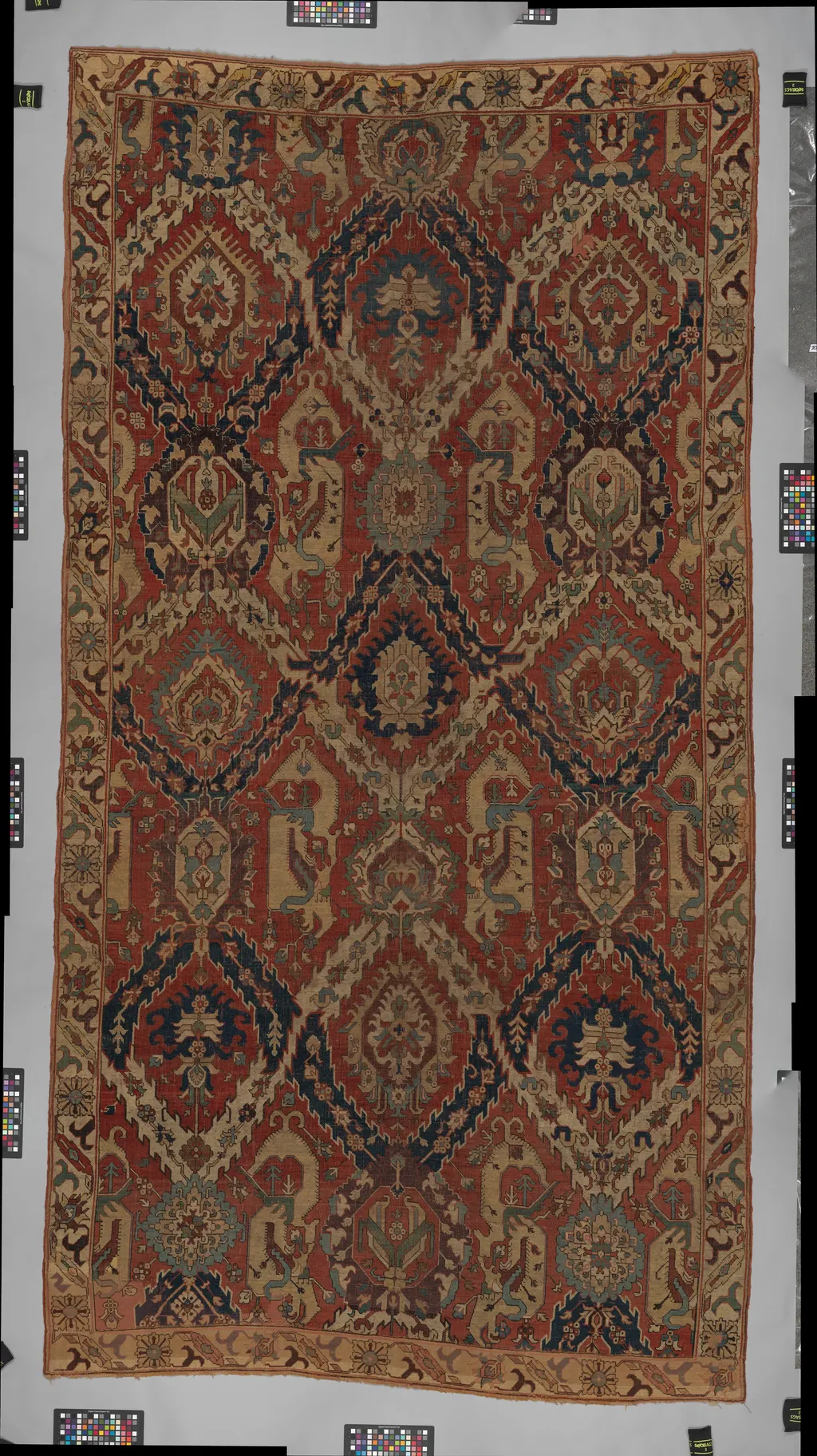
For a closer look at one city's goldsmiths, read our article on motifs in the work of Bukharan Jewish jewellers. Neighbouring traditions are explored in Tajik jewellery and silver wonders from the East, and the same patterns of birds, trees and protective devices reward attention in Central Asian and Persian rugs. More articles on ornament and craft are gathered under decorative arts.
Sources
- Turkmen Jewelry (Heilbrunn Timeline of Art History), The Metropolitan Museum of Art
- Cordiform Pendant, Teke, mid–late 19th century, The Metropolitan Museum of Art
- Triangular Amulet Holder, present-day Uzbekistan, late 19th–early 20th century, The Metropolitan Museum of Art
- Head Ornament, Samarqand, first half 19th century, The Metropolitan Museum of Art
- Ornament, one of a pair, Bukhara or Samarqand, first half 19th century, The Metropolitan Museum of Art