Heavenly Frogs: Motifs in the Work of Bukharan Jewish Jewellers
Frogs, moons and birds in the gold jewellery of Bukhara, the city's Jewish community, and how to read old jewellery symbols without over-reading them.
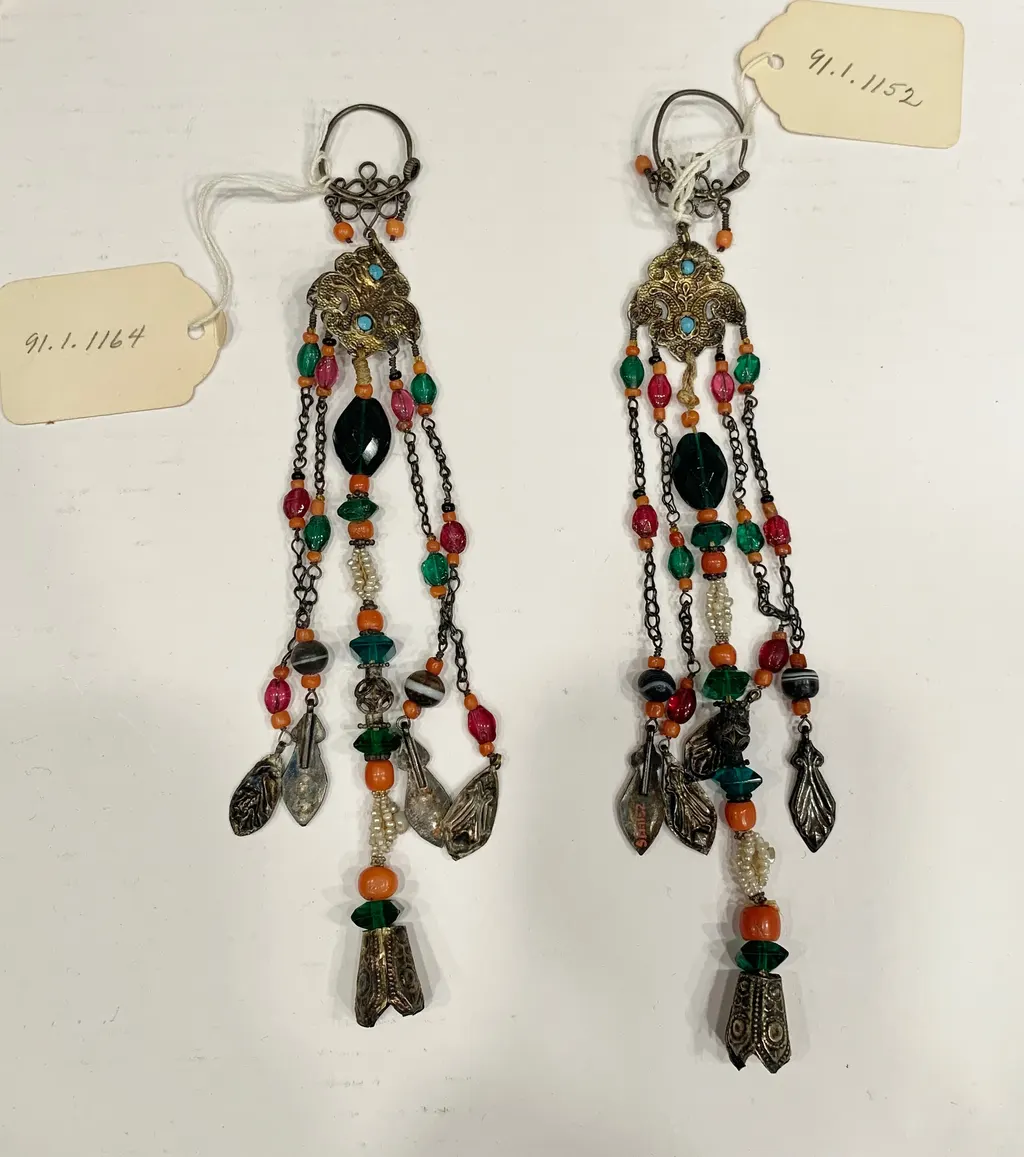
Unknown makerEarring, One of a Pair, 19th centurySilver, gold, coral, seed pearls, imitation stoneThe Metropolitan Museum of Art, collection record. CC0 1.0 (Public Domain)
Imagine a gold forehead ornament made in Bukhara in the nineteenth century, worn by a bride on her wedding day. Across its front, small turquoises and pearls glitter around cut-out shapes; at its centre and edges sit little creatures with splayed legs and flattened bodies. Some writers on Central Asian jewellery read these shapes as frogs, and link them with water, fertility and the moon. To a modern eye a frog may seem an odd thing to put on a bride's brow. In the long history of Eurasian ornament it is not odd at all.
This article looks at the jewellery of Bukhara, at the Jewish community that formed one of the city's oldest minorities, and at the frog as a symbol across the ancient world. It also asks a careful question: how far can we really know what a nineteenth-century jeweller, or the woman who wore his work, meant by a motif?
Bukhara, a city of craftsmen
Bukhara, in present-day Uzbekistan, was for centuries one of the great cities of Central Asia, a centre of trade, Islamic learning and fine craftsmanship. Under the emirs who ruled it until 1920, its bazaars were organised by trade, with goldsmiths, silversmiths, metal-chasers, weavers and dyers working in their own streets and covered markets. In Persian and Tajik, the language of the city, a goldsmith is a zargar, from zar, gold.
Bukharan jewellery of the nineteenth century, much of it worn by women on festive occasions, is quite different from the heavy silver of the neighbouring Turkmen. It favours gold or gilt silver, set with turquoise, coral, pearls and coloured glass, often with fringes of small pendants. Examples in the Metropolitan Museum of Art in New York include nineteenth-century earrings from Bukhara of silver and gold with coral, seed pearls and glass, and a gold-leaf head ornament from Samarqand set with turquoise, coral and glass.
The Jews of Bukhara
Bukharan Jews are one of the oldest Jewish communities of Central Asia, part of the wider family of Persian-speaking Jewry. They traditionally spoke a Jewish form of Tajik, known as Bukhori. From around the late sixteenth or early seventeenth century they lived in their own quarter, the mahalla, in the city of Bukhara.
Under the emirate they held the status of protected but subordinate non-Muslims and were subject to visible restrictions, including distinctive dress. Over many generations, Jewish families became closely associated with the region's textile trades, above all silk dyeing and weaving, and with commerce. After the Russian conquest of the region in the 1860s, many gained new freedom to trade and travel. In the later twentieth century, especially in the 1970s and after the break-up of the Soviet Union, most of the community emigrated, chiefly to Israel and the United States, where Queens in New York became a major centre.
Jewish and Muslim craftsmen worked in the same city, for overlapping clients, using the same materials and many of the same forms. Women of both communities wore similar types of jewellery on festive occasions. For that reason it is rarely possible to say from an unsigned piece alone whether it came from a Jewish or a Muslim workshop, and it is wise to be cautious when a dealer or catalogue makes that claim without documentation.
Why a frog?
The frog is one of the oldest animal symbols in the art of Eurasia and North Africa, and it gathers similar meanings in very different cultures.
- Water and rain. Frogs appear with the rains and live between water and land. In arid Central Asia, where life depended on irrigation, any creature associated with water carried weight.
- Birth and renewal. In ancient Egypt, the frog-headed goddess Heqet was linked with childbirth, and small frog amulets were widely worn. The Met holds several, including a New Kingdom example carved in serpentinite around 1300–1080 BCE.
- The moon. In Chinese tradition a toad or three-legged toad lives in the moon, linked with the legend of the moon goddess Chang'e. The frog's link with the night sky and the lunar cycle is one reason some writers speak of "heavenly" frogs.
Did Bukharan jewellers know any of this? Almost certainly not as a body of ancient mythology. What survives more often is a habit: a creature placed on an ornament because it has always been placed there, because it is believed to bring luck or children, and because the bride's mother wore one too. Meanings recorded by ethnographers in the nineteenth and twentieth centuries tend to be practical and protective rather than mythological.
Look closer: On a Bukharan ornament, check how an animal is made. Is it cut from sheet gold and soldered on, cast as a small separate piece, or simply implied by the outline of a setting? A frog "read" into the outline of a stone setting is a much weaker identification than one with clearly modelled legs and eyes.
Frogs among other creatures
A frog rarely appears alone. Bukharan and wider Central Asian ornaments combine it with:
| Motif | Commonly suggested associations | How it usually appears |
|---|---|---|
| Crescent moon | Light, protection, the feminine, fertility | Outline of temple pendants and forehead ornaments |
| Paired birds | Marriage, the soul, abundance | Small cut or cast silhouettes facing each other |
| Tree or plant | Life, growth, a family's continuity | Central stem with scrolling branches |
| Fish | Water, plenty, protection | Pendants and small hanging ornaments |
| Frog | Water, rain, birth, the moon | Small flattened creatures at the centre or ends of an ornament |
These associations come from a mixture of folklore, comparison with other cultures and modern interpretation. They are useful as a guide to looking, but they should not be presented as fixed meanings that every wearer would have recognised.
Reading symbols responsibly
A few principles help when you meet a confident claim about what a motif "means":
- Ask for a source. Is the meaning taken from a named community or recorded informant, from a historical text, or from a modern author's comparison?
- Check the date and place. A meaning documented in one valley in the 1920s may not apply to a city workshop a century earlier.
- Separate identification from interpretation. First establish what the shape is. Only then ask what it might signify.
- Allow for decoration. Craftsmen also repeated shapes because they were beautiful, saleable and familiar.
Where to see Bukharan jewellery
The Metropolitan Museum of Art has a fine group of nineteenth-century gold and silver ornaments from Bukhara and Samarqand, much of it from the Edward C. Moore collection bequeathed in 1891, all searchable online. Museums of Jewish life, notably the Israel Museum in Jerusalem, have shown Bukharan Jewish costume in exhibitions on Jewish dress, and Uzbekistan's own museums, including those in Bukhara's historic centre, hold the largest collections in the region.
For the broader picture of Central Asian ornament, from the ancient Bactrian gold of Tillya Tepe to Turkmen silver, read Central Asian jewellery and the symbols of the ancient world. Neighbouring traditions appear in Tajik jewellery and silver wonders from the East, and you will find more under decorative arts.
Sources
- Earring, one of a pair, Bukhara, 19th century, The Metropolitan Museum of Art
- Head Ornament, Samarqand, first half 19th century, The Metropolitan Museum of Art
- Earring, one of a pair, Bukhara, late 19th–early 20th century, The Metropolitan Museum of Art
- Frog amulet, Egypt, New Kingdom, c. 1300–1080 BCE, The Metropolitan Museum of Art
- BUKHARA vii. Bukharan Jews, Encyclopaedia Iranica