Silver Wonders from the East: Filigree and Peter the Great
Asian silver filigree dazzled European courts from the seventeenth century, yet most royal collections were melted down. Why Russia's survived.
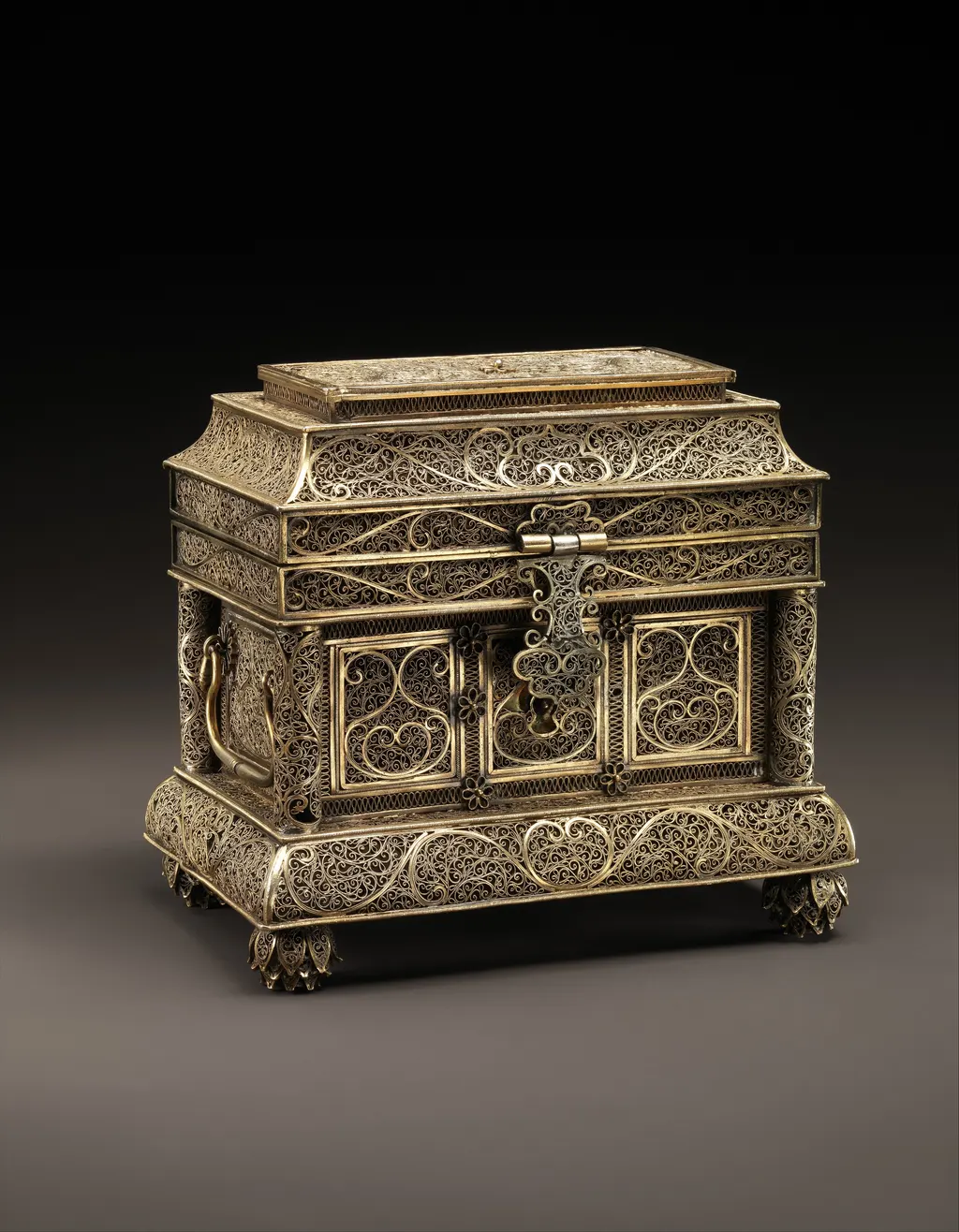
Unknown makerFiligree Casket with Sliding Top, 17th centurySilver filigree; parcel-giltThe Metropolitan Museum of Art, collection record. CC0 1.0 (Public Domain)
Imagine a dressing table laid out for an empress: a mirror, caskets, boxes, brushes and flasks, thirty-two pieces in all, every one built from silver wire so fine that the metal looks less like metal than like frost on a window. Here and there the silver is gilded; elsewhere it frames shimmering blue kingfisher feathers and mother-of-pearl. The set was made in China around 1740–1750 and belonged to Catherine the Great. It survives today in the State Hermitage Museum in St Petersburg.
Objects like this were once the delight of courts across Europe. Almost all of them have vanished. This article explains what filigree is, where the pieces that reached Europe were made, why so few survive, and how the Russian imperial collections, whose Asian holdings reach back to the reign of Peter the Great, came to preserve what elsewhere was lost.
What filigree is
The word comes from the Latin filum, thread, and granum, grain. Encyclopaedia Britannica defines filigree as a delicate, lacelike openwork of intertwined gold or silver wire, made by curling, twisting or plaiting fine threads of metal and soldering them where they touch.
The craft depends on the extraordinary ductility of pure silver and gold, which can be drawn through ever smaller holes in a draw-plate until it becomes a hair-thin wire. Goldsmiths then twist two or more wires together to create a beaded, rope-like strand, flatten it, and bend it into scrolls, spirals and petals. These small units are laid out within a framework of thicker wire and joined with solder, often with tiny grains of metal (granulation) added at the junctions.
The technique is ancient. Filigree and granulation were both used by goldsmiths of the ancient Mediterranean and western Asia, and filigree was practised in China from early times. What changed in the seventeenth century was scale and direction: workshops in Asia began producing filigree in quantity for a new, distant market.
From Asian workshops to European cabinets
Silver filigree began reaching Europe in significant numbers in the seventeenth century and the trade expanded in the eighteenth, carried by the European East India companies, above all the Dutch and the English. The objects were small, light and spectacular, which made them ideal cargo and ideal gifts.
Where exactly they were made is one of the field's most interesting problems. Broadly, three sources are usually proposed:
- China, where filigree was a long-established luxury craft and where export workshops made boxes, caskets, toilet sets and miniature furniture for foreign buyers.
- India, where filigree traditions remain alive today, with towns such as Karimnagar in Telangana still known for silver filigree.
- South-East Asia, especially the Dutch colonial city of Batavia (now Jakarta), where Chinese craftsmen worked in large numbers.
Attribution between these centres is often uncertain. Pieces made by Chinese silversmiths working in Batavia, for instance, may be almost indistinguishable from work made in China itself, and old inventories that describe an object as "Chinese" may simply mean "from the East". Specialists continue to debate the attribution of individual groups, and a cautious museum label will often say "China or Batavia" or "India or South-East Asia".
Not all filigree in old European collections is Asian. Filigree was also made in Europe, from Scandinavia to Italy and Portugal, and some pieces once catalogued as Eastern have since been reattributed to European workshops. Style, construction and the form of the object all have to be weighed together.
Why royal collections disappeared
If filigree was so prized, where did it all go? The answer lies in the nature of silver. Until modern times silver plate was a form of stored wealth as much as decoration. When a treasury needed money, it went to the mint.
The most famous example is France. Louis XIV had his spectacular silver furniture at Versailles melted down in 1689 to pay for war, and further plate went to the mint later in his reign. Other courts did the same in times of crisis. Delicate filigree, which could not easily be repaired and soon looked old-fashioned, was especially vulnerable. Fashions changed, inheritance divided collections, and objects were broken up for their metal.
Against that background, the tsarist filigree in the Hermitage stands out. It has been described as the only royal filigree collection to have survived more or less intact, and it formed the core of the 2006 exhibition and catalogue Silver Wonders from the East: Filigree of the Tsars, edited by the Hermitage curator Maria Menshikova.
Peter the Great and the East
Peter the Great (reigned 1682–1725) is remembered for his fascination with the Dutch Republic. On his Grand Embassy of 1697–98 he spent months in Amsterdam and Zaandam studying shipbuilding and visiting collectors' cabinets. In 1714 he founded the Kunstkamera in St Petersburg, Russia's first public museum, and in 1716 he bought material from the cabinet of the Amsterdam apothecary Albertus Seba.
Peter's reign also saw a remarkable exchange of gifts with Qing China. A study published in The Tretyakov Gallery Magazine traces objects associated with two Russian missions to the Kangxi emperor. The first, led by Fyodor Golovin between 1686 and 1690, negotiated the Treaty of Nerchinsk (1689), when Peter was still co-tsar. Among the gifts it brought back were two small gold cups with saucers, each set in an openwork frame of the finest filigree in the form of a six-petalled mallow flower. These cups are now in the Hermitage. Intriguingly, they appear to be older than the embassy itself, made in the late sixteenth or early seventeenth century, which suggests that the Chinese court presented heirlooms from its own stores. A second mission, under Lev Izmailov in 1719–21, may have brought mechanical toys now divided between the Hermitage and the Kunstkamera.
These pieces show that Asian goldsmiths' work, filigree included, was entering Russian imperial possession in Peter's lifetime. Much of the larger body of silver filigree now in the Hermitage, however, was acquired by his successors. Catherine the Great's toilet set, for example, dates from the 1740s, two decades after Peter's death. The tsarist collection is best understood as a cumulative achievement: begun in Peter's era of curiosity about the wider world, enlarged by later rulers, and preserved because Russian sovereigns, unusually, did not send it to the melting pot.
Looking at filigree: a short checklist
Whether you are in a museum gallery or examining a piece at a fair, these questions help:
- Structure. Look for a framework of thicker wire filled with finer twisted wire. Good early work is even and crisp, with neat solder joins.
- Colour. Is the silver gilded overall, or only in parts (parcel-gilt)? Is there enamel or are there feathers, as in Chinese kingfisher-feather work?
- Form. European forms such as caskets with hinged lids, toilet sets and tea caddies suggest objects made for export.
- Condition. Filigree is fragile. Repairs, crushed areas and replaced sections are common; they do not make a piece worthless, but they affect its integrity.
- Attribution. Treat firm statements such as "made in Canton for the Dutch market" with caution unless they rest on documentation.
For a wider introduction to judging objects of this kind, see Understanding the Decorative Arts. The parallel story of Central Asian goldsmiths is told in Central Asian Jewellery and the Symbols of the Ancient World and Tajik Jewellery: Gold, Silver and Symbol.
Where to see Eastern filigree
- The State Hermitage Museum, St Petersburg holds the tsarist collection, including Catherine the Great's Chinese toilet set and the gold filigree cups associated with the Golovin embassy.
- Major decorative-arts museums in Europe and North America hold individual export pieces; search their online catalogues for "filigree" together with "China", "India" or "Batavia".
- Dresden's Grünes Gewölbe and other surviving princely treasuries contain filigree that escaped the melting pot, and are worth visiting for comparison.
Browse more on silver, jewellery and ornament on our decorative arts topic page.
Sources
- filigree, Encyclopaedia Britannica
- On Certain Official Precious and Rare Gifts to the Russian Emperor Peter I from the Chinese Kangxi Emperor, The Tretyakov Gallery Magazine
- Toilet set of Catherine the Great, consisting of 32 objects, China, 1740–1750, State Hermitage Museum via Google Arts & Culture
- 17th–19th Century Silver Filigree from the Orient in the Collection of the State Hermitage, State Hermitage Museum