How to Read an Oriental Rug
A practical guide to hand-knotted rugs: warp, weft and knots, field and border, common motifs, dyes, and what the back of a rug reveals about its making.
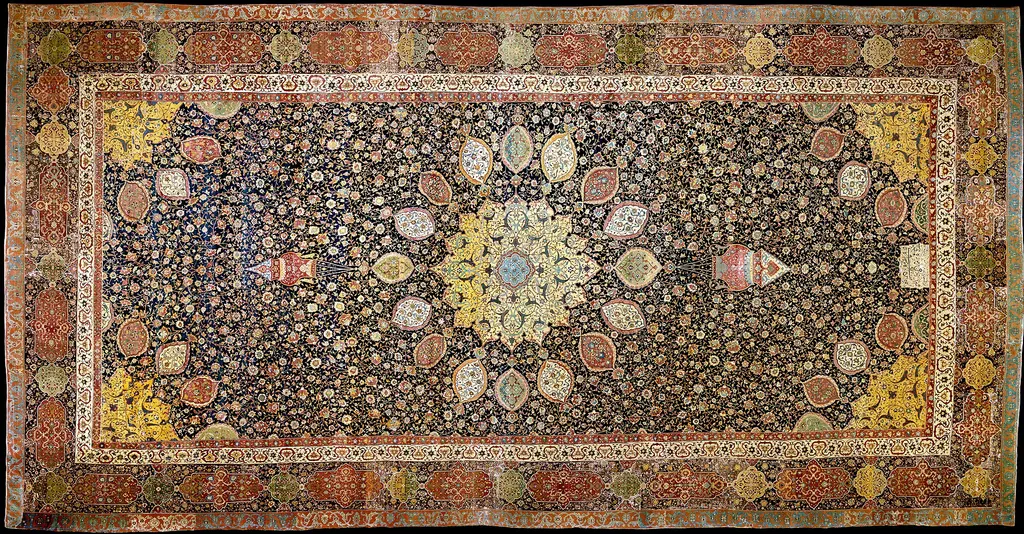
Unknown – productionThe Ardabil Carpet, (ca. 1539-1540 (made) - 1543)AAG4cbGKXbWxeA at Google Cultural Institute maximum zoom level (via Wikimedia Commons), collection record. Public domain
Along one edge of the Ardabil Carpet, in the Victoria and Albert Museum, runs a woven inscription. It contains a couplet of poetry, the name Maqsud Kashani, and a date: 946 in the Islamic calendar, which corresponds to 1539–40. The V&A believes Maqsud was probably the court official who oversaw the carpet's production for the Safavid dynastic shrine at Ardabil in north-west Iran. The carpet is one of the largest of its kind, with roughly 5,300 knots in every ten-centimetre square, each tied by hand.
Few rugs carry their own documentation, but every hand-knotted carpet records how it was made. Its structure, colours and designs can tell you whether it was woven in a city workshop or a village, how fine it is, roughly how old it might be and sometimes where it came from. This guide shows you how to read those clues, starting from the back.
A note on names: "Oriental rug" is a long-established trade term in Europe and North America for hand-knotted pile rugs from a vast region stretching from Anatolia and the Caucasus through Iran and Central Asia to India and China. Specialists today prefer to name the weaving culture or region (Persian, Anatolian, Caucasian, Turkmen and so on), and so do we where possible.
The anatomy of a rug: warp, weft and pile
A knotted-pile rug is built on a loom in three elements.
- Warps are the threads stretched lengthwise on the loom before weaving begins. At the ends of the finished rug they become the fringe. Fringes are not usually added decoration but the warp ends themselves.
- Wefts are threads passed across, over and under the warps, after each row of knots. They lock the knots in place and give the foundation its strength.
- Pile is formed by short lengths of yarn, usually wool and sometimes silk, knotted around pairs of warps. The weaver ties a knot, cuts the yarn, moves along the row, then beats the row down with a comb before adding wefts. The ends of the knots stand up to form the soft surface.
The sides of the rug are bound with selvedges (side finishes), often overcast with wool. Original selvedges and ends are worth checking: rugs are frequently trimmed, rebound or reduced in size during repairs.
Two kinds of knot
Most pile rugs use one of two knots, and identifying them is one of the first things a specialist does.
| Symmetrical knot | Asymmetrical knot | |
|---|---|---|
| Other names | Turkish, Ghiordes | Persian, Senneh |
| How it is tied | Yarn wraps both warps of a pair, and both ends emerge together between them | Yarn wraps one warp fully and passes under or around the other, so the ends emerge separately |
| Variants | Open to the left or to the right | |
| Where commonly found | Anatolia, the Caucasus, parts of Iran, Europe | Much of Iran, Mughal India, Egypt, some Turkmen groups |
The geographical names are traditional rather than reliable. Britannica notes that the symmetrical knot is used in Iran as well as Anatolia and the Caucasus, and the Encyclopaedia Iranica observes that Persian weavers themselves call that technique torkībāf. Knot type is evidence, not proof, of origin.
To see the knots, fold the rug back gently along a row so the pile parts, or look at the back with a magnifying glass. On the back, each knot appears as a small bump; the shape and spacing of those bumps, together with the colour of the foundation threads, tell an experienced eye a great deal.
Fineness and knot density
Knot density is usually expressed as knots per square inch or per square decimetre. Count the knots along one inch horizontally and one inch vertically on the back, then multiply the two numbers. The Ardabil Carpet's 5,300 knots per ten-centimetre square works out at roughly 340 knots per square inch, which is very fine.
Higher density allows more detailed, curvilinear drawing, which is why court and city workshop carpets often have intricate floral scrolls while many village and nomadic rugs favour bolder, geometric designs. But fineness is not the same as quality or beauty. A coarsely knotted village rug with superb wool and colour can be a far more distinguished object than a finely knotted commercial piece.
Reading the design
Most rugs are organised in the same basic way.
- The field is the central area. It may be covered with an all-over repeating pattern, or organised around one or more medallions.
- The medallion is a central motif, often lozenge-shaped or round, sometimes with pendants at top and bottom.
- The spandrels or corner pieces are quarter-sections of a design in the corners of the field, framing a medallion.
- The borders surround the field: usually a wide main border flanked by narrower guard stripes. Look at how the border pattern turns the corners. Planned, resolved corners suggest a workshop with drawn cartoons; improvised corners are common, and charming, in village weaving.
Motifs worth knowing
- Boteh: a teardrop or almond-shaped motif with a curled tip, the ancestor of the "paisley" pattern.
- Herati: a small lozenge surrounded by curving leaves, repeated across the field of many Persian rugs.
- Gul: the octagonal or lobed medallions repeated in rows across Turkmen rugs, often associated with particular tribal groups.
- Prayer niche (mihrab): an arch at one end of the field, found on rugs made for prayer.
Some carpet designs are named after the European painters who depicted them. The Met explains that the "Holbein" and "Lotto" carpets, both woven in Ottoman Anatolia, take their names from paintings by Hans Holbein the Younger and Lorenzo Lotto in which similar carpets appear. Carpets laid over tables are a familiar sight in seventeenth-century Dutch interiors too; our beginner's guide to Dutch Golden Age painting suggests what else to notice in those rooms.
Colour and dyes
Traditional dyes came from plants, insects and minerals: madder root for reds, indigo for blues, and various plants for yellows, often combined to make greens and oranges. Synthetic dyes, developed in Europe from the 1850s, spread into rug weaving during the later nineteenth century. Some early synthetic dyes faded or ran badly, which is one reason specialists examine colour carefully.
Look closer: Look for abrash, bands of slightly different shades of the same colour running across a rug. They occur when the weaver used wool from different dye batches. Abrash is common and often attractive in village rugs. Then part the pile and compare the colour at the tips with the colour at the base. A strong difference suggests fading, or sometimes chemical washing or painting to "age" the surface.
A checklist for the back of a rug
- Foundation: Are warps and wefts wool, cotton or silk? Cotton foundations are common in workshop rugs; wool foundations in many nomadic and village rugs.
- Knot type and density: Symmetrical or asymmetrical? How many knots per square inch?
- Clarity of design on the back: In hand-knotted rugs the pattern is clearly visible on the back. Machine-made rugs often show a rigidly uniform grid, and tufted rugs typically have a glued fabric backing.
- Selvedges and ends: Original or replaced? Has the rug been shortened?
- Repairs: Look for reknotting (patches of slightly different colour or texture), painted worn areas and patches sewn in from other rugs.
- Condition: Check for moth damage, especially under furniture, and for dry rot in the foundation, which can make a rug crack when folded.
Where to see great carpets
The V&A in London displays the Ardabil Carpet under carefully controlled light to protect its colours. The Met in New York has outstanding Anatolian, Persian and Mughal carpets in its Islamic art galleries. For the related traditions of the Caucasus, see our articles on Armenian rugs and attribution without inscriptions and on Kaitag embroideries of Daghestan. If you own a rug, our guide to caring for objects at home covers light, moths and cleaning. More textiles and furnishings are gathered under decorative arts.
Sources
- The Ardabil Carpet, Victoria and Albert Museum
- Islamic Carpets in European Paintings, The Metropolitan Museum of Art, Heilbrunn Timeline of Art History
- 'Lotto' Carpet, The Metropolitan Museum of Art
- Ghiordes knot, Encyclopaedia Britannica
- Carpets iii. Knotting techniques and weaving methods, Encyclopaedia Iranica