Dutch Golden Age Painting: A Beginner's Guide
Why the seventeenth-century Dutch Republic produced so many paintings, the genres it specialised in, the artists to know, and how to look at their work.
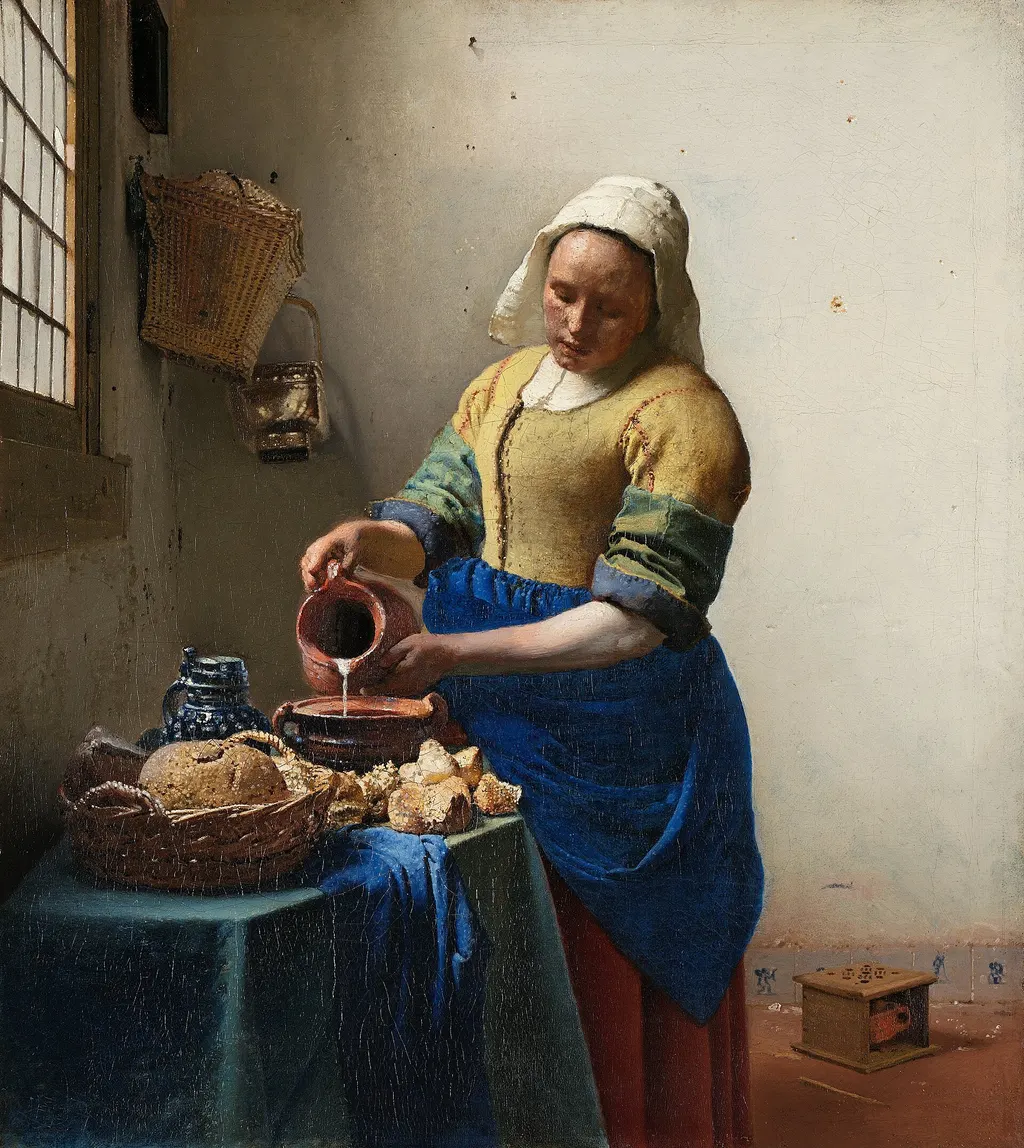
Johannes VermeerThe Milkmaid, circa 1660Wikimedia Commons, collection record. Public domain
A woman in a yellow bodice stands at a table by a window, pouring milk from an earthenware jug into a bowl. Bread lies broken beside her; a foot-warmer sits on the floor; the plastered wall behind her is marked with nail holes. Nothing happens, and yet Vermeer's The Milkmaid, painted around 1660 and now in the Rijksmuseum, holds visitors in front of it for minutes at a time. The thin white stream of milk is the only thing that moves.
That painting is a good doorway into one of the most productive episodes in the history of art. In the seventeenth century the young Dutch Republic, a small country of merchants, farmers and sailors, produced paintings in quantities that astonished foreign visitors, and in genres that the rest of Europe considered minor: landscapes, still lifes, scenes of everyday life. This guide explains why that happened, introduces the main types of painting and the artists to know, and suggests how to look at them.
A new country and a new market
The Dutch Republic emerged from the revolt of the northern Netherlands against Habsburg Spain, which began in the 1560s. The Union of Utrecht of 1579 bound the northern provinces together; independence was formally recognised by Spain in the Peace of Münster in 1648. In between, Amsterdam became the commercial hub of Europe, with ships trading from the Baltic to the East Indies.
Two features of this society shaped its art.
- No great church patron. The Reformed (Calvinist) Church, the Republic's public church, did not allow religious images in its buildings. The enormous altarpieces that Catholic churches commissioned in Flanders, Italy and Spain had no equivalent in Dutch churches.
- A broad, open market. Instead, paintings were bought by a wide range of private households, from wealthy merchants to more modest citizens. Artists often painted speculatively, without a commission, and sold through dealers, fairs, lotteries and their own studios.
Painters were organised in local Guilds of St Luke, which controlled training and sales in each city. To compete in a crowded market, many artists specialised in a single kind of subject, sometimes even a single type of landscape or still life, and cities developed their own specialities.
Why "Golden Age"? The term was coined later, and historians increasingly use it with care: the Republic's wealth was built partly on colonial trade and, in the Dutch Atlantic and East Indies, on enslaved labour. Many museums now use the more neutral "seventeenth-century Dutch painting" alongside or instead of it.
The genres
Art theorists of the time ranked subjects in a hierarchy: history painting (biblical, mythological and allegorical scenes) at the top, followed by portraiture, scenes of daily life, landscape and still life. Dutch painters did not reject this ranking, but the market pushed most of them towards the lower categories.
| Genre | What it shows | Artists to know |
|---|---|---|
| History painting | Biblical, mythological and historical stories | Rembrandt van Rijn, Hendrick ter Brugghen, Gerard van Honthorst |
| Portraiture | Individuals, married couples, families and civic groups | Frans Hals, Rembrandt, Bartholomeus van der Helst |
| Genre painting | Scenes of everyday life, indoors and out | Jan Steen, Pieter de Hooch, Gerard ter Borch, Johannes Vermeer, Judith Leyster |
| Landscape and seascape | Dunes, rivers, winter scenes, ships at sea | Jan van Goyen, Jacob van Ruisdael, Aelbert Cuyp, Willem van de Velde the Younger |
| Architectural painting | Church interiors and townscapes | Pieter Saenredam, Emanuel de Witte |
| Still life | Flowers, food, tableware, books and symbolic objects | Pieter Claesz, Willem Claesz Heda, Willem Kalf, Rachel Ruysch |
Portraits and civic pride
Portraiture was the most reliable source of income. Frans Hals in Haarlem was famous for loose, rapid brushwork that makes his sitters seem caught mid-laugh. Group portraits of civic guard companies and charitable boards were a Dutch speciality, and the most ambitious of all is Rembrandt's 1642 Militia Company of District II under the Command of Captain Frans Banninck Cocq, better known as The Night Watch. For more on this world, see Portrait Painters in Rembrandt's Amsterdam.
Everyday life
Genre painting ranges from Jan Steen's rowdy households, so chaotic that "a Jan Steen household" became a Dutch expression for a mess, to the hushed interiors of Pieter de Hooch and Vermeer in Delft. Judith Leyster, admitted to the Haarlem Guild of St Luke in 1633, painted lively scenes of musicians and children. Many of these pictures carry moral messages about temperance, love or domestic virtue, though how literally to read them is debated.
Landscape and the sea
Dutch landscape painters made the flat country and its enormous skies into serious art. In the 1620s and 1630s painters such as Jan van Goyen worked in a restrained, near-monochrome "tonal" manner focused on atmosphere. Later, Jacob van Ruisdael gave landscape a new grandeur: in The Windmill at Wijk bij Duurstede (c. 1668–70, Rijksmuseum) a mill rises against storm clouds over the river Lek. Marine painters recorded the ships on which the Republic's wealth depended. The same commercial culture fuelled a boom in mapmaking, described in our article on the golden age of Dutch cartography.
Still life
Still lifes ranged from modest "breakfast pieces" (ontbijtjes) of bread, herring and a glass of beer to lavish displays of silver, porcelain and exotic fruit, known as pronkstillevens ("ostentatious still lifes"). Flower pieces combined blooms from different seasons into bouquets that could never have existed at one moment. Our guide to reading the symbols in still life painting explains what skulls, watches and peeled lemons might mean.
The Italian connection
Not all Dutch painting was quiet and domestic. In Utrecht, a city with a strong Catholic presence, painters including Hendrick ter Brugghen, Gerard van Honthorst and Dirck van Baburen spent time in Rome in the early seventeenth century and brought back the dramatic lighting and life-size figures of Caravaggio. These "Utrecht Caravaggisti" painted biblical scenes and half-length musicians and drinkers lit by candlelight. Whether ter Brugghen returned to Italy later in life is explored in Did Hendrick ter Brugghen Return to Italy?
A short timeline
- 1579: The Union of Utrecht unites the northern provinces in their revolt against Spain.
- 1609–21: The Twelve Years' Truce with Spain brings a period of commercial expansion.
- 1620s–30s: Tonal landscapes in Haarlem; the Utrecht Caravaggisti at their height; Frans Hals's major group portraits.
- 1642: Rembrandt completes The Night Watch.
- 1648: The Peace of Münster confirms Dutch independence.
- 1654: A gunpowder magazine explodes in Delft, killing the painter Carel Fabritius, whose small Goldfinch of the same year is now in the Mauritshuis.
- c. 1660: Vermeer paints The Milkmaid; de Hooch is also working in Delft.
- 1672: The "Disaster Year" (Rampjaar), when France and its allies invade the Republic. The art market collapses and never fully recovers; this is often taken as the end of the great period.
How to look at a Dutch painting
Dutch paintings reward close, slow looking. Many are small, made to hang in a domestic room rather than a church or palace, so get closer than you would to a large altarpiece (while respecting the museum's barriers).
- Start with light. Find the window or light source. Notice how Vermeer and de Hooch let daylight fall across walls, floors and faces, and how Rembrandt pulls figures out of darkness.
- Look at surfaces. Dutch painters competed to render materials: the sheen of satin, the cold glint of a silver cup, the translucence of a glass of wine, the soft skin of a peach.
- Read the room. In interiors, maps, paintings within paintings, letters and musical instruments often hint at a story or a theme.
- Consider the message, cautiously. Some objects carried moral meanings for seventeenth-century viewers, but not every dog or broken pipe is a symbol. Scholars disagree about how much hidden meaning to read in.
- Check the label for the city. Knowing whether a painting was made in Haarlem, Leiden, Delft, Utrecht or Amsterdam tells you something about its likely style and market.
Look closer: In front of The Milkmaid or any reproduction of it, look at the bread on the table. Vermeer applied tiny dots of light-coloured paint to suggest light glinting off the crust. Then look at the wall behind the woman: the nail holes and patches of shadow are as carefully observed as her face.
Where to see Dutch Golden Age painting
The Rijksmuseum in Amsterdam has the richest collection anywhere, including The Night Watch and four paintings by Vermeer. The Mauritshuis in The Hague is small but exceptional, with Vermeer's View of Delft and Girl with a Pearl Earring and Fabritius's Goldfinch. The Frans Hals Museum in Haarlem holds the great civic guard portraits. Outside the Netherlands, the National Gallery in London, the Metropolitan Museum of Art in New York, the Louvre and the Gemäldegalerie in Berlin all have outstanding holdings. For one painter's circle in depth, read Vermeer and His Milieu, and for researching Dutch artists, the RKD in The Hague offers extensive free online records. More articles on the period are gathered under art history.