Reading the Symbols in Still Life Painting
What skulls, watches, flowers, lemons and luxury goods meant in European still life painting, and why scholars warn against reading every object as a code.
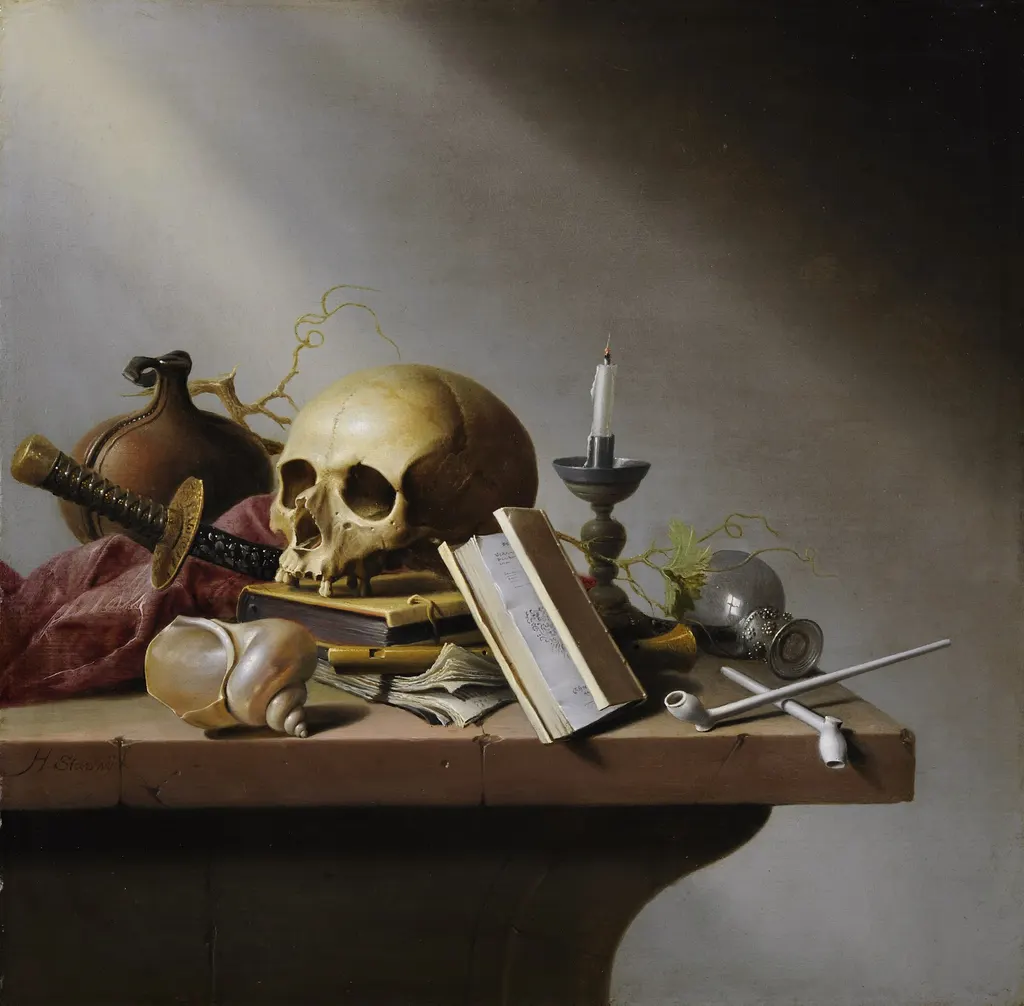
Harmen SteenwijckVanitas, circa 1640Not necessary, PD by age. (via Wikimedia Commons), collection record. Public domain
On a stone ledge, a skull rests on a book. Behind it, a lamp has just been snuffed out, a thread of smoke still curling from the wick. A pocket watch lies open, a shawm and a recorder beside an upturned lute, a Japanese sword, a seashell from distant waters. Harmen Steenwyck painted this small panel, Still Life: An Allegory of the Vanities of Human Life, in Leiden around 1640. It is now in the National Gallery in London, and its message would have been clear to anyone who knew their Bible: all of this (learning, music, wealth, travel) will pass.
Still life painting, which flourished across Europe from around 1600 and reached extraordinary heights in the Netherlands, can look at first like simple description: food, flowers and tableware arranged on a table. But many of these pictures were also designed to be read. This article explains the main families of still life symbols, what they probably meant to their first viewers, and why modern scholars urge caution before treating every lemon as a hidden sermon.
Vanitas: reminders of mortality
The most explicitly symbolic still lifes are vanitas paintings, named after the opening of the Book of Ecclesiastes in the Latin Bible: "Vanitas vanitatum", vanity of vanities, all is vanity. The genre was especially associated with the university town of Leiden in the first half of the seventeenth century, where painters such as David Bailly and Harmen Steenwyck worked.
| Object | Usual meaning |
|---|---|
| Skull | Death, the inevitable end of every life (memento mori: remember you must die) |
| Hourglass, watch or clock | Time running out |
| Candle or lamp, especially snuffed | Life extinguished |
| Soap bubbles | The fragility and brevity of life |
| Books, globes, scientific instruments | The limits of human learning |
| Musical instruments | Fleeting pleasures of the senses; music fades as soon as it is played |
| Jewellery, coins, shells, rare goods | Worldly wealth that cannot be taken beyond death |
| Wilting flowers, overripe fruit | Decay and the passing of beauty |
In Steenwyck's painting, the National Gallery notes that X-rays reveal he originally included a wreathed bust, probably of a Roman emperor, then painted it out: a symbol of earthly power that he decided to remove.
Look closer: Vanitas paintings often contain a reflective surface: a glass, a silver ewer, a polished globe. Look carefully at the highlights. Some painters, Clara Peeters among them, painted tiny reflections of themselves at work, a reminder that the artist, too, belongs to the passing world.
Flowers: beauty that cannot last
Flower paintings were among the most expensive still lifes, and they were rarely painted from a single bouquet. Painters such as Ambrosius Bosschaert the Elder, Jan Davidsz de Heem and, later, Rachel Ruysch assembled flowers that bloom months apart, working from studies of individual blooms. The result was a display no garden could produce at one moment: an encyclopedia of nature as well as a decoration.
Flowers could carry several meanings at once:
- Transience: a drooping stem, fallen petals or a bloom past its best recall that beauty fades.
- Value: rare varieties, especially striped tulips, were costly luxuries. Speculation in tulip bulbs reached a famous peak and crash in the Dutch Republic in 1636–37.
- Religious associations: the white lily traditionally stands for purity and the Virgin Mary; the rose has associations with both Mary and love.
- Small creatures: butterflies, caterpillars, snails, flies and dragonflies show off the painter's skill. A butterfly could suggest the soul or resurrection; a fly or snail, decay. Painters also simply enjoyed showing the variety of creation.
Food and drink: plenty, temperance and faith
Dutch painters distinguished between simple "breakfast pieces" (ontbijtjes), with bread, cheese, herring and a glass of beer, and grander "banquet pieces" (banketjes) laden with pies, oysters, silver and imported goods. In Haarlem in the 1620s and 1630s, Pieter Claesz and Willem Claesz Heda developed a restrained, near-monochrome style in which pewter, glass and linen are rendered in subtle greys and browns.
Common motifs and their possible meanings:
- Bread and wine: in a Christian culture, these inevitably recall the Eucharist, though in a simple breakfast piece they may also just be bread and wine.
- The peeled lemon: a lemon with its peel spiralling down from the table edge is a virtuoso display of texture. It is sometimes read as a warning that something attractive outside may be bitter within.
- Oysters: a luxury food, often read as an allusion to sensual pleasure.
- Toppled glasses and half-eaten food: excess, disorder or the interruption of pleasure.
- Salt, pepper and spices: costly imports that point to the Republic's global trade.
That last point has become central to how museums now present these pictures. The Rijksmuseum's Still Life with a Turkey Pie by Pieter Claesz (1627) includes oysters from Zeeland, Chinese porcelain, a nautilus shell from the Pacific and Indian pepper, and the museum notes that the nutmeg in such a pie was grown in the Moluccas by enslaved people. A table of delicacies is also a map of colonial trade.
Luxury and display
Later in the century, Amsterdam painters such as Willem Kalf specialised in sumptuous pronkstillevens ("ostentatious still lifes"): Chinese porcelain bowls, Venetian-style glass, gilded silver, Turkish carpets, a half-peeled orange. These paintings celebrate wealth and craftsmanship even as they may hint, gently, at its vanity. The tension is part of their appeal: the viewer can admire the luxury and feel virtuous for recognising its emptiness at the same time.
Beyond the Netherlands
Still life symbolism was not only Dutch. In Spain, the bodegón tradition produced some of the most austere still lifes ever painted. Juan Sánchez Cotán's Quince, Cabbage, Melon and Cucumber (c. 1602, San Diego Museum of Art) sets four everyday foods on a window ledge against a black void. Cotán joined the Carthusian order, known for its strict fasting, shortly afterwards, and the painting is often read in that light, though it was made before he took his vows. In Flanders, earlier sixteenth-century painters such as Pieter Aertsen set religious scenes in the background of overflowing market and kitchen pictures, inviting viewers to weigh worldly abundance against spiritual matters; see our article on Pieter Aertsen.
A word of caution: when a lemon is just a lemon
In the 1960s and 1970s, scholars led by the Dutch art historian Eddy de Jongh showed how often Dutch paintings drew on emblem books, illustrated volumes that paired images with moralising verses. This "iconographic" approach revealed genuine layers of meaning, but it also encouraged a hunt for symbols in everything.
In 1983 the American art historian Svetlana Alpers argued in The Art of Describing that Dutch painting was fundamentally about observing and recording the visible world, not encoding texts. Most scholars today take a middle position:
- Some still lifes are explicitly symbolic. A skull beside a snuffed candle and an hourglass is a vanitas by design.
- Many objects could carry meaning without having to. A viewer might see a moral in a peeled lemon, or simply enjoy the painter's skill.
- Context matters. The painter's city, the date, the market and any inscription help determine how likely a symbolic reading is.
- Pleasure was part of the point. These paintings were bought to give delight as well as instruction, and seventeenth-century writers praised still lifes for their convincing illusion.
Try this. Next time you stand in front of a still life, first describe everything you see without interpreting it. Only then ask which objects might carry meaning, and whether the painting as a whole points in one direction (towards death, plenty, luxury or faith) or simply celebrates the look and feel of things.
A checklist for reading a still life
- Is there a skull, timepiece or extinguished light? If so, read the painting as a vanitas first.
- Are flowers from different seasons combined? Then the bouquet is an imagined display, not a record.
- Which objects are imported or rare? They speak of wealth and trade, and sometimes of exploitation.
- Is anything broken, toppled, decaying or half-eaten? Disorder often signals transience or excess.
- Are there reflections? Look for the painter, the window or the room mirrored in glass or metal.
- Is there an inscription? Latin mottoes or biblical texts settle the question of meaning.
- What is the painter showing off? Sometimes the real subject is the challenge of painting glass, silver, fur or fruit.
For one of the pioneering women of the genre, read A Hidden Marriage: Clara Peeters and the Early Still Life. The broader context is covered in Dutch Golden Age Painting: A Beginner's Guide, and a general method for looking at older pictures in How to Appreciate a Historical Painting. More guides to looking at art are collected under art appreciation.
Sources
- Still Life: An Allegory of the Vanities of Human Life, Harmen Steenwyck, about 1640, The National Gallery, London
- Still Life with a Turkey Pie, Pieter Claesz, 1627, Rijksmuseum
- Still Life with a Gilt Cup, Willem Claesz Heda, 1635, Rijksmuseum