Teaching Art Appreciation at Home
A practical approach to talking about art at home: proven questioning routines, picture-of-the-week habits, comparisons and hands-on responses for all ages.
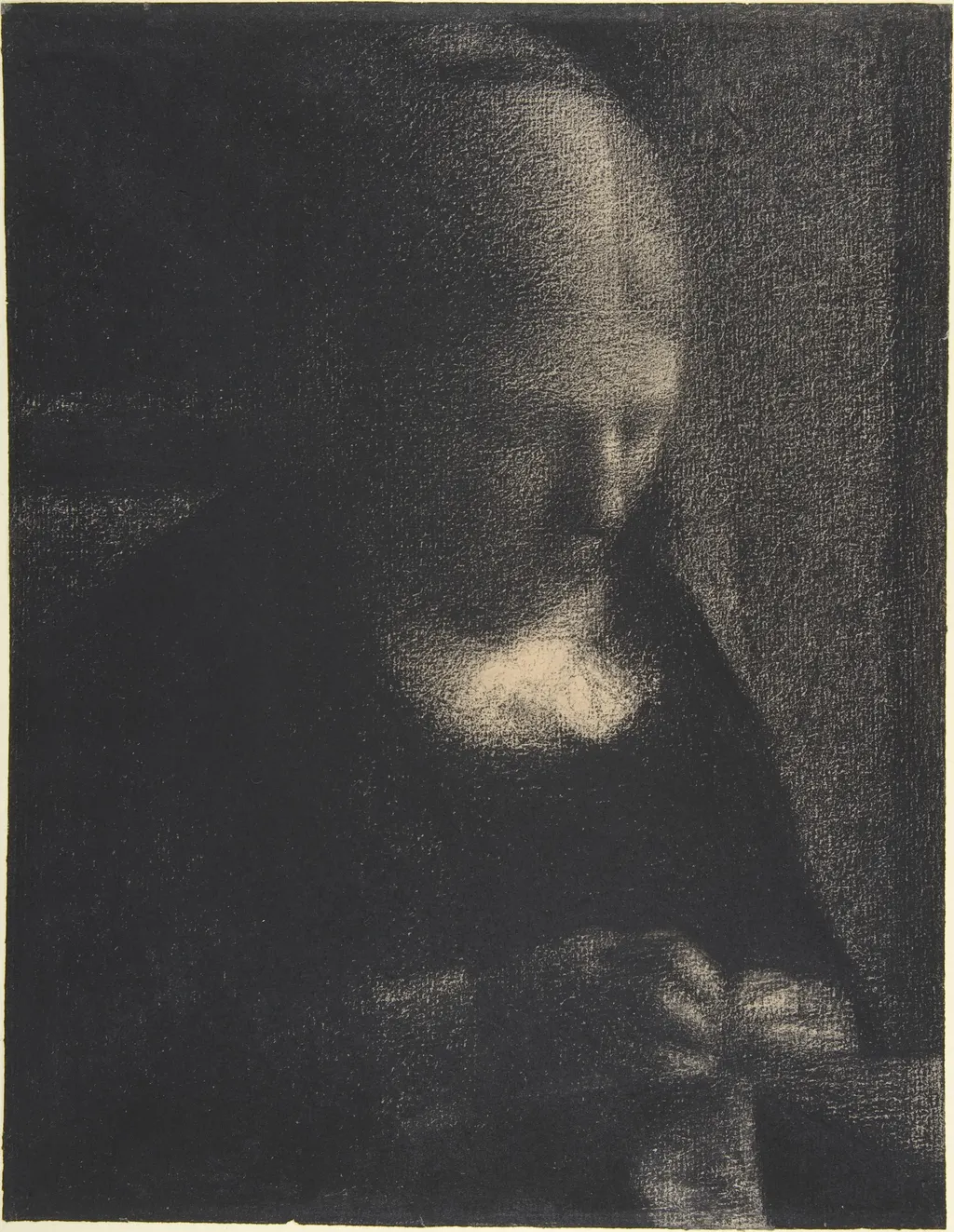
Georges SeuratEmbroidery; The Artist's Mother, 1882–83Conté crayonThe Metropolitan Museum of Art, collection record. CC0 1.0 (Public Domain)
Prop a postcard of Katsushika Hokusai's Under the Wave off Kanagawa, the print usually called The Great Wave, against the fruit bowl on a Monday morning and say nothing. By Wednesday someone will have asked why the mountain is so small. By Friday someone will have noticed the boats, and the rowers clinging on beneath the claw-like foam. Nobody needed a lecture; the picture did the asking.
Art appreciation is often imagined as a body of knowledge: names, dates, movements. Those things matter, but the foundation is a habit of attentive, curious looking, and that habit is best built at home, in small, regular doses, through conversation rather than instruction. You do not need a background in art history to do it well. You need good pictures, good questions and a little patience.
This article sets out two well-tested questioning methods, a simple weekly routine, ideas for comparisons and hands-on responses, and some common pitfalls.
Start with looking, not knowing
The most important shift is to put observation before information. When an adult opens with "This is a Vermeer, painted in Delft in the seventeenth century", the conversation tends to stop: the answer has been given. When the adult opens with "What do you notice?", the conversation begins, and facts introduced later attach themselves to something the child has already seen.
This does not mean facts are unimportant. It means their timing matters. Information lands best when it answers a question someone is actually asking.
Two routines that work
Visual Thinking Strategies
Visual Thinking Strategies (VTS), developed by the cognitive psychologist Abigail Housen and the museum educator Philip Yenawine, formerly director of education at the Museum of Modern Art in New York, is built on three open questions:
- What's going on in this picture?
- What do you see that makes you say that?
- What more can we find?
The second question is the engine. It asks the speaker to point to evidence, which turns opinions into observations and keeps the conversation tied to the image. The facilitator's role is to listen, paraphrase what each person says (often pointing to the area they mention) and link different contributions, without correcting or supplying answers.
See, Think, Wonder
Harvard's Project Zero offers a similar routine, used in classrooms and museums around the world:
- What do you see?
- What do you think about that?
- What does it make you wonder?
The "wonder" stage is especially valuable at home, because it legitimises questions nobody can answer immediately ("Why is the woman pouring so slowly?"). Those unanswered questions are good reasons to look things up together later.
Both routines work with any image: a painting, a photograph, a sculpture, a teapot, an antique map. Project Zero suggests using the same routine repeatedly with different objects rather than changing the method every time; familiarity frees everyone to concentrate on looking.
A picture-of-the-week routine
Consistency matters more than length. A simple weekly rhythm might look like this:
| Day | Activity | Time |
|---|---|---|
| Monday | Put up a new image (postcard, print-out or screen) in a shared space without comment. | 1 minute |
| Midweek | A short VTS or See-Think-Wonder conversation, ideally at a meal. | 10 minutes |
| Weekend | Find out one or two facts together: who made it, when, where it is now. Look at the museum's own object page. | 10–15 minutes |
| Weekend | Optional response: a drawing, a story, a model, a playlist. | As long as it lasts |
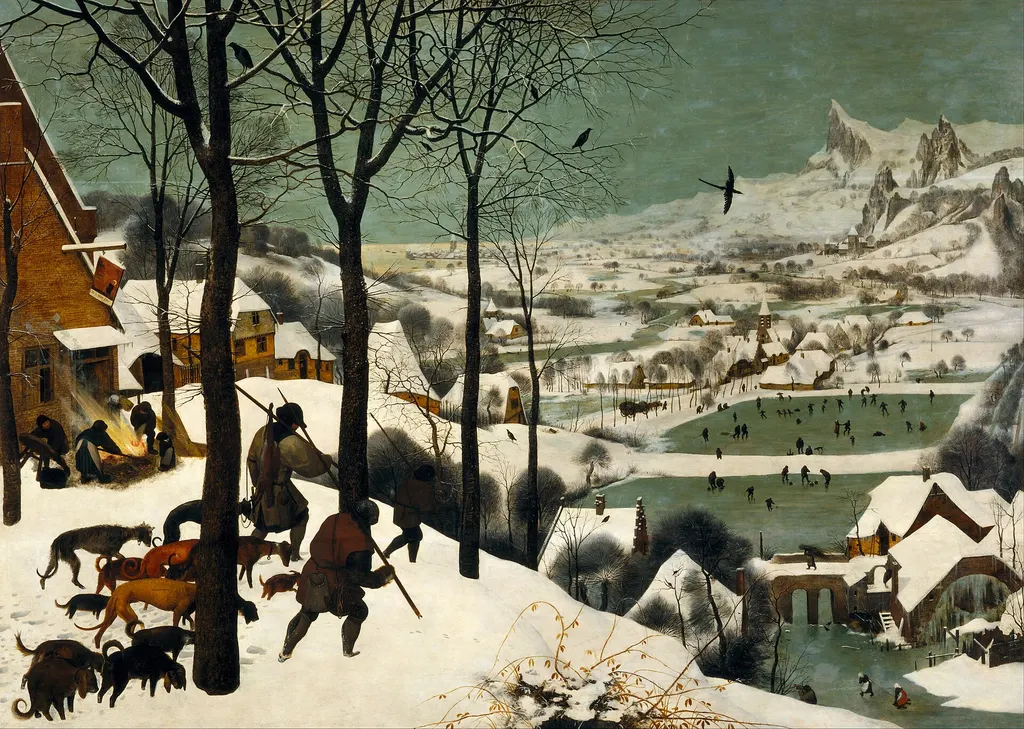
Choose images that are rich in detail and open to interpretation. Pieter Bruegel the Elder's Hunters in the Snow (1565, Kunsthistorisches Museum, Vienna) is ideal: a hunting party returns with a single fox hanging from a spear, dogs trailing, while skaters play on frozen ponds far below. Johannes Vermeer's The Milkmaid (Rijksmuseum, Amsterdam) rewards slower attention: the thin stream of milk, the bread, the foot warmer on the floor, the tiles along the skirting. Free high-resolution images of works like these are easy to find; see our guide to open-access museum collections.
Conversation starters beyond "Do you like it?"
"Do you like it?" is a fine question, but it closes quickly. These prompts open up specific aspects of a work.
- Composition: Where did your eye go first? Where does it go next? What is in the middle, and what is pushed to the edges?
- Colour and light: Where is the brightest spot? Which colour appears most often? What would change if the sky were a different colour?
- Story: What happened just before this moment? What happens next? Who is in charge here?
- People: Where are they looking? What might they be saying or thinking? Who is left out?
- Materials: What is it made of? How big do you think it is in real life? (Then check, because scale often surprises.)
- Time and place: What clues tell us when or where this was made: clothes, buildings, tools, food?
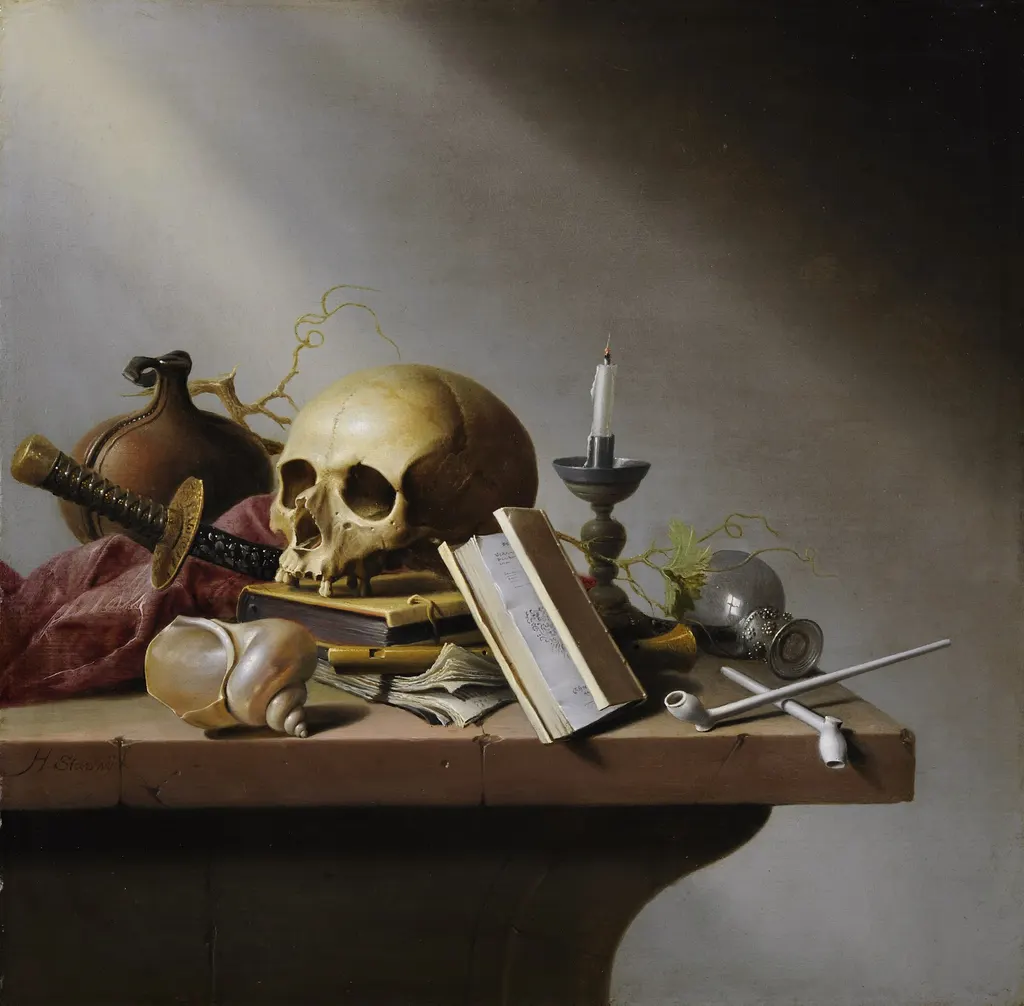
Older children and teenagers can move towards interpretation: symbols, patrons, purposes. Our guides to how to appreciate a historical painting and reading the symbols in still life painting give adults the background to support those conversations.
Comparisons sharpen the eye
Putting two images side by side makes differences visible that a single image hides. Some productive pairings:
- Two waves. Hokusai's Great Wave (c. 1830–32), a colour woodblock print from his series Thirty-six Views of Mount Fuji, and a stormy seascape by J. M. W. Turner. One uses crisp outlines and flat colour; the other dissolves the sea into brushwork. Which feels more dangerous, and why?
- Two kitchens. A Dutch seventeenth-century kitchen scene and a modern photograph of a kitchen. What has changed, and what has not?
- Two portraits of the same person by different artists, or a painted portrait and a photograph.
- Object and image. A real teapot or jug from your cupboard next to a still life in which a similar vessel appears.
Look closer: With any comparison, ask everyone to name three similarities before naming any differences. It slows the conversation down and almost always produces more interesting observations.
Responding with hands, words and bodies
Making something in response to a work deepens attention and gives less talkative children another way in.
- Draw a detail. Choose one small part of the picture and draw it large.
- Change one thing. Redraw the scene at night, in summer, or from the point of view of the dog.
- Write a label or a postcard. Imagine you are a figure in the painting writing home.
- Pose it. Recreate the composition with family members and photograph it.
- Build it. Make a cardboard model of a painted room, which quickly reveals how the artist handled space.
A dedicated corner with paper, pencils and a few good materials makes these responses easy to start; our guide to creating a home art space for children covers practical set-ups and safe, non-toxic materials.
Pitfalls to avoid
- Quizzing. Constant questions with right answers ("Who painted this?") turn looking into a test. Save factual questions for when curiosity is already running.
- Over-explaining. Adults often fill silences too quickly. Wait. A pause of ten seconds frequently produces the best observation.
- Only famous works. Masterpieces are wonderful, but so are anonymous textiles, everyday ceramics, maps, coins and posters. Variety keeps interest alive.
- Judging taste. It is fine for a child to dislike a celebrated painting. Ask what they would change; that is appreciation too.
- Doing too much at once. One image, well looked at, beats ten flicked through.
Taking it further
As habits form, you can begin connecting pictures into a larger story: who came before whom, how styles changed, why certain subjects were popular. How to introduce children to art history suggests ways to build that framework without overwhelming younger learners, and a museum visit becomes much richer when children arrive already knowing two or three works they want to see in person.
A starter kit
- A small stack of postcards or printed images, changed weekly
- A visible place to display them
- The three VTS questions written on a card
- Paper, pencils and a notebook for "wonder" questions
- Bookmarks to two or three museum collection websites
Sources
- See, Think, Wonder (thinking routine), Project Zero, Harvard Graduate School of Education
- Visual Thinking Strategies, Visual Thinking Strategies
- Hunters in the Snow (Winter), Pieter Bruegel the Elder, Kunsthistorisches Museum Vienna
- Under the Wave off Kanagawa (Kanagawa oki nami ura), Katsushika Hokusai, The Metropolitan Museum of Art