Open-Access Museum Collections: A Practical Guide
Where to find free, high-resolution images of artworks, what CC0 and other licences allow, and how to search, credit and use museum images well.
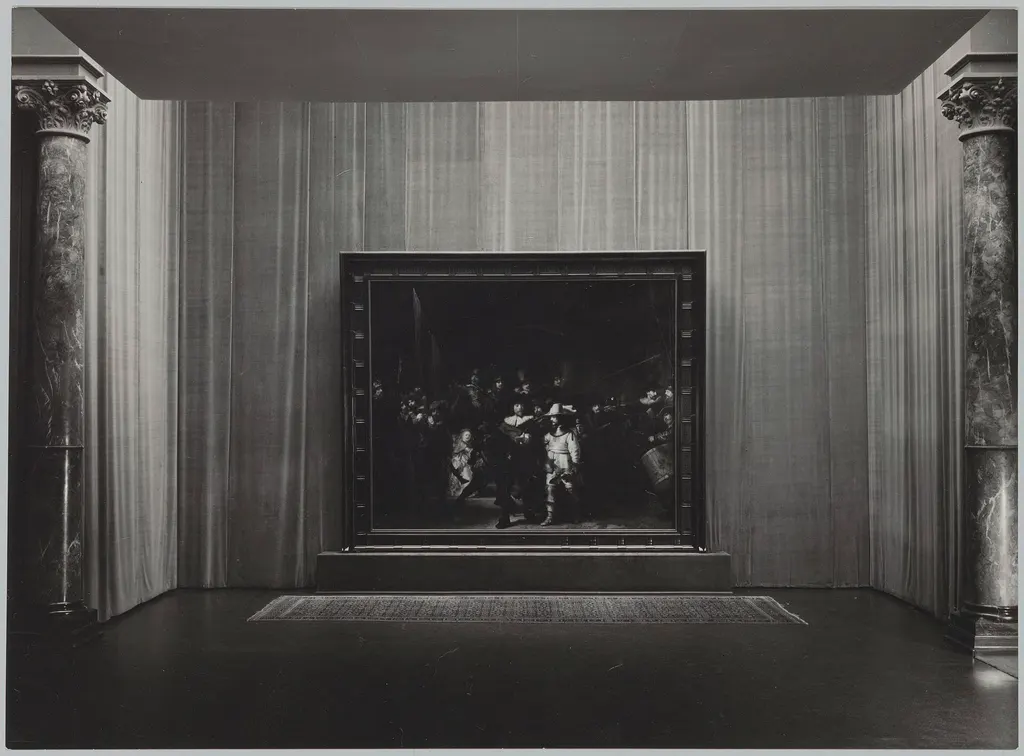
Unknown authorUnknown authorThe Night Watch in Cuypers frame again, 1956, 1956-01-01Wikimedia Commons, collection record. CC0 1.0 (Public Domain)
Open Johannes Vermeer's The Milkmaid on the Rijksmuseum's website and zoom in. Within seconds you are closer than any guard would let you stand: you can see the tiny dots of light on the crust of the bread, the nail and its shadow on the whitewashed wall, the cracks in the paint. Then press "download". The image is yours, free, to print, to study, to put in a school worksheet or even on a T-shirt.
That last part still surprises people. Over the past fifteen years, many of the world's great museums have released images of public-domain works under open licences, allowing anyone to reuse them for any purpose without asking permission or paying a fee. The result is an extraordinary public resource, but one that is unevenly organised and surrounded by confusing terminology.
This guide explains what open access means, which collections are most useful, how to search them efficiently and how to use images responsibly.
What "open access" actually means
When a museum says its images are open access, it usually means three things:
- The artwork itself is in the public domain, because its copyright has expired or it was never protected. In the United Kingdom and the European Union, copyright in an artwork generally lasts for the creator's lifetime plus seventy years, so an old master painting is long out of copyright, while a work by a twentieth-century artist may not be.
- The museum does not claim copyright in its photograph of the work, or waives any such rights. In the EU, Article 14 of the 2019 Directive on Copyright in the Digital Single Market provides that faithful reproductions of public-domain visual art should not themselves attract new copyright, although rules differ elsewhere.
- The museum makes a good-quality file available, with clear labelling of its licence.
The most generous licence is CC0 (Creative Commons Zero), a public-domain dedication that waives all rights to the extent the law allows. CC0 images can be used commercially, altered and published without attribution, although museums ask, as a courtesy, to be credited. Other museums use licences with conditions, such as CC BY (credit required) or CC BY-NC-SA (credit required, non-commercial use only, and adaptations shared under the same terms).
The major open-access collections
The following museums have particularly large or well-organised open-access programmes. Numbers change constantly as more objects are photographed, so treat the figures as indicative.
| Museum | Launched | Licence | Notes |
|---|---|---|---|
| Rijksmuseum, Amsterdam | 2012 (Rijksstudio) | Public domain / CC0 | Offered 125,000 high-resolution images free at launch; its Collection Online, launched in November 2024, gives access to around 800,000 artworks. Superb for Dutch Golden Age painting, prints and decorative arts. |
| National Gallery of Art, Washington | 2012 | CC0 | More than 20,000 images at launch, now tens of thousands; asks for the credit "Courtesy National Gallery of Art, Washington". |
| Metropolitan Museum of Art, New York | 2017 | CC0 | Over 375,000 images at launch; the Met now lists more than 490,000 open-access works. Look for the "Open Access" filter in the online collection. |
| Cleveland Museum of Art | 2019 | CC0 | Around 30,000 images released in January 2019, with data available through a public API. |
| Smithsonian Institution | 2020 | CC0 | About 2.8 million two- and three-dimensional images across its museums, archives and libraries at launch. |
| British Museum, London | Collection online revamped 2020 | CC BY-NC-SA 4.0 | Around 1.9 million images; free for non-commercial use with the credit "© The Trustees of the British Museum". |
Many others deserve a look, including the Art Institute of Chicago (which offers more than 50,000 public-domain images under CC0), the Statens Museum for Kunst in Copenhagen, the Nationalmuseum in Stockholm, Paris Musées, and numerous university museums. Aggregators such as Europeana and Wikimedia Commons gather images from hundreds of institutions, though the rights information there should always be checked against the original museum page. For a broader list of reference sites, see Artwis's curated directory of art and antiques resources.
How to search efficiently
Museum websites are designed for very different audiences, and their search tools vary widely. A few tactics help across the board:
- Use the open-access or public-domain filter. Most open-access collections let you restrict results to downloadable images. Without the filter you will waste time on objects with no usable image.
- Search the maker's name in the museum's preferred form. A Dutch museum may list "Rembrandt van Rijn", an American one "Rembrandt (Rembrandt van Rijn)". If a search fails, try the surname alone.
- Search by object type and material. Terms such as "maiolica dish", "pendulum clock", "celestial globe" or "lacquer box" often surface objects that artist-based searches miss.
- Search by place and date. Filters for culture, place of production or date range are invaluable for decorative arts and for anonymous works.
- Read the object record, not just the picture. Records often include provenance, inscriptions, dimensions, bibliography and related objects, all of which turn an image into evidence.
Look closer: High-resolution images reward slow examination. Try zooming into the same area of two related works, for example the hands in two Dutch portraits or the cartouches on two antique maps, and compare how they were painted or engraved. Our guide to reading an antique map suggests what to look for in cartographic details.
Using images well
For learning and teaching
Open-access images make it possible to build a slideshow, worksheet or printed handout around exactly the works you want, at a quality that used to require expensive books. Teachers will find specific ideas in using museum collections in the classroom, and parents in teaching art appreciation at home. A themed set (for example, kitchens and markets in Dutch Golden Age painting) is often more useful than a random selection of famous works.
For printing
For a sharp print, a useful rule of thumb is around 300 pixels per inch of print size. A file 4,500 pixels across will therefore print well at about 15 inches (38 cm) wide. Museum colour is generally carefully calibrated, but home printers vary, so do a test print before committing to expensive paper.
For research and publication
Always record the museum, the object's accession or inventory number, and the URL of the record. Even when a CC0 licence makes credit optional, a full citation lets readers find the object and is good scholarly practice.
What open access does not cover
Open licences solve a great deal, but not everything.
- Works still in copyright. Images of twentieth- and twenty-first-century art are often shown at low resolution only, or not at all, because the museum does not own the copyright.
- Third-party rights. Some photographs belong to photographers or agencies rather than to the museum; CC0 applies only to what the museum controls. The Smithsonian, for instance, notes that some uses of CC0 assets may still require permission from others.
- Culturally sensitive material. Some museums restrict images of sacred or ceremonial objects, human remains, or material whose communities of origin have asked for limits on circulation. Respecting those restrictions matters even where the law might allow reuse.
- Trademarks and endorsement. Using an image freely is not the same as implying a museum endorses your product or project.
A quick checklist before you download
- Is the work itself in the public domain?
- What licence does the museum state on the object page (CC0, CC BY, CC BY-NC-SA, or "all rights reserved")?
- Have you recorded the museum, object number and URL?
- Is there a requested credit line?
- Is the image large enough for what you need?
- Are there any cultural or third-party restrictions noted in the record?
Used with care, open-access collections give everyone, from a student in a library to a collector checking a comparison, a front-row seat in the world's museums.
Sources
- Open Access at The Met, The Metropolitan Museum of Art
- Smithsonian Releases 2.8 Million Free Images for Broader Public Use, Smithsonian Institution
- Rijksmuseum launches Collection Online, Rijksmuseum
- Open Access at the National Gallery of Art, National Gallery of Art, Washington
- Open Access, The Cleveland Museum of Art