Using Museum Collections in the Classroom
How teachers can bring museum objects into lessons: choosing works, slow-looking routines, open-access images, planning visits and links across the curriculum.
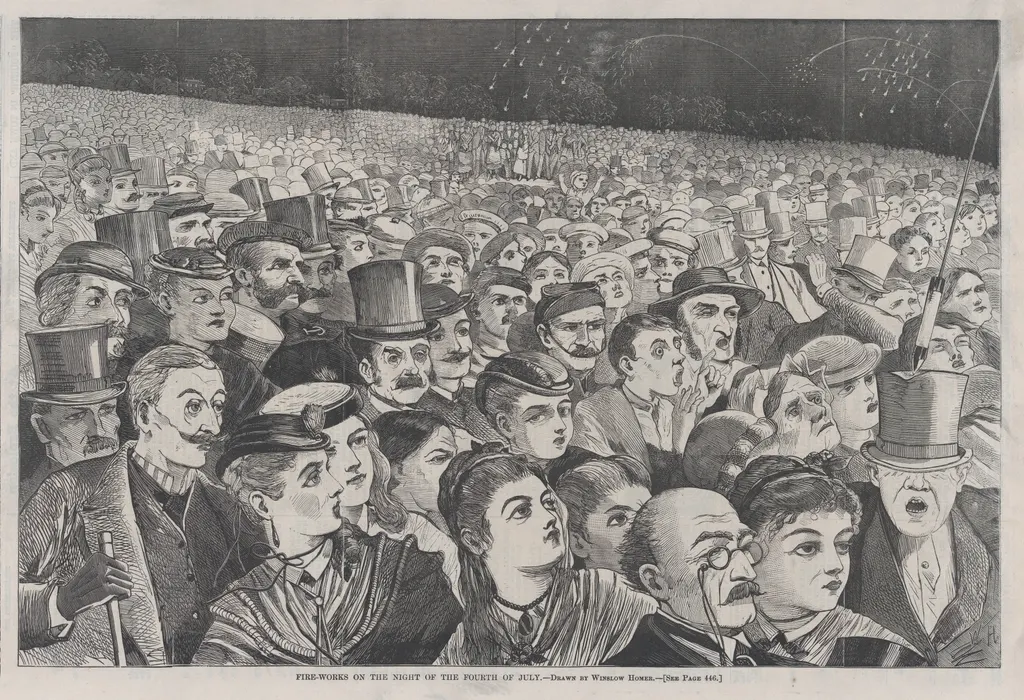
Winslow HomerFire-Works on the Night of the Fourth of July (from "Harper's Weekly," Vol. XII), July 11, 1868Wood engravingThe Metropolitan Museum of Art, collection record. CC0 1.0 (Public Domain)
Put a single image on the classroom screen, say nothing for a full minute, and watch what happens. Hokusai's Under the Wave off Kanagawa, the print most people call the Great Wave, works beautifully for this. At first the class sees a wave. Then someone notices the three boats, then the rowers bent over their oars, then the small grey peak of Mount Fuji sitting in the trough of the wave as if it, too, were about to be swamped. By the end of ten minutes a group of eleven-year-olds has discovered composition, scale, viewpoint and drama without a single slide of definitions.
That is the quiet power of museum collections in teaching. A real object, or a good image of one, carries evidence that pupils can find for themselves. Museums hold millions of such objects, and a remarkable number are now available to any classroom with an internet connection. This article looks at how to choose objects, how to structure the looking, how to use digital collections well, and how to make a museum visit count.
Why objects teach differently
A textbook tells pupils what to think about the past. An object asks them to work it out. A seventeenth-century Delft tile, a Roman coin or a nineteenth-century sampler stitched by a girl of nine is a primary source in the fullest sense: someone made it, used it and kept it, and every scratch and repair is a clue.
Object-based learning, as museum educators often call it, rests on a few simple habits: look before you explain; let pupils describe before they interpret; ask them to support every idea with something they can point to. Those habits transfer to every subject. Describing a painting carefully is practice for describing a chemical reaction or a line of poetry carefully.
Objects also level the room. A pupil who struggles with reading can be the first to spot that the woman in a Dutch interior is wearing a fur-trimmed jacket, or that a ceramic jar has been mended with metal staples. Close looking rewards attention rather than prior knowledge.
Structured looking: three tried routines
Unstructured "What do you think of this?" discussions tend to drift. Two well-established approaches give discussions a backbone.
See, Think, Wonder
Developed at Project Zero, the Harvard Graduate School of Education research centre, this routine asks three questions in order: What do you see? What do you think about that? What does it make you wonder? Its value lies in the sequence. Pupils first list only what is visibly there, without guessing; then they interpret; then they generate questions that can drive further research. Project Zero suggests prompting with "What do you see that makes you say that?" to keep interpretations tied to evidence, and recording responses where everyone can see them.
Visual Thinking Strategies
Visual Thinking Strategies (VTS) grew out of the work of the researcher Abigail Housen and Philip Yenawine, formerly head of education at the Museum of Modern Art in New York. A VTS discussion is built around three open questions: What's going on in this picture? What do you see that makes you say that? What more can we find? The facilitator paraphrases each contribution neutrally, points to the part of the image being discussed, and links related comments, without offering their own interpretation. It takes discipline from the teacher, but the payoff is a class that listens to each other.
The slow inventory
A simpler routine for younger children: set a timer for three minutes and ask everyone to list as many things as they can see in the object. Then go round the room, each child adding one item nobody has mentioned. Lists of forty or fifty details for a single painting are common, and the exercise makes vivid how much we miss at first glance.
Look closer: In the Great Wave, ask pupils to find every shade of blue. The Met's conservation scientists found that Hokusai's printers used both imported Prussian blue and traditional indigo, and printed some areas of the wave twice to deepen them. A pupil who notices "there are two different blues" has spotted something a laboratory later confirmed.
Finding and choosing objects
The best classroom objects are rich enough to reward ten minutes of looking but legible enough that pupils can get a foothold. Narrative paintings, everyday objects with visible wear, maps, portraits with props and costume, and objects that look puzzling at first all work well. Very abstract works can be excellent too, but usually after a class has practised looking on something more concrete.
Open-access collections
Many major museums now release images of public-domain works for free use. The Metropolitan Museum of Art launched its Open Access policy in February 2017, making more than 375,000 images available under the Creative Commons Zero designation, and the number has grown since. Other collections, including the Rijksmuseum in Amsterdam, the Art Institute of Chicago and the National Gallery of Art in Washington, offer high-resolution downloads you can zoom into on a whiteboard far more closely than you could stand to the real thing. Our guide to open-access museum collections explains how to search them and what the licences allow.
The Smithsonian Learning Lab goes a step further: teachers can gather images and records from across the Smithsonian's museums into their own collections, add questions and activities, and share them with pupils.
A quick checklist for choosing
- Is the image good enough? Choose high-resolution files you can zoom into without blurring.
- Is the record reliable? Use the museum's own catalogue entry for title, date, maker and materials rather than a reposted image with a vague caption.
- Does it connect? Tie the object to something the class is already studying, even loosely.
- Is it appropriate? Check the whole image at full size before showing it; museum collections include violence and nudity that may need context.
- Whose story is it? For objects from other cultures, use the maker's own names and terms and say how the object reached the museum where that is known.
Planning a visit that counts
A trip to the museum is expensive in time and money, so it pays to plan it as carefully as any lesson.
- Visit first, alone if you can. Find the galleries you want, check which works are actually on display (loans and rehangs move things), and locate toilets, lunch space and a meeting point.
- Contact the learning department. Many museums offer school sessions, handling collections or self-guided resources, and some ask schools to book even for unguided visits.
- Choose few objects. Three or four works studied properly beat thirty glimpsed in passing. Show images of them in class beforehand so pupils arrive with questions.
- Give every pupil a job. Sketching an object, finding a detail, or collecting evidence for a class question keeps groups purposeful.
- Build in time to sit. Most galleries allow pencils (not pens) for sketching; folding stools are often available on request.
- Follow up. Back at school, return to the same objects through the museum's online records and compare what the class noticed in person with what they see on screen.
Our general guide to how to visit an art museum has more ideas on pacing and gallery manners, and museum activities for families suggests games that also work with small school groups.
Museum objects across the curriculum
Art lessons are the obvious home for collections, but they are far from the only one.
| Subject | Example object | What pupils can investigate |
|---|---|---|
| History | A Roman coin or a medieval seal | Who issued it, what images of power it uses, how it was made |
| Geography | An early printed map | What the mapmaker knew, guessed or left blank; how coasts compare with a modern map |
| Science | A Japanese woodblock print or a stained-glass panel | How colours were made; what pigments fade in light |
| Mathematics | Islamic tilework or a quilt | Symmetry, tessellation, repeating units |
| English | A narrative painting | Writing the moment before or after the scene; dialogue for the figures |
| Design and technology | A chair or a piece of silver | Materials, joints, how form follows use |
Antique maps are particularly good value, because they combine art, geography, history and a little detective work; our introduction to reading an antique map gives pupils a framework. For younger children, introducing children to art history offers ways to build the story of art gradually.
Ask pupils to write their own museum label for an object: 40 words that say what it is, who made it, and one thing a visitor should look for. Writing a good label forces them to decide what really matters, and comparing their versions with the museum's own text sparks lively discussion.
Things to try next week
- Pick one object and run See, Think, Wonder for ten minutes at the start of a lesson.
- Search an open-access collection for an object linked to your current topic and zoom into a detail before revealing the whole.
- Ask pupils to bring in (or photograph) an ordinary object from home and analyse it as a museum curator would: material, maker, use, age, evidence of wear.
- Look up your nearest museum's learning pages; many publish free resource packs, handling-box loans or online sessions for schools.
- Return to the same object later in the term and ask what pupils notice now that they missed before.
For more ideas across the whole subject, browse our creative education section.
Sources
- See, Think, Wonder, Project Zero, Harvard Graduate School of Education
- About VTS, Visual Thinking Strategies
- Open Access at The Met (press release, 7 February 2017), The Metropolitan Museum of Art
- Smithsonian Learning Lab, Smithsonian Institution
- Hokusai's Great Wave, The Metropolitan Museum of Art