How to Introduce Children to Art History
Practical ways to share art history with children: slow looking, stories, a family timeline, period-inspired making, museum visits and honest talk.
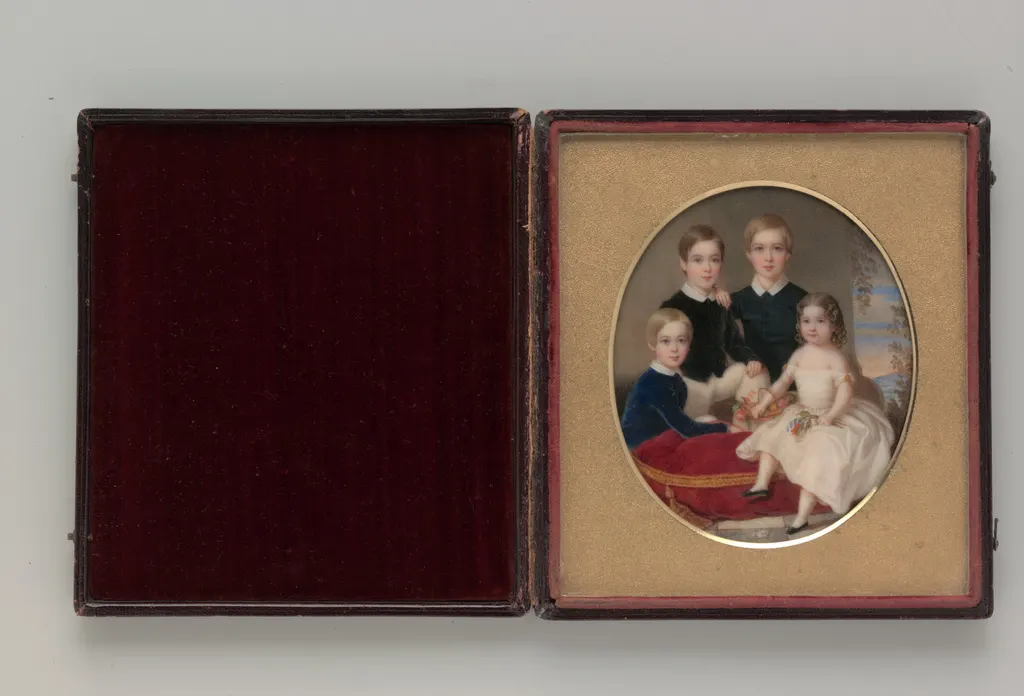
John CarlinThe Thompson Children, 1846Watercolor on ivoryThe Metropolitan Museum of Art, collection record. CC0 1.0 (Public Domain)
Picture a seven-year-old standing in front of a crowded seventeenth-century Dutch painting of a tavern. You might expect boredom. Instead she points: there is a dog stealing food, a baby with a spoon, a man asleep with his hat falling off, someone who has clearly had too much to drink. Within two minutes she has found a dozen stories, and she wants to know why the painter put them there.
Children are often better at looking than adults. They notice details, ask direct questions and are untroubled by the idea that they ought to know the "right" answer. Art history, for them, does not need to begin with names, dates and movements. It can begin with curiosity about pictures and objects, and grow, over years, into a sense of how people in other times and places saw the world. This article offers practical approaches for parents, carers and teachers: ways of looking, building a timeline, making things inspired by the past, visiting museums and talking honestly about difficult subjects.
Begin with looking, not facts
The single most useful habit is slow, open-ended looking. Choose one image, give it a few quiet minutes, and talk about what you see before you say anything about who made it.
Many museums and schools use Visual Thinking Strategies (VTS), a method that grew out of work at the Museum of Modern Art in New York in the 1990s. It was developed by the cognitive psychologist Abigail Housen and Philip Yenawine, who led MoMA's education department. VTS discussions are built around three questions:
- What's going on here?
- What do you see that makes you say that?
- What more can you find?
The second question is the clever one. It asks children to ground their ideas in evidence ("I think it's winter because everyone's wearing coats"), which is exactly what art historians do. Adults leading the conversation paraphrase what children say, point to the details they mention and resist correcting them. Information can come later, when children ask for it.
Look closer: Try a "detail hunt". Before looking at a painting together, describe a small detail, such as a red shoe, a bird or a hidden face, and challenge your child to find it. Then swap roles. Hunting for details trains the patient, close looking that makes larger questions possible.
Stories first, chronology later
Children connect with art through stories: the story a picture tells, the story of how it was made, and the story of the person who made it. Narrative paintings, myths, Bible stories and history paintings work well because there is something to work out. So do portraits, which invite questions such as: who was this person, what are they wearing, and why did they want to be painted like this?
Stories behind artworks are just as gripping: a painting stolen and recovered, a sculpture carved from a single block of marble, an artist who worked in secret. Our collection of famous paintings and the stories behind them is a good source of starting points. Be honest when a popular story is a legend rather than documented fact; children enjoy the idea that historians argue and investigate.
Build a family timeline
Once children have met a handful of artworks, a timeline helps them see that the cave painters, the ancient Egyptians, the Renaissance and the Impressionists did not all live at once.
- Run a long strip of paper or a length of string along a wall or corridor. Mark it in centuries, or for younger children simply "a very long time ago", "long ago" and "nearly now".
- Add pictures of artworks your child has enjoyed, printed from museum websites or cut from postcards and old catalogues.
- Add family dates too: the year a grandparent was born, the year your house was built. Personal anchors make abstract dates meaningful.
- Leave gaps. Empty stretches invite the question "what was happening then?", which is a good prompt for the next visit or book.
- Revisit and rearrange as you learn more. A timeline is a working tool, not a finished display.
The prehistoric end of the line is always popular. The painted cave of Lascaux in south-west France, discovered in 1940, contains images around 21,000 years old. The cave itself is closed to protect the paintings, but replicas let visitors experience it, most recently Lascaux IV, the International Centre for Parietal Art, which opened in 2016. The French Ministry of Culture's Lascaux website lets families explore the cave and its discovery online.
Learning by making
Making things inspired by the past helps children understand how art was made and why it looks the way it does. Keep the focus on discovery rather than on copying perfectly.
| Period or tradition | A making idea | What it teaches |
|---|---|---|
| Prehistoric cave art | Paint animals on crumpled brown paper with fingers and sponges, using earthy colours | How surfaces and limited colours shape images |
| Medieval manuscripts | Design an illuminated first letter of your name with patterns and tiny creatures | Books made by hand; decoration as meaning |
| Gothic stained glass | Layer coloured tissue paper between sheets of tracing paper and hang in a window | How light changes colour |
| Dutch Golden Age | Draw a still life of objects from your kitchen, or design a blue-and-white "tile" on a white paper square | Everyday objects as art; trade and fashion |
| Impressionism | Paint the same view outdoors at different times of day | Light, weather and quick brushwork |
| Twentieth-century collage | Cut shapes from painted paper and arrange them, as Henri Matisse did in his late paper cut-outs | Shape, colour and composition |
Our article on art activities inspired by famous artists offers fuller instructions for many of these.
Safety: Use paints, glues and crayons labelled as non-toxic and suitable for children, such as products carrying the ACMI "AP" seal and conforming to ASTM D-4236 in the US, or conforming to the EN 71 toy-safety standard in Europe. Avoid historical materials such as powdered pigments, solvents and lead-based or arsenic-based colours, however authentic they might be. Supervise scissors, craft knives and anything hot, and keep small items away from very young children.
Museums, books and screens
Museum visits work best when they are short and focused. Choose three or four works in advance rather than trying to see everything; let children choose one of their own; and stop before anyone is tired. Many museums offer free family trails, activity backpacks and holiday workshops. Our guide to museum activities for families has practical ideas for making visits enjoyable.
Between visits, museum websites are an extraordinary resource. Many institutions now publish high-resolution images of their collections free of charge; Open-Access Museum Collections: A Practical Guide explains how to find and use them. Tate Kids, from the Tate galleries in Britain, offers games, making activities and short videos about artists for children. For older children and teenagers, Smarthistory publishes short, expert-written essays and videos on artworks across world history.
Look for picture books about individual artists and artworks at your local library, and read them together before or after a visit. Above all, follow your child's interests: a passion for horses, dinosaurs, castles or football can lead straight into art history if you look for the right images.
Talking about difficult subjects
Art history includes nudity, violence, religion, slavery, war and colonial conquest. Children will notice, and they deserve honest, age-appropriate answers.
- Nudity: explain calmly that artists in many cultures depicted the human body to show ideas such as beauty, strength or vulnerability, and that classical statues were often meant to represent gods and heroes.
- Violence and suffering: many paintings show battles, martyrdoms and disasters. Ask what the artist wanted viewers to feel, and let children step away if an image upsets them.
- Whose history? Many museum objects came from other parts of the world, some acquired fairly and some taken during wars or colonial rule. Older children can explore why people now debate where such objects belong.
Growing with your child
There is no correct order or age for any of this. Younger children often enjoy colour, animals, spotting games and making; many older children become interested in how and why things were made, in artists' lives, and in comparing works from different times. Let the conversation grow with them. A child who learned to ask "what do you see that makes you say that?" at six will be ready, at twelve, to ask how a painting was used, who paid for it and what it meant to people at the time.
For a wider approach to looking at art together, see Teaching Art Appreciation at Home, and explore more ideas under creative education.
Sources
- Visual Thinking Strategies, Visual Thinking Strategies
- Our Founders, Visual Thinking Strategies
- Tate Kids, Tate
- Lascaux, French Ministry of Culture
- Smarthistory, Smarthistory