The Prado Mona Lisa: A Tale of Two Paintings
How the 2012 restoration of the Prado's Mona Lisa revealed a copy made in Leonardo's workshop beside the original, and what it shows about the Louvre panel.
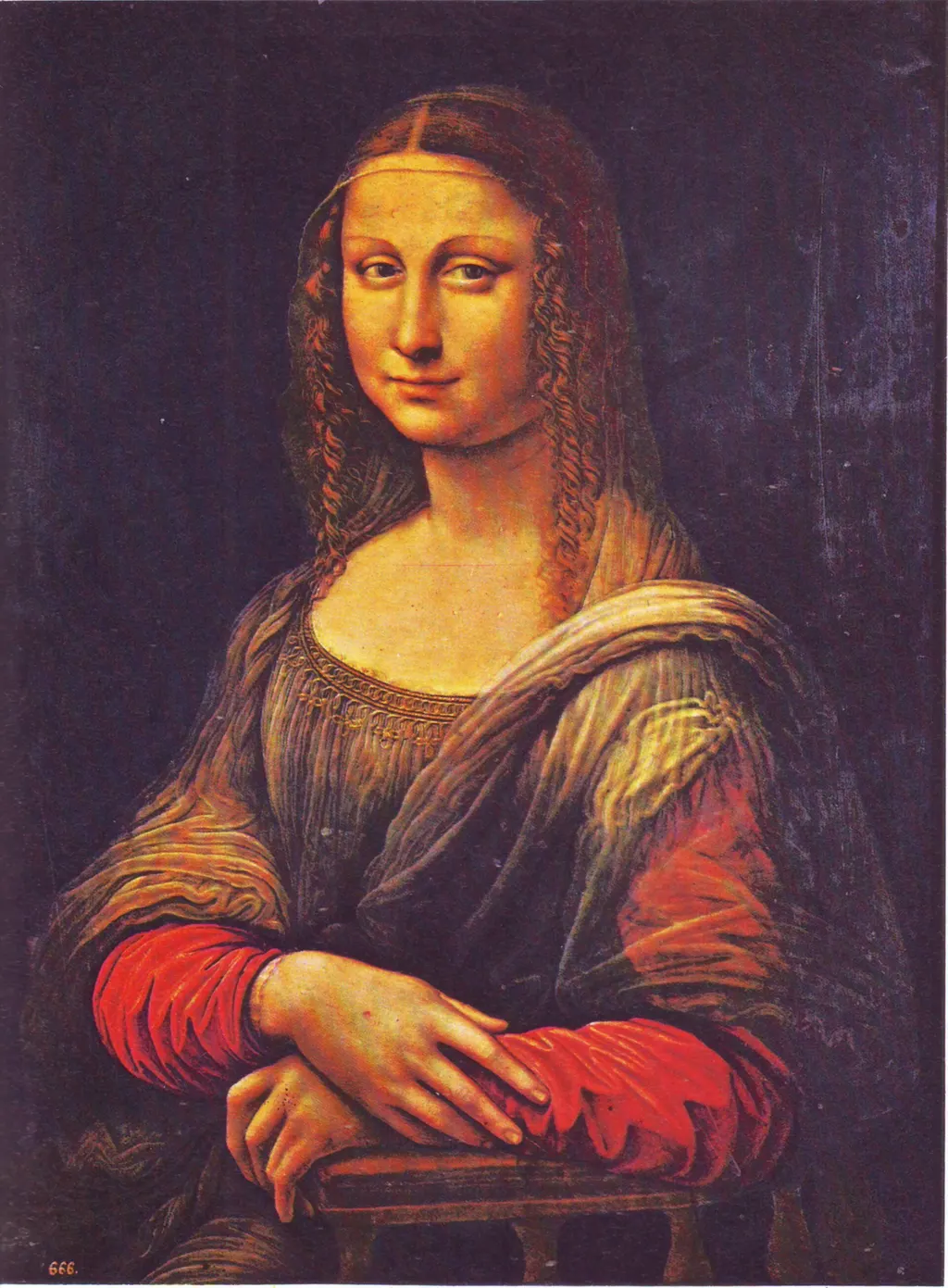
Unknown makerMona Lisa (copy, Prado)The world of Leonardo, 1452-1519 by Robert Wallace (via Wikimedia Commons), collection record. Public domain
For most of its history the Prado's Mona Lisa was easy to walk past. It hung in Madrid as one of many copies of Leonardo da Vinci's famous portrait, the sitter set against a flat black background, her face a little hard, her charm muted. Then, in 2011–12, conservators at the Museo del Prado began cleaning it. As layers of discoloured varnish and black overpaint came away, a luminous Tuscan landscape emerged behind the sitter, with winding paths, water and blue mountains, in colours fresher than anyone had seen in the Louvre picture for centuries.
The discovery made headlines because of what technical study revealed next: this was not a later copy made by someone who had seen the original, but a version painted in Leonardo's own workshop, at the same time as the master's painting and following its changes step by step. This article explains what was found, what the two paintings tell us about each other, and what remains uncertain.
The original in the Louvre
Leonardo's portrait is identified as Lisa Gherardini, wife of the Florentine merchant Francesco del Giocondo; hence its Italian and French names, La Gioconda and La Joconde. The Louvre dates it to 1503–1519. Work began in Florence around 1503, and the portrait was probably commissioned by the sitter's husband, but Leonardo never delivered it. He kept it with him, continuing to work on it, and it was never entirely finished. It was most likely acquired by the French king François I around 1518; a payment of that year to Leonardo's pupil Salaì is part of the evidence. Painted in oil on a poplar panel, 79.4 by 53.4 centimetres, it has been in French royal and then national ownership ever since.
Over five centuries its varnish has darkened and cracked, giving the painting the greenish-brown tonality familiar from millions of reproductions. Because of its fame and fragility, it has never been given the kind of thorough cleaning that might reveal its original colours.
The copy in Madrid
The Prado painting is a little smaller, 76.3 by 57 centimetres, and is painted on walnut. It is first documented in 1666, in an inventory of the royal Alcázar in Madrid, as a woman "by the hand of Leonardo", and it has been in the Prado since the museum opened in 1819. How and when it reached Spain is unknown.
Its black background was not original. Study of the varnish layers indicated that the overpaint was added long after the picture was made, not before about 1750. Beneath it, the restoration of 2011–12 uncovered a landscape that closely follows the Louvre painting. The restored picture was lent to the Louvre for the exhibition Leonardo's Last Masterpiece: The Saint Anne (29 March to 25 June 2012), where it was displayed in the same building as the original.
Two panels compared
Louvre: by Leonardo; oil on poplar; 79.4 × 53.4 cm; begun c. 1503, worked on until c. 1519; yellowed varnish.
Prado: Leonardo's workshop; oil on walnut; 76.3 × 57 cm; probably painted alongside the original; black overpaint removed 2011–12.
What the technical evidence shows
The key evidence came from infrared reflectography and X-radiography, which look beneath the paint surface. They revealed an underdrawing in the Prado painting that corresponds to the underdrawing of the Louvre original, including the same changes of mind, but drawn in a different hand and style. In other words, as Leonardo adjusted his composition, the copyist adjusted his. That is hard to explain unless the two panels were developed side by side in the same studio.
The quality of materials points the same way. The Prado copy uses costly pigments, including lapis lazuli and red lake, and is carefully executed, more like a sanctioned workshop replica than a casual copy.
Who painted it?
The painter is not documented. Among the names proposed, the most frequently cited are two of Leonardo's pupils and companions: Gian Giacomo Caprotti, known as Salaì, and Francesco Melzi. Others have suggested Spanish artists who are thought to have worked with Leonardo in Florence, Fernando Yáñez de la Almedina or Hernando de los Llanos. None of these attributions is certain, and the Prado catalogues the work as from Leonardo's workshop.
One further idea attracted attention: because the copy seems to have been painted from a slightly different viewpoint, some researchers suggested in 2013–15 that the two pictures might form a stereoscopic pair, an early experiment in three-dimensional vision. A later study in 2017 found that the pair does not produce reliable stereoscopic depth. The hypothesis is best treated as an intriguing but unproven suggestion.
What the copy tells us about the original
The Prado panel's main value is as a guide to how the Louvre painting may once have looked. Its good condition and cleaned surface show clearer, cooler colours: crisper landscape detail, more legible drapery and a sense of space that the original's darkened varnish now obscures. It also shows how a successful painter's workshop operated, with assistants producing high-quality versions of a master's composition while it was still being developed, sometimes for sale or for patrons who could not have the original.
It is worth stressing what the copy cannot do. It is not a photograph of the original in 1505 or 1519. Leonardo's subtle modelling, the sfumato in which edges dissolve into shadow, is his own, and the Prado painting, for all its quality, is handled differently. The two pictures are best seen as a dialogue: one a masterpiece altered by time, the other a fresher but less profound record made alongside it. How layered oil paint and varnish change with age is explained in how oil painting works.
Look closer: Put good reproductions of the two paintings side by side. Compare the background on each side of the sitter: does the horizon line match? Then look at the transitions around the eyes and the corners of the mouth. In the Louvre painting they melt; in the Prado version they are a little more defined. Finally, notice the colours of the sleeves. Which differences come from different hands, and which simply from varnish?
Copies, versions and value
The Prado story reminds us that "copy" covers a wide range of objects, from workshop replicas made under the master's eye to later imitations and outright fakes. For collectors and museum-goers alike, the distinctions matter, as our guide to copies, fakes and decorative miniatures explains in a different field.
Seeing the two paintings
- Musée du Louvre, Paris: Leonardo's original, displayed behind protective glass in the Salle des États.
- Museo del Prado, Madrid: the workshop version, cleaned and with its landscape restored.
- Looking well: crowds around the Louvre painting make slow looking difficult; the Prado version, usually far quieter, offers a chance to study the composition at leisure before or after a visit to Paris.
For more on how famous images acquire their stories, see ten famous paintings and the stories behind them and how to appreciate a historical painting. More is collected under art appreciation.
Sources
- Portrait de Lisa Gherardini, dit La Joconde ou Monna Lisa (INV 779), Musée du Louvre
- Mona Lisa (Prado), Wikipedia
- Mona Lisa, Encyclopaedia Britannica