How Oil Painting Works: Pigments, Layers and Glazes
What oil paint is, how it dries, and how old masters built paintings in layers, from ground and underdrawing to glazes, impasto and varnish, and why it matters.
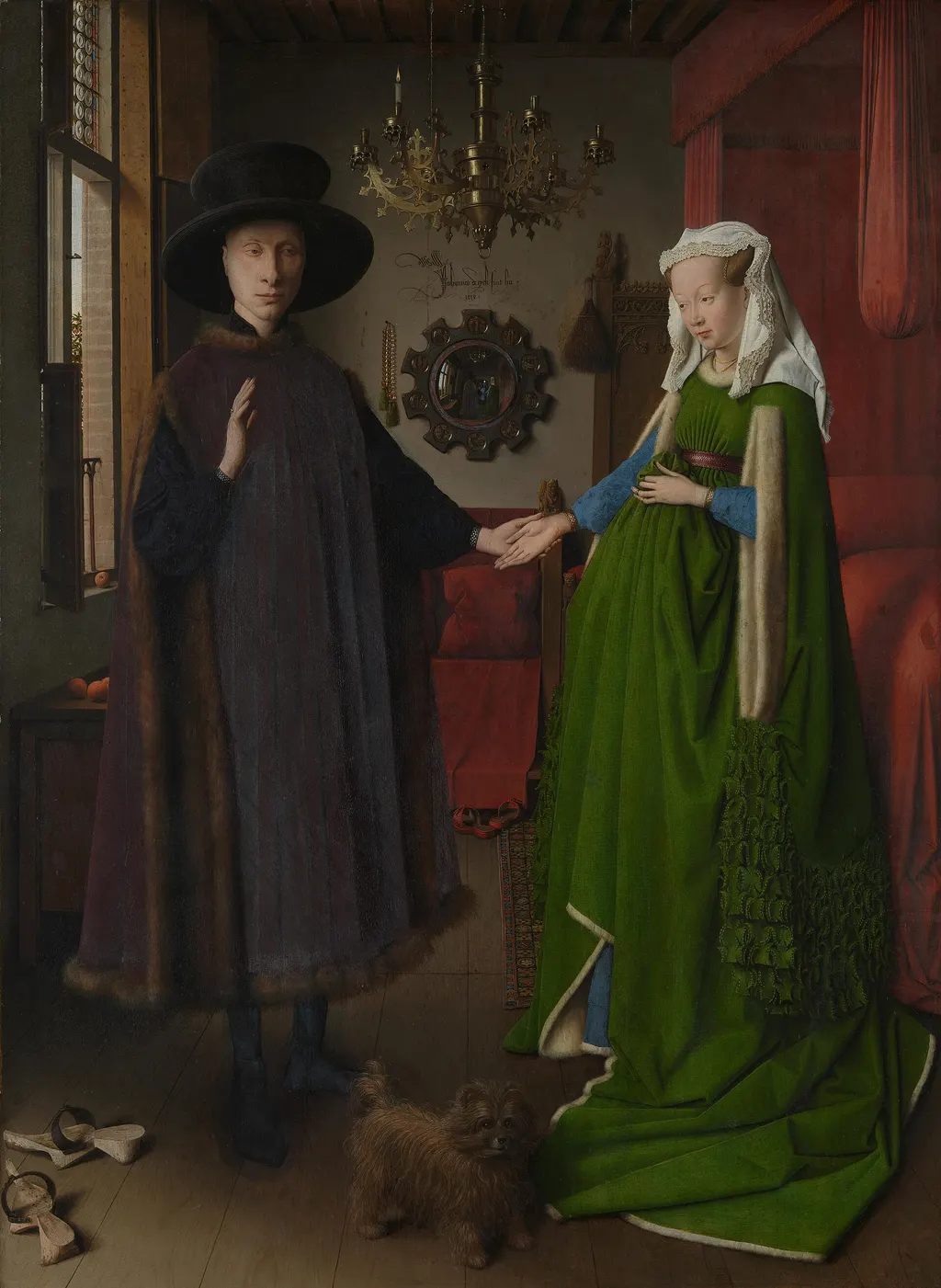
Jan van EyckThe Arnolfini Portrait, 1434Web site of National Gallery, London (via Wikimedia Commons), collection record. Public domain
Stand in front of Jan van Eyck's Arnolfini Portrait (1434) in the National Gallery in London and look at the woman's gown. The green is not a flat colour but something deeper, almost like light seen through bottle glass. Folds that turn away from the window sink into rich darkness without ever going muddy, and highlights sit on the ridges like a sheen on velvet. That effect is not a trick of the photograph or the gallery lighting. It comes from the way the paint was built up, layer over translucent layer, in a medium that made such effects possible.
Oil paint has been the dominant medium of European easel painting for some five centuries, and it is still widely used today. Understanding how it works, chemically and practically, changes the way you look at paintings in a museum. This article explains what oil paint is, how it dries, how a traditional painting is constructed from the panel up, and why old paintings look the way they do now.
What oil paint is
All paint consists of two things: pigment, the finely ground coloured particles, and a binder, which holds the particles together and sticks them to the surface. In watercolour the binder is gum arabic; in egg tempera it is egg yolk. In oil paint it is a drying oil. The National Gallery's glossary lists the three most commonly used: linseed oil, pressed from the seeds of the flax plant; walnut oil; and poppy oil.
Linseed oil forms the toughest film but yellows somewhat with age. Walnut and poppy oils are paler, and painters have often used them where yellowing would show most, in whites and blues, at the cost of slower drying and a softer film.
How oil paint "dries"
Oil paint does not dry the way watercolour does. Water evaporates; drying oil reacts. When a drying oil is exposed to air, its molecules take up oxygen and link together into a solid, flexible network. The paint becomes touch-dry in days, depending on the pigment and thickness, but the chemical changes continue for years.
This slow, chemical drying is the heart of the medium's appeal. It gives the painter time to blend colours wet into wet, to soften edges, and to come back the next day and adjust. Different pigments also affect drying speed. The National Gallery notes that lead white, for centuries painters' main white, acts as a catalyst that helps oil paint dry; earth colours containing manganese, such as umbers, are also known as fast driers.
A brief history
Van Eyck was long credited with inventing oil painting. The story goes back to the sixteenth-century biographer Giorgio Vasari, and it is wrong. The National Gallery notes that oil was already used for panel and wall painting in northern Europe in the thirteenth and fourteenth centuries. What van Eyck and his contemporaries, such as Robert Campin, achieved in the early fifteenth century was a mastery of oil's optical possibilities, particularly the use of translucent layers, that made their paintings look startlingly real.
Their techniques spread south. As the Met's Heilbrunn Timeline essay explains, oil painting was being practised in Italy in the fifteenth century; Antonello da Messina is often associated with its spread, but Giovanni Bellini was already using oil in Venice in the 1460s. Over the following century, Venetian painters such as Titian embraced oil on canvas, exploiting its ability to be worked loosely and thickly as well as smoothly. Canvas was lighter than wooden panels and could be made much larger, and it gradually became the standard support. For how those methods flourished in the north, see our guide to Dutch Golden Age painting.
Building a painting: the layers
A traditional oil painting is a layered structure, and each layer has a job.
| Layer | What it is | Purpose |
|---|---|---|
| Support | Wooden panel (often oak in the north, poplar in Italy) or linen canvas on a stretcher | Physical base |
| Size | Usually animal glue | Seals the support so oil does not soak in |
| Ground | Gesso on panels; on canvas usually layers of oil-bound priming | Smooth, even, often coloured surface |
| Imprimatura | Thin, translucent colour over the ground | Reduces absorbency; gives a mid-tone |
| Underdrawing | Drawing in charcoal, chalk, ink or paint | Lays out the composition |
| Underpainting | Monochrome or broadly coloured first layers | Establishes light and shade |
| Body colour | Opaque paint for forms and colours | Main description of the image |
| Glazes and scumbles | Thin transparent or semi-opaque layers | Deepen, adjust and unify colour |
| Varnish | Natural resin or modern synthetic varnish | Saturates colour and protects the surface |
Grounds and the colour beneath
The ground affects everything above it. The National Gallery's glossary notes that panels were usually prepared with gesso, a white mixture bound with glue, while canvas grounds were typically built up from layers of paint. Many painters chose coloured grounds: Nicolas Poussin preferred reddish grounds and Rembrandt brownish ones, while some nineteenth-century artists, especially the Impressionists, chose white grounds for brightness. A coloured ground shows through thin passages and sets the overall key of a painting before a single figure is painted.
Underdrawing
Many painters drew their compositions directly on the ground. Infrared reflectography, which can see through many paint layers to carbon-based drawing beneath, lets conservators study these underdrawings and see where artists changed their minds.
Glazing, scumbling and impasto
Three handlings of paint give oil painting its distinctive range.
Glazing. Some pigments, mixed with oil or oil and resin, form transparent or translucent films. The National Gallery defines a glaze as such a layer laid over a usually lighter colour: it modifies the colour beneath while letting it show through. Light passes through the glaze, reflects off the layer below and comes back through, which gives glazed passages their glowing depth. Varying the thickness of a glaze creates gradations of tone. Van Eyck's greens and the deep crimson draperies of many Renaissance paintings were achieved this way.
Scumbling. The opposite of a glaze: a thin layer of lighter, semi-opaque paint dragged or brushed over a darker one, creating a soft, hazy effect. It is often used for skies, distance and the bloom on skin.
Impasto. Paint applied thickly enough to stand up from the surface and keep the marks of brush or palette knife. Rembrandt's late works and Van Gogh's swirling skies show how impasto can catch real light and make the surface itself expressive.
Look closer: In a gallery, look at a painting from the side, with light raking across it. Impasto highlights stand up as ridges; glazed shadows lie flat and glassy. Where a later layer has become more transparent with age, you may glimpse a pentimento, an earlier position of a hand, a hat or a horizon that the painter covered over.
"Fat over lean"
Painters working in layers learn one rule above all: fat over lean. "Fat" paint contains more oil; "lean" paint contains less oil, or has been thinned with solvent. Each layer should be at least as flexible as the one below it. Lean layers dry faster and less flexibly; if a fast-drying, brittle layer is laid over a slow-drying, oily one, the top layer can crack as the lower one continues to move. Traditional practice was therefore to begin with lean, thin paint and to add more oil in later layers, finishing with oil-rich glazes.
How old paintings change
A painting in a museum today does not look exactly as it did when it left the studio.
- Varnish yellows. Natural resin varnishes become yellow and cloudy over time, dulling blues and whites. Removing and replacing old varnish is one of the most visible tasks of conservation.
- Oil becomes more transparent. As oil films age, some layers become more see-through, which is why underdrawing and pentimenti sometimes become visible to the naked eye.
- Some pigments change. Certain copper greens can darken towards brown, and some red lake pigments fade in light, altering the colour balance an artist intended.
- Cracks develop. The network of fine cracks called craquelure forms as paint and ground age and the support expands and contracts with humidity.
These changes are why conservators study paintings so carefully before treatment, and why galleries control light and humidity. Our article on caring for art at home explains how the same principles apply to paintings on your own walls.
Try it yourself: a simple glazing exercise
You can see the principle of glazing in an afternoon, using oils or acrylics with a glazing medium.
- Paint a small panel or canvas board with a band of opaque, light colour, such as a pale yellow or a light grey, and let it dry completely.
- Mix a small amount of a transparent colour, such as a crimson or a phthalocyanine blue, with plenty of medium so that it becomes a thin, transparent film.
- Brush the glaze over half of the dry band. Notice how the colour beneath glows through.
- When dry, add a second glaze over part of the first and compare one, two and three layers.
- Try the same transparent colour mixed with white and painted opaquely beside it. The difference between a glazed colour and a mixed one is the difference you see in an old master's drapery.
Work in a ventilated room, use low-odour solvents or water-mixable oils, and lay oil-soaked rags flat to dry outside, since rags soaked in drying oil can heat up and catch fire. Our guide to art materials for beginners covers the basic kit.
What to look for in the gallery
- The colour of the ground showing through thin passages, especially in seventeenth-century works.
- Transparent glazes in deep reds, blues and greens, compared with opaque, thicker lights.
- Impasto in highlights: jewellery, lace, the glint in an eye.
- Visible underdrawing or pentimenti where layers have become transparent.
- Cracks and their pattern, which can reveal the support and the way the painting has aged.
For more on looking closely, read how to appreciate historical paintings, and explore further in materials and techniques.
Sources
- Oil paint (glossary), The National Gallery, London
- Glaze (glossary), The National Gallery, London
- Ground (glossary), The National Gallery, London
- Lead white (glossary), The National Gallery, London
- Painting in Oil in the Low Countries and Its Spread to Southern Europe, The Metropolitan Museum of Art, Heilbrunn Timeline of Art History
- Jan van Eyck, The Arnolfini Portrait, The National Gallery, London