Art Materials for Beginners: What You Really Need
A clear guide to buying first art materials: pencils, paper weights, paints compared, pigment codes, lightfastness, brushes and safety, without wasting money.
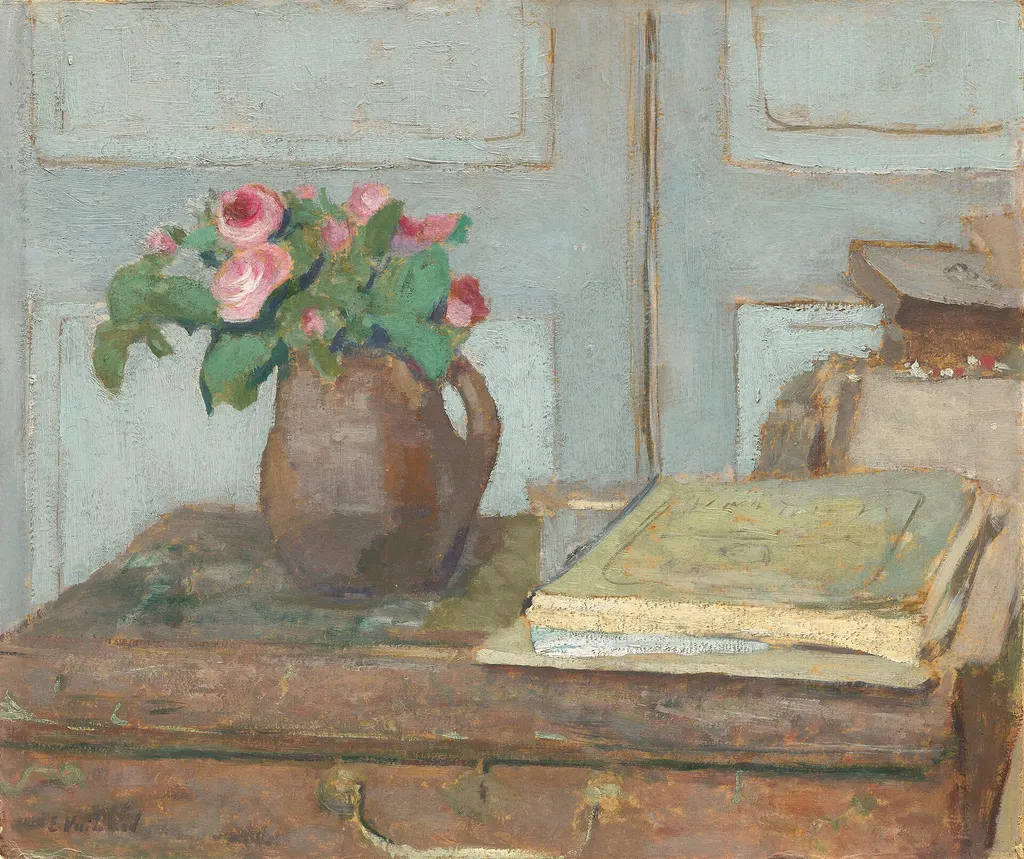
Édouard VuillardThe Artist's Paint Box and Moss Roses, 1898Wikimedia Commons, collection record. Public domain
Walk into any art shop and the choice is bewildering: forty kinds of pencil, papers measured in grams and pounds, three grades of the same blue at three different prices, brushes made of five different hairs. Beginners often respond in one of two ways. Some buy a large boxed set with a hundred colours in a wooden case; others buy almost nothing and struggle with materials that fight them at every step. Both routes lead to frustration.
The truth is that very little is needed to start well, but what you do buy should be decent. A single good pencil and a pad of proper paper will teach you more than a drawer full of novelty supplies. This guide explains what matters, what the labels mean and where it is sensible to save money.
Start with drawing
Drawing is the cheapest way into art and the foundation for everything else. You need:
- Three or four graphite pencils. A useful set is HB, 2B, 4B and 6B.
- A cartridge-paper sketchbook, A4 or A5, with paper around 110–150 gsm.
- A kneadable (putty) eraser, which lifts graphite without abrading the paper and can be shaped to a point for highlights.
- A sharpener, or a craft knife and sandpaper for long, shaped points (adults only for blades).
Understanding pencil grades
Pencil "lead" is a mixture of graphite and clay. More clay makes a harder pencil that gives paler, finer lines; more graphite makes a softer, darker one. In the European system, H pencils are hard and grow harder as the number rises (2H, 4H, 6H), B pencils are soft and grow softer and blacker (2B, 4B, 6B), and HB sits in the middle. F, between HB and H, holds a fine point. A standard American No. 2 writing pencil is roughly equivalent to HB, though grades vary between manufacturers.
Soft pencils smudge easily, which is useful for shading and frustrating for neat lines. Try the same shading exercise with each grade to learn their range. Our creative drawing exercises for beginners and perspective drawing explained give you plenty to practise with.
Paper: the most underrated material
Cheap paper is the commonest reason beginners think they "can't paint". Watercolour on thin printer paper buckles and pills; acrylic soaks straight through.
Weight is given in grams per square metre (gsm) or, in the US, in pounds per ream. Some useful landmarks:
- 80–90 gsm: office paper; fine for quick sketches, not for wet media.
- 110–200 gsm: cartridge and sketchbook paper; good for pencil, ink and light washes.
- 300 gsm (about 140 lb): the standard weight for watercolour paper; takes washes without severe buckling, especially if taped down.
Surface matters for watercolour. Hot-pressed paper is smooth, good for fine detail; cold-pressed (called "NOT" in Britain, as in "not hot-pressed") has a gentle tooth and is the most versatile; rough has a pronounced texture that breaks up washes.
Fibre content affects how paper behaves. Papers made from cotton tend to be stronger and handle repeated washes better than those made from wood cellulose, and cost more. A sensible compromise is a cellulose pad for practice and a few sheets of cotton paper for work you care about. Look for acid-free paper, which resists yellowing.
Choosing a paint
The four paints a beginner is most likely to consider differ less in their colours than in their binders: the substance that holds the pigment together and sticks it to the surface.
| Paint | Binder | Thinned with | Drying | Character | Good for beginners because |
|---|---|---|---|---|---|
| Watercolour | Gum arabic | Water | Minutes | Transparent; paper shows through | Compact, cheap to start, quick clean-up |
| Gouache | Gum arabic, more pigment and often white | Water | Minutes | Opaque, matt | Corrections possible; flat, bold colour |
| Acrylic | Acrylic polymer emulsion | Water (while wet) | Minutes to an hour | Opaque or transparent; waterproof when dry | Versatile, forgiving, no solvents |
| Oil | Drying oil, usually linseed | Solvent or more oil | Days to weeks | Rich, slow, blendable | Long working time for blending |
Tate defines gouache as a water-soluble paint that, unlike watercolour, is opaque. Watercolour is not necessarily the "easy" option it appears: it rewards planning, because light areas are made by leaving paper bare rather than adding white. Our watercolour basics explains how. Oils are covered in detail in how oil painting works.
If you are unsure, acrylics are a forgiving place to start: they dry quickly, can be painted over, clean up with water while wet and need no solvents.
Student or artist quality?
Most paint ranges come in two grades. Artist or professional quality typically contains a higher concentration of pigment and a wider range of single pigments. Student quality usually costs less because it contains less pigment, more filler, and often substitutes cheaper pigments for expensive ones.
A useful clue is the word "hue" after a colour name, as in "cadmium red hue". It means the colour is an imitation made from other, usually cheaper, pigments. That is not necessarily bad, but it will not behave exactly like the original.
A reasonable approach is to buy fewer colours of better quality. Six good tubes will mix more convincing colours than twenty-four weak ones.
Reading the label: pigment codes and lightfastness
The most useful information on a tube is often in the small print.
Pigment codes
Colour names vary wildly between brands, but pigments are identified by internationally recognised Colour Index Generic Names, maintained jointly by the Society of Dyers and Colourists and the American Association of Textile Chemists and Colorists. A code such as PB29 means "Pigment Blue 29", which is synthetic ultramarine; PW6 is titanium white. Learning a handful of codes lets you compare products across brands and see how many pigments are mixed in a single tube. Single-pigment paints generally mix more cleanly than multi-pigment ones.
Lightfastness
Some pigments fade in light. Many manufacturers rate lightfastness either on the ASTM scale, where I (excellent) and II (very good) are the categories to look for in work you intend to keep, and III to V indicate increasing risk of fading, or on the Blue Wool Scale, where higher numbers (7–8) mean better light resistance. Watercolours, applied in thin layers, are particularly vulnerable.
A starter palette
Instead of a large set, consider a "split primary" palette: a warm and a cool version of each primary colour.
- Yellows: a lemon (cool) and a deeper, warmer yellow
- Reds: a warm, orange-leaning red and a cool, crimson or magenta-leaning red
- Blues: ultramarine (warm, PB29) and a phthalocyanine or cerulean blue (cooler)
- Plus: titanium white (for opaque paints) and an earth colour such as burnt sienna or burnt umber
With these you can mix clean greens, oranges and purples as well as convincing greys and browns, and learn colour mixing far faster than by opening a new tube for every colour.
Brushes and other tools
- Brushes: good synthetic brushes are inexpensive, durable and work for every medium. Start with a medium round (roughly size 8 or 10) and a flat about 1–2 cm wide; add a small round for detail.
- Palette: a white ceramic plate works perfectly for watercolour and gouache. For acrylic, a "stay-wet" palette or a sheet of baking paper over a damp cloth stops paint drying out.
- Water jars: two jars, one for rinsing and one for clean water, keep colours fresh.
- Masking tape: for taping paper to a board to reduce buckling.
- A board: a piece of plywood or hardboard larger than your paper.
Safety in the studio
Most beginners' materials are safe with sensible use, but some precautions are worth taking.
- Read labels. In the US, art materials must carry a statement of conformance with ASTM D-4236, which shows they have been reviewed for chronic hazards; it does not mean a product is harmless. The US Consumer Product Safety Commission notes that "non-toxic" has no regulatory definition.
- Look for the AP seal on materials for children, and keep products carrying the CL (Cautionary Labeling) seal away from them; the Art & Creative Materials Institute advises that CL products should never be given to children in sixth grade or younger.
- Do not eat, drink or smoke while painting, and wash hands afterwards.
- Avoid dust. Do not sand dry pastel or blow pastel dust; tap it off outside.
- Ventilate when using solvents, and choose low-odour, high-quality solvents if you paint in oils. Better still, try water-mixable oils.
- Dispose of oily rags safely. Rags soaked in linseed oil can heat up as the oil dries and, in some conditions, catch fire. Lay them flat to dry outdoors or keep them in a sealed metal container with water before disposal.
- Never pour solvents or paint water containing heavy-metal pigments down the drain without checking local guidance.
What to buy first: a checklist
- HB, 2B, 4B and 6B pencils, a putty eraser and a sharpener
- A cartridge sketchbook (110–150 gsm)
- Either a small pan set of artist-quality watercolours or six tubes of acrylic in a split-primary palette plus white
- A pad of 300 gsm watercolour paper, or acrylic paper or canvas board
- Two or three synthetic brushes
- A palette, two water jars, masking tape and a board
Add materials one at a time as you discover what you want to do next. If you are equipping a child, see our guide to creating a home art space for children. Further techniques are collected in materials and techniques.
Sources
- Colour Index International, Society of Dyers and Colourists and American Association of Textile Chemists and Colorists
- Art Materials: Frequently Asked Questions, U.S. Consumer Product Safety Commission
- Materials Safety: AP and CL seals, The Art & Creative Materials Institute (ACMI)
- Gouache (Art Term), Tate