Pieter Aertsen, Painter of Markets and Kitchens
Pieter Aertsen's piled-up market and kitchen scenes, with Bible stories glimpsed behind the food, and why he was hailed as a modern painter of humble things.
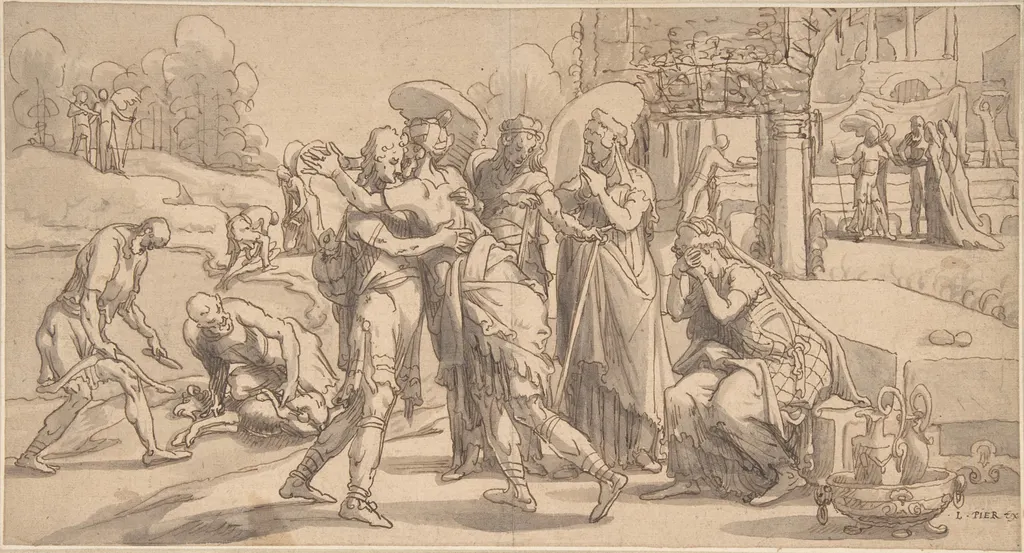
Pieter AertsenRaguel's Reception of Tobias at Ecbatana, 1520–75Pen and brown ink, with gray washThe Metropolitan Museum of Art, collection record. CC0 1.0 (Public Domain)
Hams, sausages, joints of pork, fish, cheese, butter and bread crowd the stall, and a slaughtered carcass hangs nearby. It is a feast of the senses and almost overwhelming. Only after a while do you notice, through a gap at the back of the stall, a tiny scene: the Holy Family on the road to Egypt, pausing to give bread to a poor family. The painting, dated 1551, is Pieter Aertsen's Meat Stall with the Holy Family Giving Alms, and versions of it are in Uppsala and in Raleigh, North Carolina.
Pictures like this were new. Aertsen turned the traditional hierarchy of painting upside down, placing humble produce in the foreground and the sacred story in the distance. In doing so he helped to create two genres that would flourish in the following century, the market or kitchen scene and the still life. This article explains who Aertsen was, how his "inverted" pictures work, and why one of his contemporaries compared him to an ancient Greek painter of low subjects.
Lange Pier of Amsterdam and Antwerp
Aertsen was born in Amsterdam around 1508 and trained there with Allaert Claesz. As a young man he moved south to Antwerp, then the commercial capital of northern Europe, where he lodged with the painter Jan Mandijn and was entered in the Guild of Saint Luke as Langhe Peter, schilder, "Tall Peter, painter". The nickname, Lange Pier or Lange Piet, stayed with him. He became a citizen of Antwerp in 1542 and married Kathelijne Beuckelaer.
Around 1555–56 he returned to Amsterdam, where he painted altarpieces as well as secular pictures. Much of that religious work was lost: altarpieces were destroyed in the iconoclastic outbreaks of 1566 and in the upheavals around Amsterdam's change to the Protestant cause in 1578. He died in Amsterdam in June 1575. His sons Pieter Pietersz and Aert Pietersz became painters, and his wife's nephew Joachim Beuckelaer, trained in his workshop, carried his market and kitchen pictures into the next generation.
The inverted picture
Aertsen's market and kitchen scenes typically follow a pattern:
- The foreground is crowded with food, utensils and often robust figures of cooks and market sellers, painted large and close to the picture plane.
- The middle ground may show other vendors or a tavern.
- The background opens through a doorway, window or gap to reveal a small biblical episode: the Flight into Egypt, Christ in the house of Martha and Mary, the road to Emmaus.
In the 1551 Meat Stall, a Flemish sign offers a plot of land for sale; the meat, the fish (food for Lent) and the slaughtered animals sit in sharp contrast to the Holy Family's act of charity. Scholars have read the picture in different ways: as a satire on gluttony and greed, as a meditation on the flesh and mortality, or as a play on spiritual and bodily nourishment, with the bread in the background hinting at the Eucharist. Aertsen's paintings of Christ in the house of Martha and Mary, the busy Martha among her pots and the contemplative Mary at Christ's feet, set up the same tension between the active, material life and the spiritual one. Two versions are dated 1552 and 1553 and are in Vienna and Rotterdam respectively.
It is important not to over-read these pictures as coded sermons. The joy with which Aertsen paints a cabbage or a copper pan is palpable, and the paintings clearly appealed to wealthy urban buyers who enjoyed abundance as well as moral instruction. The meanings and the pleasures are intertwined. For a broader introduction to the symbolism of food and objects, see reading the symbols in still life painting.
Look closer: In an Aertsen market scene, trace the line from the nearest object to the tiny background scene. Often a pointing hand, an angled table edge or the line of a doorway leads your eye there. Then ask what the background story says about the foreground: who is giving, who is buying, who is feasting.
A modern rhyparographer
The word in this article's address, rhyparographer, comes from antiquity. In his Natural History, written in the first century AD, Pliny the Elder described a Greek painter called Peiraikos (Piraeicus) who painted barbers' shops, cobblers' stalls, donkeys and food. Pliny called him a rhyparographos, roughly a "painter of low or sordid things". Pliny's tone is ambiguous: he says Peiraikos was highly skilled and that his small pictures sold for more than many large ones, yet implies that his choice of subject limited his fame.
That ambiguity made Peiraikos useful to Renaissance writers. In his description of Holland, Batavia, published in 1588, the Dutch humanist Hadrianus Junius praised Aertsen as a modern Peiraikos. A classical precedent gave humble subjects respectability in a culture that still ranked history painting above all else. Later Netherlandish writers, including Karel van Mander and Arnold Houbraken, would use Peiraikos in the same way to defend genre painting. Aertsen thus sits at the start of a long argument about whether paintings of ordinary life could be serious art.
Beyond the market stall
Aertsen's range was wider than market scenes. The Rijksmuseum's Egg Dance of 1552, dated on the fireplace, shows a young man in a disreputable inn trying to roll an egg inside a chalk circle and cover it with a bowl, while bagpipes play and other figures misbehave: a pointless game presented as a warning against folly and debauchery. Drawings such as the Metropolitan Museum's Raguel's Reception of Tobias at Ecbatana show him as a narrative draughtsman too.
Aertsen at a glance
c. 1508: born in Amsterdam
1542: becomes a citizen of Antwerp
1551: Meat Stall with the Holy Family Giving Alms
1552: The Egg Dance
1555–56: returns to Amsterdam
1566 and 1578: religious works destroyed in iconoclasm and upheaval
1575: dies in Amsterdam
Aertsen's legacy
The inverted market scene was taken up by Joachim Beuckelaer, who became a master in the Antwerp guild in 1560 and whose series of the Four Elements in the National Gallery, London, presents markets of fish, game, fruit and vegetables on a monumental scale. Through Beuckelaer and through prints, the formula reached Italy, where Vincenzo Campi and Bartolomeo Passarotti painted similar subjects, and eventually Spain, where the young Velázquez placed Christ in the house of Martha and Mary behind a kitchen still life. In the Netherlands, the separation of the food from the story led towards the independent still life practised by painters such as Clara Peeters, discussed in A Hidden Marriage, and the Dutch masters described in Dutch Golden Age painting.
Where to see Aertsen's work
- Rijksmuseum, Amsterdam: The Egg Dance, 1552.
- North Carolina Museum of Art, Raleigh and Uppsala University: versions of the 1551 Meat Stall.
- Kunsthistorisches Museum, Vienna and Museum Boijmans Van Beuningen, Rotterdam: Christ in the House of Martha and Mary.
- National Gallery, London: Beuckelaer's Four Elements, for comparison.
Faced with an Aertsen, take time over both scales, the near and the far. Our guide on how to appreciate a historical painting suggests ways of looking slowly, and more painting history is collected under painting and drawing.
Sources
- The Egg Dance, Pieter Aertsen, 1552, Rijksmuseum
- Raguel's Reception of Tobias at Ecbatana, Pieter Aertsen (drawing), The Metropolitan Museum of Art
- A Meat Stall with the Holy Family Giving Alms, Wikipedia
- Rhyparography, Wikipedia
- Pieter Aertsen, Wikipedia