A Short History of Illustration
From illuminated manuscripts and early woodcuts to Victorian picture books, posters and modern children's books: how images and words have worked together.
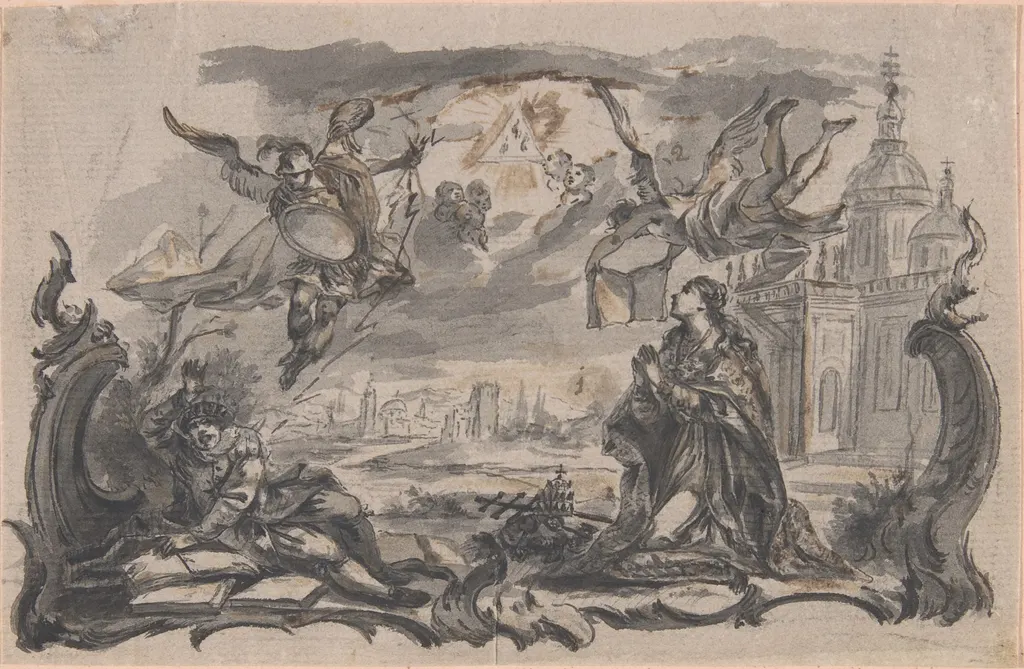
Franz SigristDesign for Book Illustration, late 18th centuryPen and black ink, brush and black, brown, gray wash on paper washed with gray. Incised for transfer. Mounted on pink paper with pencil framing lines.The Metropolitan Museum of Art, collection record. CC0 1.0 (Public Domain)
In Trinity College Dublin, behind glass in a dim room, lies a book about 1,200 years old. Its pages are turned only a few times a year to protect them. Open at one of its great decorated pages, the Book of Kells is a whirl of interlaced ribbons, spirals, animals biting their own tails and tiny human heads, all in service of a few words of Gospel text. Its makers were not decorating a book so much as making the word of God visible.
That relationship between word and image sits at the heart of illustration. An illustration (from the Latin illustrare, to light up or make clear) exists to illuminate a text, explain an idea, tell a story or sell a product. It has often been treated as a lesser art than painting, yet many of the most widely seen images ever made are illustrations. This article traces its history, from hand-painted manuscripts through printed books, scientific plates, Victorian picture books and posters, to the modern picture book.
Before printing: manuscripts and scrolls
For most of history, illustrated books were made entirely by hand. In medieval Europe, monasteries and, later, urban workshops produced illuminated manuscripts, so called because of the gold and silver leaf that seems to light up the page. The Book of Kells, made around 800 and now in the Old Library of Trinity College Dublin, is among the most celebrated; the Très Riches Heures du Duc de Berry, painted by the Limbourg brothers in the early fifteenth century and now in the Musée Condé at Chantilly, shows the calendar months through scenes of aristocratic life and peasant labour.
Other traditions were just as sophisticated. In Persia, royal workshops produced lavishly painted manuscripts of poetry and epic, among them the great Shahnameh ("Book of Kings") made for Shah Tahmasp in the sixteenth century. At the Mughal court in India, the emperor Akbar commissioned the enormous illustrated Hamzanama, an adventure romance, in the later sixteenth century. And in China, printing came first: the Diamond Sutra, a Buddhist text found at Dunhuang and dated to 868, opens with a woodblock-printed frontispiece and is often described as the earliest dated printed book.
The printed image: woodcuts and engravings
In Europe, the arrival of printing with movable type in the mid-fifteenth century transformed illustration. Woodcuts, carved in relief so that the raised lines take the ink, could be locked into the same press as the type.
The most ambitious early illustrated book was the Liber chronicarum, or Nuremberg Chronicle, published in 1493 by Anton Koberger with woodcuts from the workshop of Michael Wolgemut and Wilhelm Pleydenwurff. It contains more than 1,800 illustrations, but only about 645 different blocks: the same woodcut city or king was reused under different names. Wolgemut's former apprentice, Albrecht Dürer, raised the woodcut to a new level with his Apocalypse series of 1498.
Engraving, in which lines are cut into a copper plate and printed under great pressure, allowed finer detail and became the dominant method for high-quality illustration from the later sixteenth century. Because engraved plates had to be printed separately from type, illustrations increasingly appeared on separate pages, as plates. Our guide to printmaking techniques explains the differences between relief, intaglio and later processes.
Look closer: To tell a woodcut from an engraving in an old book, look at the lines through a magnifying glass. Woodcut lines tend to be bolder, with ink sometimes squeezed to the edges. Engraved lines swell and taper to fine points, and the paper around an engraved plate often shows a slight indentation, the plate mark.
Illustration as knowledge
From the Renaissance onward, illustration became essential to science, exploration and record-keeping. Images could convey what words alone could not.
- Anatomy: Andreas Vesalius's De humani corporis fabrica, printed in Basel by Johannes Oporinus in 1543, used over 250 woodcuts of skeletons and flayed figures posed in landscapes. Their designer is debated; modern scholars generally attribute them to artists in the circle of Titian's workshop in Venice, rather than to a single named hand.
- Microscopy: Robert Hooke's Micrographia (1665) revealed a flea and a louse, engraved at enormous size, to an astonished public.
- Natural history: Maria Sibylla Merian's Metamorphosis insectorum Surinamensium (1705), based on her own observations in Suriname, showed insects through their life cycles on their host plants. John James Audubon's The Birds of America (1827–38) printed birds life-size on huge sheets.
- Travel and ethnography: illustrated travel books shaped European ideas of distant places, sometimes accurately, sometimes not. For one influential example, see our article on Johan Nieuhof's images of China.
At the end of the eighteenth century the English engraver Thomas Bewick perfected wood engraving, cutting into the hard end grain of boxwood with engraving tools. It produced fine detail like copper engraving but could be printed alongside type. His History of British Birds (first volume 1797) made the technique famous, and wood engraving went on to dominate book and magazine illustration for most of the nineteenth century.
Poets, satirists and the Victorian boom
Some artists merged text and image completely. William Blake wrote, illustrated, etched, printed and coloured his own books, beginning with Songs of Innocence in 1789, using a relief-etching method of his own devising so that words and pictures were made together on the same copper plate.
The nineteenth century brought cheap paper, steam presses, rising literacy and an explosion of illustrated magazines and novels. Punch, founded in London in 1841, helped give the word "cartoon" its modern meaning of a humorous or satirical drawing. Charles Dickens's novels appeared with illustrations by George Cruikshank and "Phiz" (Hablot Knight Browne). John Tenniel, Punch's leading cartoonist, illustrated Lewis Carroll's Alice's Adventures in Wonderland (1865), fixing the appearance of Alice, the Hatter and the Cheshire Cat for generations.
Lithography, invented by Alois Senefelder in the 1790s, and later colour processes made colour printing increasingly affordable. In London the printer Edmund Evans used colour wood engraving to produce children's books by Walter Crane, Randolph Caldecott and Kate Greenaway, creating the modern illustrated picture book. In the United States, the American Library Association's Caldecott Medal for picture-book illustration, first awarded in 1938, is named after Caldecott.
The golden age and the poster
Around 1900, new photomechanical processes allowed artists' original drawings and watercolours to be reproduced faithfully in colour. Lavish gift books illustrated by Arthur Rackham and Edmund Dulac made fairy tales and classics into luxury objects. Beatrix Potter's The Tale of Peter Rabbit, privately printed in 1901 and published by Frederick Warne in 1902, showed what small-format watercolour illustration could achieve; our guide to watercolour basics covers the medium she used.
On the streets, colour lithography produced the art poster. In Paris, Jules Chéret, Henri de Toulouse-Lautrec and Alphonse Mucha, whose posters for the actress Sarah Bernhardt began in the mid-1890s, turned advertising into art. Their sinuous lines fed directly into Art Nouveau, discussed in Art Nouveau and Art Deco: How to Tell Them Apart. In Britain, Aubrey Beardsley's black-and-white drawings for books and magazines were equally influential.
Japan had its own rich tradition of illustrated books and prints. Katsushika Hokusai's Hokusai Manga, sketchbooks of figures, animals and everyday life published in volumes from 1814, reached Europe later in the century and influenced artists there.
The twentieth century and after
Illustration became central to mass media: magazine covers, advertising, comics and children's books. Norman Rockwell painted his first cover for the American Saturday Evening Post in 1916 and went on to create hundreds more. In the Netherlands, painters such as Jan Sluijters also worked as book illustrators, as we explore in Jan Sluijters as a Book Illustrator.
The modern picture book, in which words and images carry the story equally, matured in the mid-twentieth century. Maurice Sendak's Where the Wild Things Are (1963) is a famous example: as Max's imaginary journey grows, the pictures expand to fill the page and the text shrinks away. Since then, digital tools have joined pencil, paint and printmaking, but the illustrator's task remains the same.
A brief timeline
| Date | Development |
|---|---|
| c. 800 | The Book of Kells, an illuminated Gospel manuscript |
| 868 | The Diamond Sutra, a printed Buddhist text with a woodblock frontispiece |
| 1493 | The Nuremberg Chronicle, with hundreds of woodcuts |
| 1498 | Dürer's Apocalypse woodcuts |
| 1543 | Vesalius's Fabrica, a landmark of scientific illustration |
| 1789 | Blake's Songs of Innocence, words and images etched together |
| 1797 | Bewick's History of British Birds popularises wood engraving |
| 1865 | Tenniel's illustrations for Alice's Adventures in Wonderland |
| 1890s | The art poster flourishes in Paris |
| 1902 | The Tale of Peter Rabbit published by Warne |
| 1963 | Sendak's Where the Wild Things Are |
Looking at illustration
Next time you open an illustrated book, old or new, try asking:
- What does the image add? Does it show something the text describes, or something the text leaves unsaid?
- How was it made and printed? Woodcut, engraving, lithograph, photographic reproduction or digital print each leave characteristic marks.
- How do word and image share the page? Are illustrations separate plates, or woven into the layout?
- Who was the audience? Scholars, worshippers, children, newspaper readers and shoppers all needed different kinds of picture.
More on drawing and its history is collected under painting and drawing.
Sources
- The Book of Kells, Trinity College Dublin
- Historical Anatomies on the Web: Andreas Vesalius, U.S. National Library of Medicine
- William Blake 1757–1827, Tate
- Art Nouveau (art term), Tate