Johan Nieuhof's Images of China
How a steward on the Dutch East India Company's embassy to Beijing in 1655–57 drew China, and how his illustrated book of 1665 shaped Europe's chinoiserie.
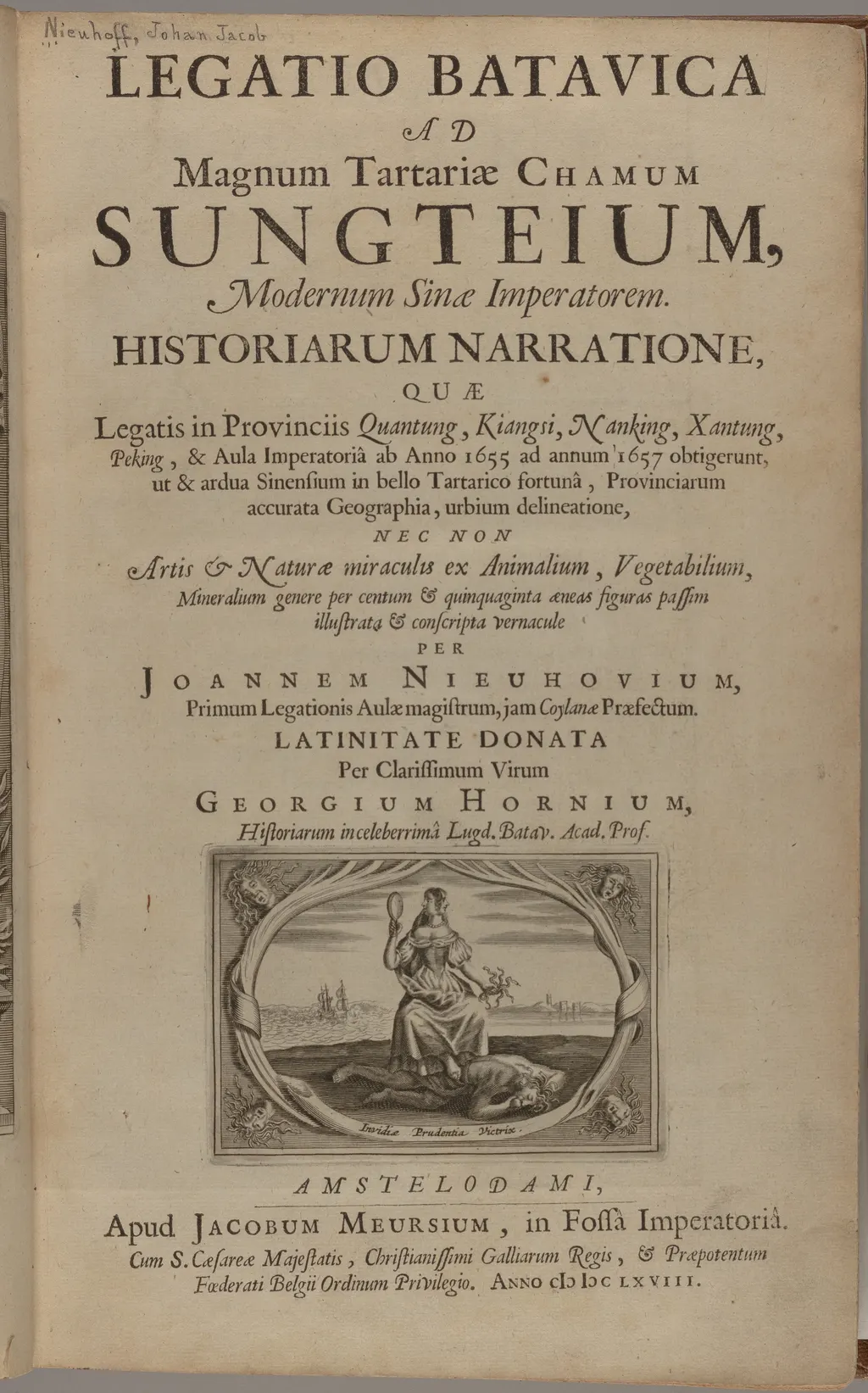
Johannes NieuhofLegatio batavica ad magnum Tartariæ chamum Sungteium, modernum Sinæ imperatorem : historiarum narratione, quæ legatis…, 1668The Metropolitan Museum of Art, collection record. CC0 1.0 (Public Domain)
Turn the pages of a Dutch travel book of 1665 and you come upon a tower that seems to belong to a fairy tale. It rises in tier after tier, each roof flicking up at the corners and hung with bells, while tiny figures stroll at its base. This is the Porcelain Tower of Nanjing, completed in 1431 and destroyed in 1856, as shown in Johan Nieuhof's account of the Dutch East India Company's embassy to the Chinese emperor. For many Europeans of the later seventeenth century, this engraving was the Porcelain Tower. Before long it was counted among the wonders of the world.
Nieuhof's book was one of the most influential illustrated books of its age. Its 150-odd plates of cities, temples, officials, boats, plants and animals gave European readers a visual vocabulary for China that designers drew on for a century and more.
This article follows Nieuhof from Batavia to Beijing, looks at how his drawings became prints, and explains why the book mattered so much to the European fashion for chinoiserie.
A traveller for hire
Johan Nieuhof was born on 22 July 1618 in Uelsen, in the county of Bentheim, just across today's border between the Netherlands and Germany. Like many young men of the region, he sought his fortune in Dutch overseas enterprise. In 1640 he sailed to Dutch Brazil, where he stayed until 1649, and he then entered the service of the Dutch East India Company (VOC), living for several years in Batavia, present-day Jakarta.
The embassy to Beijing
In 1655 the VOC sent an embassy to the new Qing court, hoping to secure trading rights in China. The Manchu Qing dynasty had taken Beijing in 1644, and fighting against Ming loyalists still continued in the south. The embassy was led by two merchants, Pieter de Goyer and Jacob de Keyzer. Nieuhof went as steward, responsible for ceremonial matters and lodgings, and was given a second task: to draw the cities, palaces, temples and rivers they passed, as they really appeared.
The party left Canton (Guangzhou) by barge on 17 March 1656 and travelled north by river and canal, passing Nanjing on the way. They reached Beijing on 18 July 1656. On 24 September they were received by the Shunzhi Emperor and performed the kowtow. Diplomatically the mission was a disappointment: the emperor allowed Dutch embassies to come once every eight years but granted no trading rights. The embassy was asked to leave Beijing in October and returned south, reaching Batavia in 1657.
From notes to book
Back in the Netherlands, Nieuhof's notes and drawings were turned into a book by his brother Hendrik. It was published in Amsterdam in 1665 by Jacob van Meurs, a printer and publisher who specialised in lavishly illustrated travel books. Its title, abbreviated, is Het gezantschap der Neêrlandtsche Oost-Indische Compagnie, aan den grooten Tartarischen Cham, den tegenwoordigen keizer van China, "The embassy of the Netherlands East India Company to the Great Tartar Khan, the present emperor of China".
The book was an immediate success across Europe:
- 1665 – Dutch first edition, Amsterdam, Jacob van Meurs.
- 1665 – French translation by Jean le Carpentier.
- 1666 – German translation.
- 1668 – Latin translation by Georg Horn, as Legatio Batavica.
- 1669 – English translation by John Ogilby, An Embassy from the East-India Company, London.
Further editions followed, including later Dutch printings in the 1690s.
Drawings and prints
For three centuries, readers knew Nieuhof's China only through the engravings. Then, in 1984, his original drawings were rediscovered in the collection formed by Prince Roland Bonaparte. The historians Leonard Blussé and Reindert Falkenburg published them in 1987 under the title Johan Nieuhofs beelden van een Chinareis, 1655–1657, "Johan Nieuhof's images of a journey to China".
The rediscovery made it possible to compare what Nieuhof saw with what his publisher printed. Engravers in seventeenth-century publishing houses commonly redrew travellers' sketches to fit the page and the market, and could add figures or details along the way. Comparing drawing and print shows where the engravers kept close to Nieuhof's observations and where they elaborated, and reminds us that "drawn from life" on a title page was a selling point as well as a claim.
Look closer: In a Nieuhof plate, look at the edges rather than the centre. The main building is often close to what a traveller could have drawn, while foreground figures, animals and decorative boats may have been added in the workshop to make the scene livelier. Ask which parts look observed and which look composed.
Why the book mattered
Before 1665 European images of China were scarce and often fanciful. Nieuhof's plates were not the first, but they were by far the most numerous and the most widely circulated, and they were presented as true to nature. They showed pagodas, city gates, arched bridges, junks and sampans, mandarins and their attendants, people at work, and exotic plants and animals. The Porcelain Tower became a fixture of European writing about China; the Austrian architect Johann Bernhard Fischer von Erlach included it in his illustrated history of architecture of 1721.
Above all, the book fed the taste for chinoiserie, the European style that borrowed motifs from China and East Asia and recombined them freely. Artists, craftsmen and architects took figures, buildings and landscapes from its plates, along with other printed sources, for decoration on ceramics, lacquer, textiles, wallpapers and garden buildings. The fashion reached the French court, where in the mid-1680s the Beauvais tapestry works commissioned a series showing the emperors Shunzhi and Kangxi. The demand for such images helps explain why Dutch potters in Delft, imitating imported Chinese porcelain, so often painted Chinese figures and landscapes, a story told in our history of Delftware.
Tracing a particular decorative scene back to a particular Nieuhof plate needs care. Designers mixed sources, and many images circulated through copies of copies. But the book's role in giving Europe a shared repertoire of "Chinese" images is not in doubt.
A restless end
Nieuhof continued to serve the VOC. He was sent on a mission to Quilon on the Malabar coast in 1663 and was stationed in Ceylon from 1663 to 1667, where he was imprisoned for seven months for illegal pearl trading. In 1672, on a voyage that called at Madagascar, he went inland to trade and look for water and was never seen again; 8 October 1672 is given as the date of his disappearance. Accounts of his travels in Brazil and the East Indies were published posthumously in 1682.
Where to see Nieuhof's China
Copies of the book in several languages are held by major libraries, and digitised editions, including Ogilby's English translation and Horn's Latin version, can be read online. Individual plates appear regularly in print rooms and on the market. To understand how they were made, see printmaking techniques explained, and for the wider story of pictures in books, a short history of illustration. For the Dutch world that produced the book, read Dutch Golden Age painting: a beginner's guide. More in art history.
Sources
- An embassy from the East-India Company of the United Provinces, to the Grand Tartar Cham, emperour of China (London, 1669), Internet Archive (McGill University Library copy)
- Legatio Batavica ad magnum Tartariae chamum Sungteium (Amsterdam, 1668), Internet Archive
- Johan Nieuhof, Wikipedia
- Porcelain Tower of Nanjing, Wikipedia