Delftware: The Story of Dutch Blue and White
How Dutch potters in Delft turned tin-glazed earthenware into a rival for Chinese porcelain, from Antwerp origins and flower pyramids to tiles and decline.
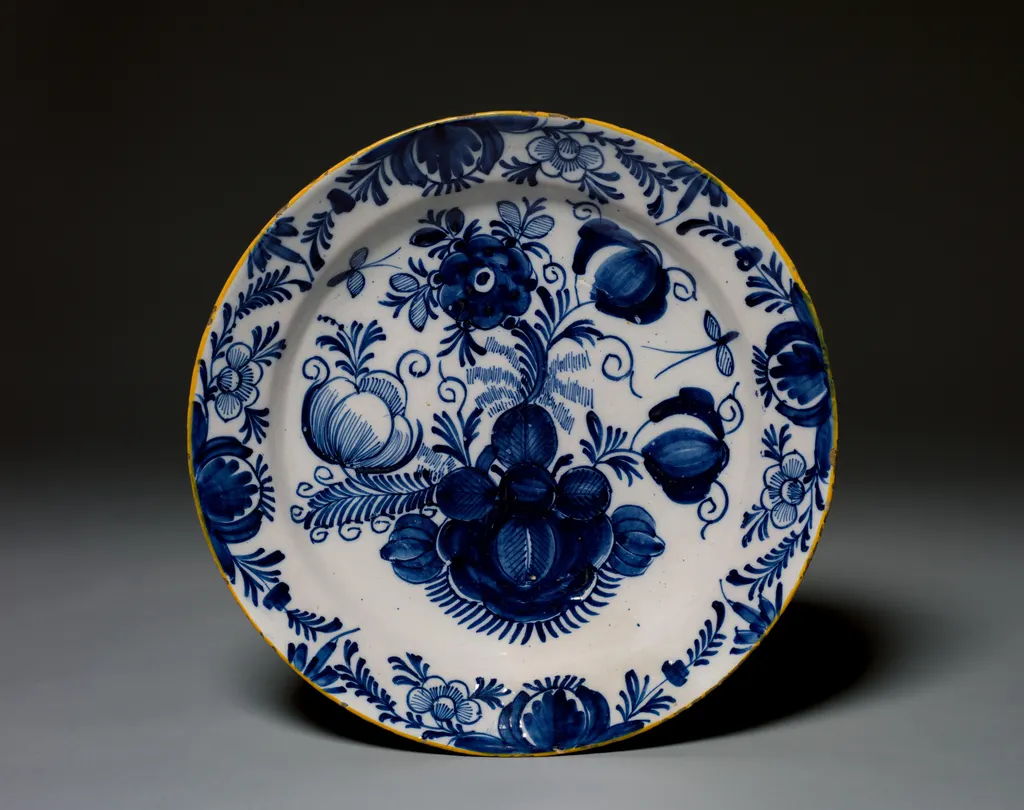
Netherlands, HollandDelftware Plate, c. 1750glazed ceramicCleveland Museum of Art, collection record. CC0 1.0 (Public Domain)
In the Victoria and Albert Museum stands a blue-and-white tower nearly a metre high. It is built from stacked tiers, each bristling with little spouts, and each spout was made to hold a single cut flower. Seen in full bloom it would have looked like a fountain of tulips. The object was made around 1695 at the Greek A factory in Delft, then run by Adrianus Kocx, and it carries his monogram. Kocx's most important customer was Queen Mary II, who, according to the V&A, introduced the fashion for Dutch delftware to England after 1689 and still owed him £122 14s 9d for "Dutch China or ware" when she died.
That flower pyramid captures the ambition of Delft's potters. They were working in earthenware, a soft, porous clay fired at low temperature, yet they made it look, and sell, like the hard white porcelain that Dutch ships were bringing from China. This article traces how the craft reached Delft, why the town became its centre, what the potters made, and how to look at a piece of Delftware with a sharper eye.
From Italy to Antwerp to Delft
The technique behind Delftware is tin glazing: a lead glaze made opaque and white with tin oxide, painted with metallic oxides such as cobalt for blue. It came to the Low Countries from Italy, where the same ware is called maiolica. Italian potters settled in Antwerp in the early sixteenth century; the best known, Guido Andries (also recorded as Guido da Savino), is documented there in the first years of the century, although sources disagree on the exact date of his arrival.
After Antwerp fell to Spanish forces in 1585, many craftsmen moved north into the Dutch Republic, and tin-glaze workshops appeared in towns such as Middelburg, Haarlem, Rotterdam and Delft. In English usage, the V&A explains, "delftware" (lower case) covers all tin-glazed earthenware made in the Netherlands and the British Isles, while wares made in Delft itself are simply called "Delft".
The porcelain problem
Early Dutch tin-glazed pottery was colourful and often Italianate. What changed it was Chinese porcelain. The Dutch East India Company (VOC), founded in 1602, began shipping it in quantity, and the seizure of Portuguese carracks laden with Chinese goods in the first years of the century helped make it fashionable. One of these, the Santa Catarina, was captured off Singapore in 1603. Blue-and-white export porcelain of the late Ming period became known in Dutch as kraakporselein, a name that the Rijksmuseum and other authorities link to the Portuguese carrack (caracca) in which it was carried.
Delft potters set out to imitate it. Around 1615, according to research summarised by Essential Vermeer, they began covering whole pieces in white tin glaze and adding a clear top glaze, known by the Italian-derived term kwaart, which gave the surface a porcelain-like depth and shine.
Then the supply of Chinese porcelain faltered. The civil wars that accompanied the fall of the Ming dynasty in 1644 disrupted both trade routes and the great kilns at Jingdezhen. The VOC turned to Japan for porcelain, and Delft's potteries expanded to fill the gap.
A boom town of potteries
Several local circumstances favoured Delft. The town lay on the Schie river, had access to clay, hosted a chamber of the VOC, and had a declining brewing industry whose large empty buildings could be turned into workshops. Many potteries kept the old brewery names, which is why Delft factories bear names such as De Metaale Pot (The Metal Pot), De Porceleyne Fles (The Porcelain Bottle) and De Grieksche A (The Greek A).
The numbers show the scale of the boom:
- By 1625: eight workshops were making Delftware, according to the Dutch Delftware heritage website.
- 1640: eleven factories, according to figures cited by Essential Vermeer.
- 1653: De Porceleyne Fles was founded; it is the only seventeenth-century Delft pottery still in operation today.
- 1661: faience producers and sellers became official members of the city's Guild of St Luke, the guild that also included painters.
- Around 1700: some 34 workshops and potteries, the peak of the industry.
- End of the eighteenth century: eleven potteries remained.
The Guild of St Luke connection matters. Delft's potters and painters belonged to the same artistic world, and many pot painters were skilled draughtsmen working from prints, Chinese models and pattern sheets. Vermeer, a member of the guild himself, painted a row of Delft tiles along the base of the wall in The Milkmaid (Rijksmuseum, about 1660). For more on that world, see Vermeer and His Milieu.
What Delft made
Blue and white "chinoiserie"
The core product imitated Chinese export porcelain: plates with panelled borders, ginger jars, garnitures of vases for the mantelpiece, and figures in invented "Chinese" landscapes. Dutch travel books with engraved views of China, such as the account discussed in Johan Nieuhof's Images of China, helped feed a European appetite for Eastern imagery.
Tiles
Tiles were Delft's everyday mass product: biblical scenes, children's games, ships, soldiers, flowers and landscapes, usually blue on white or manganese purple on white, set into kitchen walls, fireplaces and skirting. They survive in enormous numbers and are often the most affordable way to own seventeenth- or eighteenth-century Delftware.
Showpieces
At the top end were tulip vases, flower pyramids, large plaques and elaborate polychrome wares. Polychrome decoration in green, yellow and manganese, and later in enamel colours over the glaze, broadened the palette, though blue and white remained the signature.
Delft and the Dutch interior: Delftware appears again and again in Dutch genre painting, on shelves, mantelpieces and kitchen walls. When you visit a gallery of seventeenth-century Dutch pictures, try spotting tiles and blue-and-white jars in the backgrounds. Our beginner's guide to Dutch Golden Age painting is a good companion for that kind of looking.
Decline and revival
The eighteenth century brought competition from every direction. European porcelain became available after Meissen began production in 1710; Chinese porcelain grew cheaper again; and English creamware, a thin, durable, lead-glazed earthenware, took over the market for everyday tableware. English and French import restrictions closed off important markets. Delft's factories closed one by one, and by the nineteenth century De Porceleyne Fles was the last survivor. Its revival began in 1876 under a new owner, the engineer Joost Thooft, and it continues today as Royal Delft.
How to look at a piece of Delftware
- Find the body. Turn the piece over and look at chips on the rim or the unglazed areas of the base. Delftware is earthenware, so the body is soft and buff, pinkish or yellowish, not white. If the exposed body is hard and white, you are looking at porcelain or a later ware. Our guide to identifying ceramic styles explains the differences.
- Check the rims. Tin glaze flakes easily from edges. Old Delft plates almost always show some fritting or chipping along the rim.
- Look underneath. Many plates show three small marks on the underside where they rested on kiln supports. A slightly bluish or pinkish tinge to the white glaze is typical.
- Read the painting. Brushwork on tin glaze has to be quick and sure, because the powdery raw glaze absorbs pigment immediately and leaves no room for correction. Confident, fluid lines are a good sign; laboured, stiff ones may indicate a later copy.
- Be wary of marks. Factory marks and monograms were copied extensively in the nineteenth and twentieth centuries. A mark should agree with the body, glaze, form and style, not the other way round.
Where to see Delftware
The Rijksmuseum in Amsterdam has one of the world's great Delftware collections, including several tulip vases and pyramids. Museum Prinsenhof Delft and the Kunstmuseum Den Haag both hold important collections, and Royal Delft maintains a museum at its factory in Delft. In Britain the V&A shows Kocx's flower pyramid, and its collections of English delftware, made in centres such as London, Bristol and Liverpool, invite instructive comparison with the Dutch originals. Many of these collections are searchable online, so you can compare dozens of examples before you ever handle one.
Sources
- Flower pyramid, 'Greek A' factory, Delft, c. 1695, Victoria and Albert Museum
- A–Z of ceramics, Victoria and Albert Museum
- The Milkmaid, Johannes Vermeer, c. 1660, Rijksmuseum
- How did Delftware develop?, Dutch Delftware (DelftsAardewerk.nl)
- The Evolution and Production of Delftware, Essential Vermeer