Vermeer and His Milieu: Delft, Patrons and Fellow Painters
Vermeer's Delft through the archives: his family, the Guild of St Luke, patrons Pieter van Ruijven and Maria de Knuijt, and the painters who worked around him.
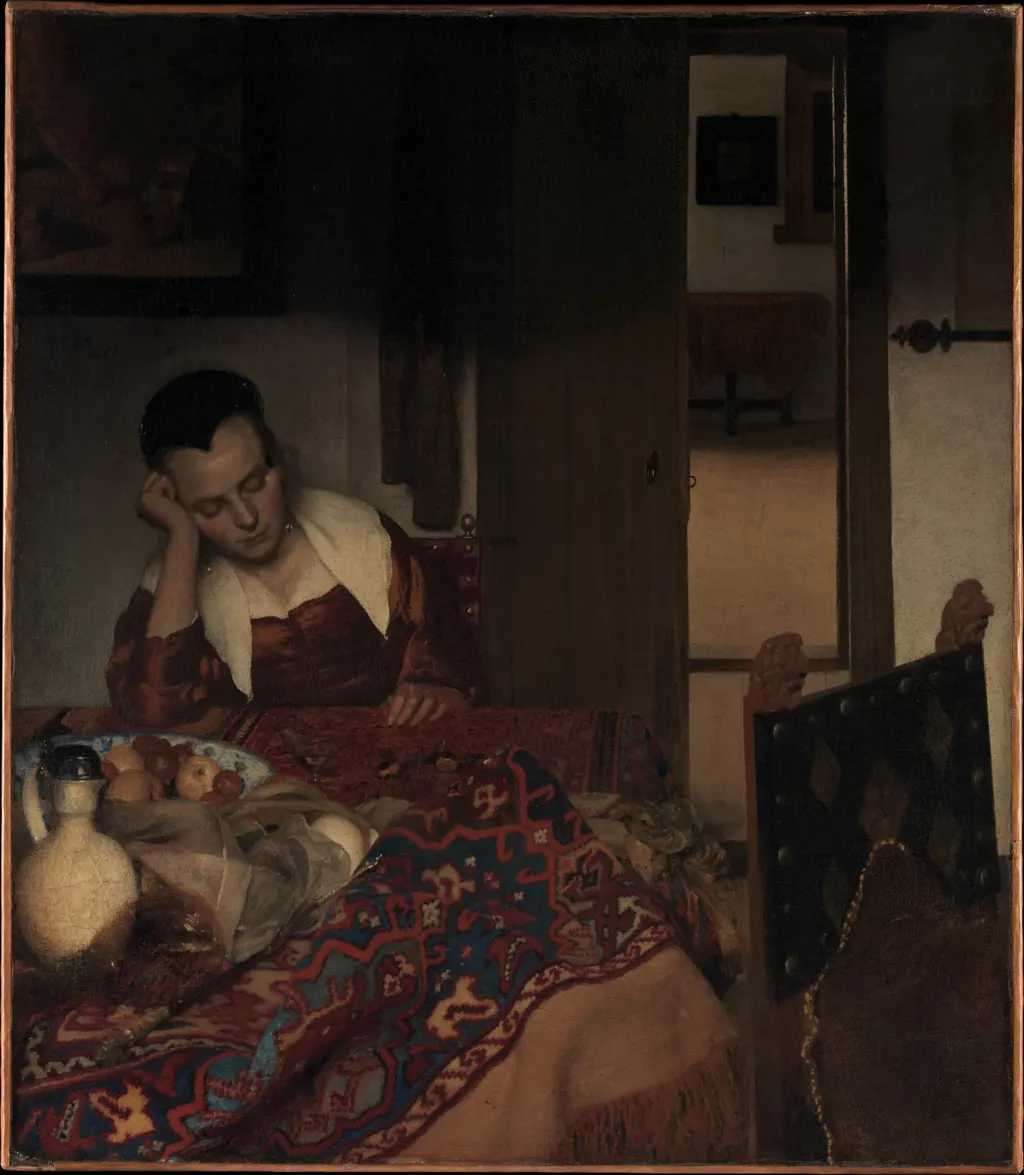
Johannes VermeerA Maid Asleep, ca. 1656–57Oil on canvasThe Metropolitan Museum of Art, collection record. CC0 1.0 (Public Domain)
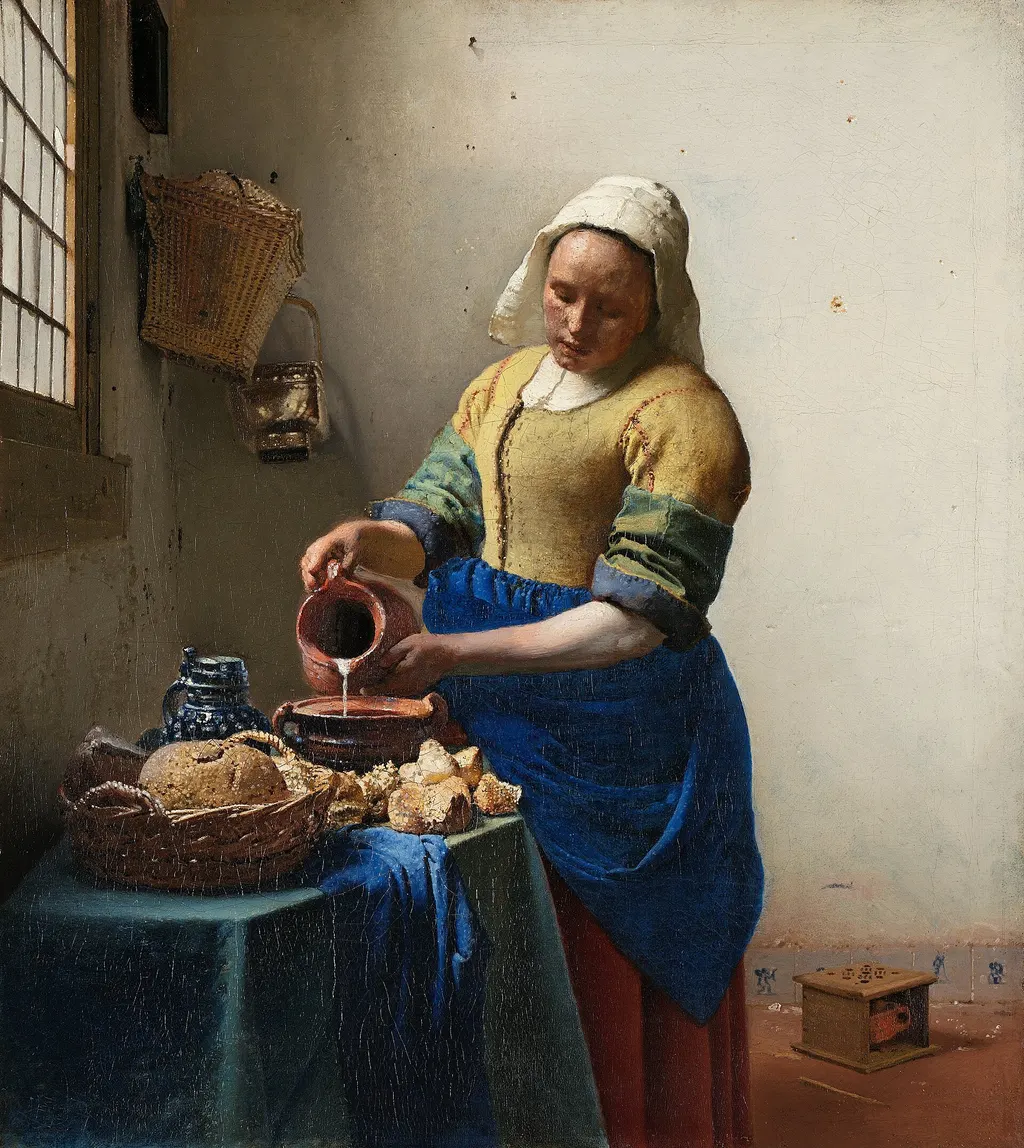
On 16 May 1696 an auction was held in Amsterdam of the paintings left by Jacob Dissius of Delft. Among them were twenty-one pictures by Johannes Vermeer, who had died twenty years earlier. Lot 2, described as a maid pouring out milk, sold for 175 guilders; a view of the city of Delft fetched 200. Today The Milkmaid is in the Rijksmuseum and the View of Delft in the Mauritshuis, and that single sale accounts for a large share of the Vermeers we know.
How did so many of one painter's works end up in a single Delft household? Answering that question has driven some of the most productive archival research in the history of Dutch art. This article looks at what the documents reveal about Vermeer's family, his guild, his clients and his fellow painters, and how recent research has shifted the picture once again.
A family in the art trade
Vermeer was baptised in the Nieuwe Kerk in Delft on 31 October 1632. His father, Reynier Jansz., was a weaver of fine silk satin (caffa) who also kept an inn and, from 1631, was registered with the Delft Guild of St Luke as an art dealer. In 1641 the family bought a larger inn, called Mechelen, on the Market Square, a few steps from the Nieuwe Kerk. Vermeer therefore grew up among pictures being bought and sold, and after his father's death in 1652 he appears to have continued the dealing side of the business.
In April 1653 Vermeer married Catharina Bolnes, whose mother, Maria Thins, was a well-off Catholic from Gouda. The marriage seems to have met initial resistance from Maria Thins; the Delft painter Leonaert Bramer is among those documented as supporting the young couple at the time. Vermeer and Catharina eventually lived in Maria Thins's house on the Oude Langendijk, in the part of Delft known as the Papenhoek, where Catholic households clustered.
The Guild of St Luke
On 29 December 1653 Vermeer was registered as a master painter in the Delft Guild of St Luke, which regulated painters, glassmakers, faience potters, printers, booksellers and art dealers. Membership allowed him to sell his work and take pupils in the city. He served as one of the guild's headmen in 1662–63 and again in 1670–71, a sign of the respect in which his colleagues held him.
The guild brought him into regular contact with the rest of Delft's artistic world, including the potters of the city's booming faience industry, whose blue-and-white wares appear in Dutch interiors of the period.
Fellow painters in a small city
Delft in the 1650s was home to an unusually inventive group of painters, many of them interested in light, space and perspective.
| Painter | Dates | Delft connection | Why he matters to Vermeer |
|---|---|---|---|
| Carel Fabritius | 1622–1654 | Joined the Delft guild in 1652; killed in the gunpowder explosion of 12 October 1654 | Former pupil of Rembrandt; luminous, experimental works such as The Goldfinch (1654) |
| Pieter de Hooch | 1629–1684 | In Delft in the 1650s; joined the guild in 1655; moved to Amsterdam around 1660–61 | Courtyards and interiors with carefully measured space and daylight |
| Gerard Houckgeest and Emanuel de Witte | active in Delft c. 1650 | Painted the interiors of the Oude and Nieuwe Kerk | Innovative viewpoints and the play of light through tall windows |
| Leonaert Bramer | 1596–1674 | Senior Delft painter, long active in the guild | Documented as supporting Vermeer at the time of his marriage |
Scholars have long debated who, if anyone, taught Vermeer. No apprenticeship record survives, and Fabritius and Bramer have both been suggested; neither link is documented.
Montias and the "web of social history"
Our knowledge of these networks owes a great deal to John Michael Montias (1928–2005), an American economist who turned to the archives of Delft. In Vermeer and His Milieu: A Web of Social History (1989), he published hundreds of documents concerning Vermeer's family and associates, from notarial deeds to wills and inventories.
Montias's most influential finding concerned Pieter Claesz. van Ruijven (1624–1674), a wealthy Delft patrician. A notarial deed of November 1657 records a loan of 200 guilders from Van Ruijven to Vermeer and his wife. Montias argued that the paintings sold in 1696 had passed from Van Ruijven to his daughter Magdalena and so to her husband, Jacob Dissius, and that Van Ruijven had been Vermeer's principal patron, buying roughly half his output over many years. This interpretation shaped Vermeer studies for a generation, though some scholars questioned how close the relationship really was.
Maria de Knuijt: a new principal patron?
Van Ruijven's wife, Maria de Knuijt (1623–1681), appeared in Montias's documents too, and in her will of the mid-1660s she left a legacy to "Johannes Vermeer, painter". Because Vermeer died before her, the bequest was never paid.
Recent research has put her at the centre of the story. The Rijksmuseum's major Vermeer exhibition of 2023 drew attention to her role, and in 2025 the art historians Piet Bakker and Judith Noorman of the University of Amsterdam published new archival findings in Closer to Vermeer: New Research on the Painter and His Art, issued by the Rijksmuseum. They argue that De Knuijt herself was most likely the driving force behind the purchases, and that she, rather than her husband, should be seen as Vermeer's main client. As with Montias's thesis, the evidence is circumstantial, and it will continue to be weighed.
Archival research rarely produces a single "smoking gun". It works by accumulating small facts, such as a loan, a legacy, an inventory entry or an auction lot, and testing which story explains them best. Each new document can change the balance.
Other buyers and a difficult end
Not all of Vermeer's clients were patricians. In 1663 the French traveller Balthasar de Monconys called on Vermeer, who had no paintings to show him, and was sent to see one owned by a Delft baker, Hendrick van Buyten. After Vermeer's death, his widow transferred two paintings to Van Buyten as security for a large unpaid bread bill.
Vermeer died in December 1675 and was buried in the Oude Kerk on 15 December, leaving Catharina with many young children and heavy debts. In a petition, she blamed the economic collapse that followed the French invasion of 1672, when, she said, her husband had been unable to sell art. The Delft scientist Antonie van Leeuwenhoek was appointed trustee of the estate, and in 1677 paintings from it were sold at the guild hall.
What to look for, and where
- The painted city. Compare the View of Delft (Mauritshuis, The Hague) with The Little Street (Rijksmuseum) to see how Vermeer recorded real places while subtly adjusting them.
- The neighbours. Hang De Hooch's courtyards in your mind beside Vermeer's interiors: the shared interest in daylight, tiled floors and half-open doors is unmistakable.
- The objects. Maps, faience tiles, chairs with lion-head finials and the same yellow jacket recur across several paintings, suggesting a stock of studio props.
- The provenance. Read the ownership histories on museum websites; many begin "Pieter Claesz. van Ruijven and Maria de Knuijt, Delft", sometimes with a question mark.
For more on the period, read our overview of Dutch Golden Age painting and the story of Delftware, the industry that shared Vermeer's guild. Our explainer on provenance shows how ownership histories like the Dissius sale are pieced together, and how oil painting works helps explain Vermeer's glowing surfaces. Browse more under art history.
Sources
- Johannes Vermeer (1632–1675) (Heilbrunn Timeline of Art History), The Metropolitan Museum of Art
- The Milkmaid, Johannes Vermeer, c. 1660, Rijksmuseum
- Was Vermeer's main client a woman? (press release, 10 July 2025), University of Amsterdam
- Vermeer's clients and patrons, Essential Vermeer