The Man Behind the Painter: Houbraken's Lives of Dutch Artists
Arnold Houbraken's Groote Schouburgh (1718–21) holds the best-known stories about Dutch painters. What it tells us, where it errs, and how to read it now.
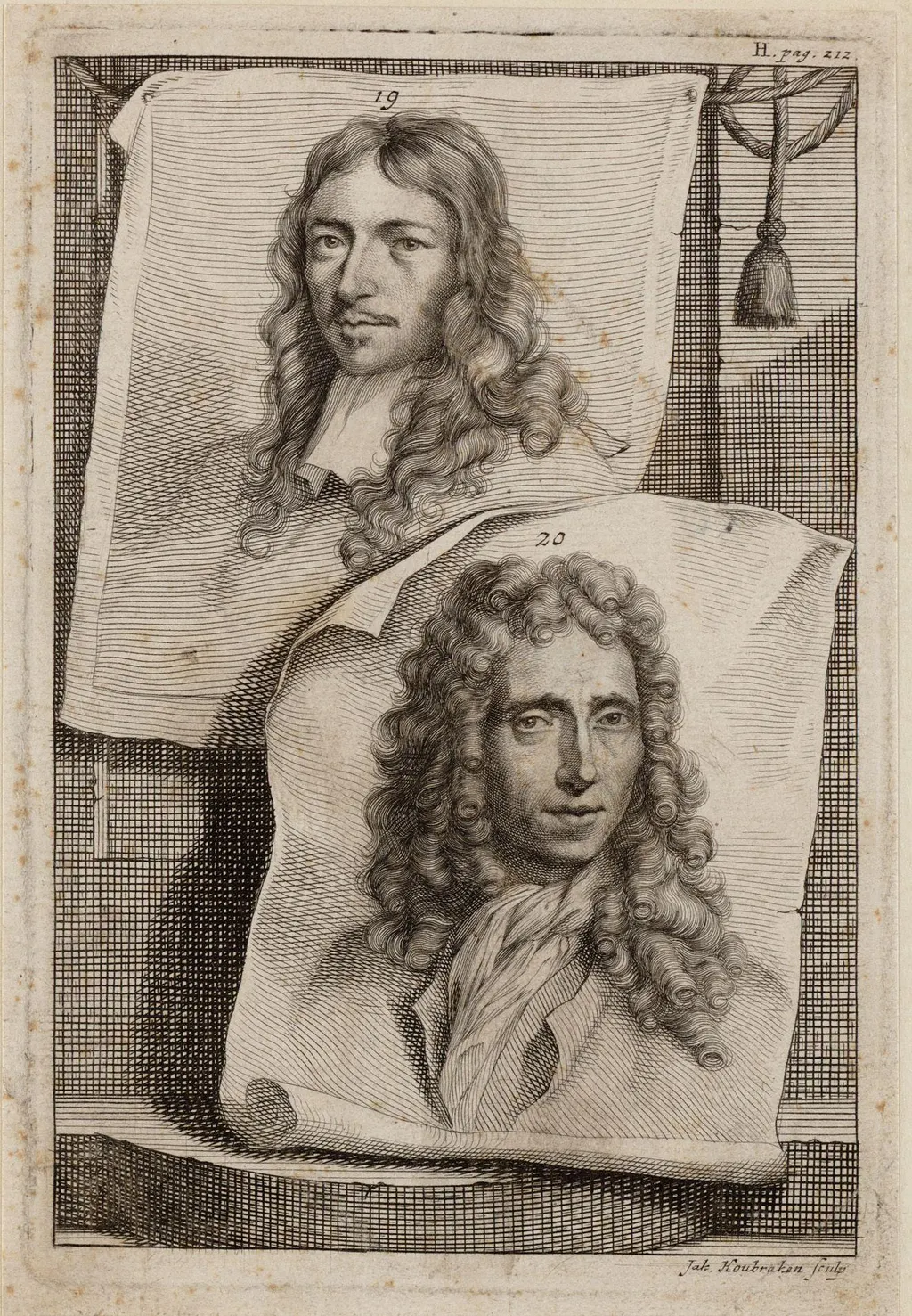
Jacob HoubrakenTwo portraits, plate from Houbraken's Groote Schouburgh, volume II, c. 1721Amsterdam City Archives (via Wikimedia Commons), collection record. Public domain
Frans Hals, so the story goes, was so often drunk by evening that his senior pupils took turns fetching him from the tavern and putting him to bed. One night, after hearing him pray to be taken up to heaven, they tied ropes to his bed and began to hoist it towards the ceiling. Hals, half asleep, begged them to go more slowly, and never said that prayer again.
Nobody knows whether this happened. It comes from a single book, published in Amsterdam almost a century after the event is supposed to have taken place: Arnold Houbraken's De groote schouburgh der Nederlantsche konstschilders en schilderessen, "the great theatre of Netherlandish painters and paintresses". For three hundred years it has supplied the colour in almost every popular account of the Dutch Golden Age: Hals the drinker, Jan Steen the feckless innkeeper, Rembrandt the miser whose pupils painted coins on the floor to tease him.
This article introduces Houbraken himself, explains how his book is built, and offers a practical way to tell where it is a precious witness and where it is telling a good story.
A painter who became a biographer
Houbraken was born in Dordrecht on 28 March 1660 and died in Amsterdam on 14 October 1719. He trained with several local masters before entering the studio of Samuel van Hoogstraten, the Dordrecht painter and theorist who had himself been a pupil of Rembrandt, between about 1675 and 1678. In the Schouburgh Houbraken calls himself the eldest of Hoogstraten's pupils and says he owed the foundations of everything he knew about art to him. His portrait of the teacher is warm: Hoogstraten was patient, made students explain the thinking behind their compositions, and had them act out scenes to learn gesture and expression.
Houbraken spent most of his career in Dordrecht as a painter of portraits, histories, genre scenes and landscapes, and also worked as an etcher, draughtsman and poet. He moved to Amsterdam around 1709–10 and spent time in England in 1713–14. It was in Amsterdam, in the last decade of his life, that he assembled the book that made his name.
How the book is built
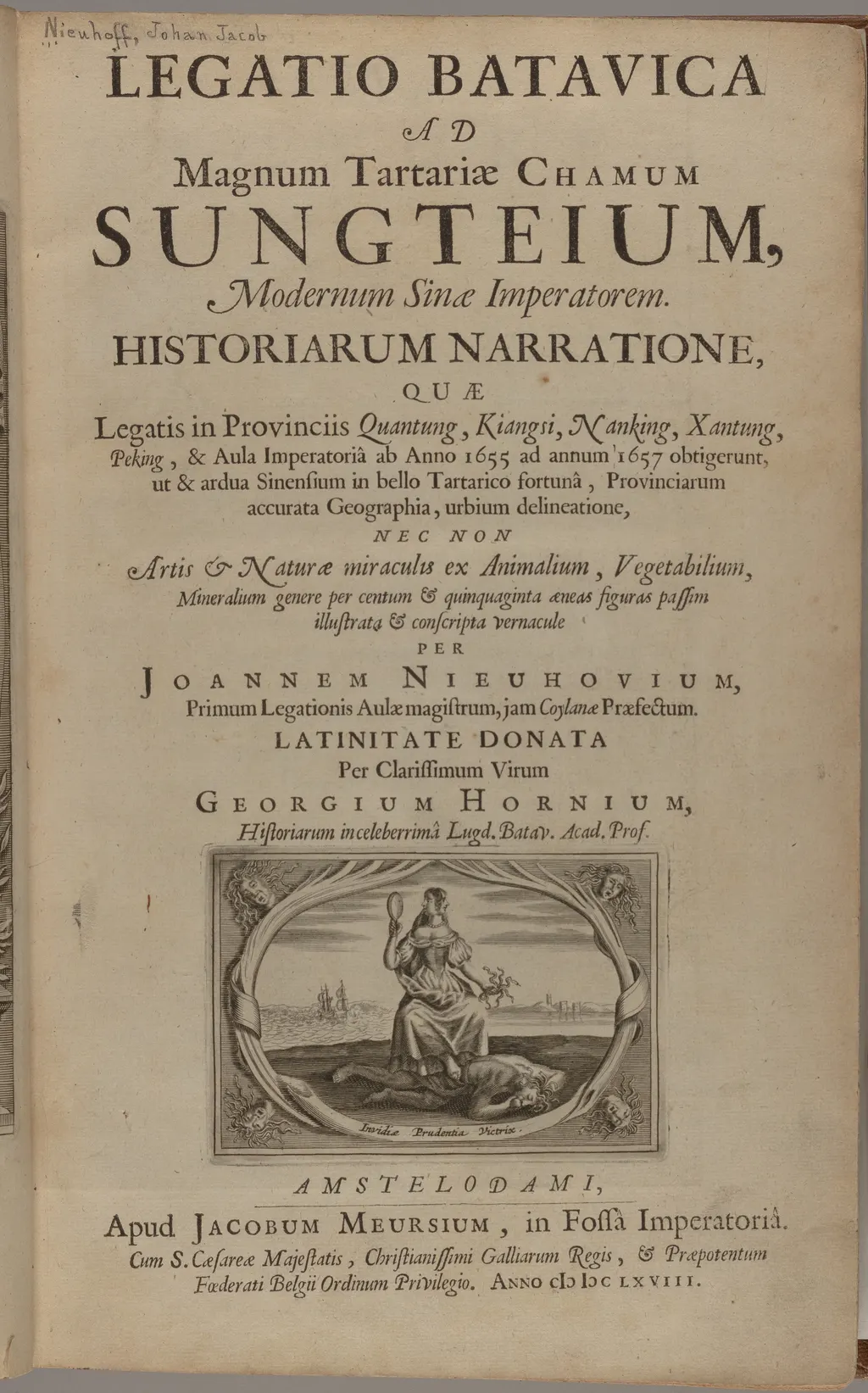
The Schouburgh appeared in three volumes between 1718 and 1721; the last was therefore published after its author's death. A second edition followed in The Hague in 1753, and it is that edition, in a 1976 facsimile, that the Dutch digital library DBNL has transcribed and made freely available online.
Houbraken presented the work as a continuation of Karel van Mander's Schilder-boeck of 1604, the founding collection of Netherlandish artists' lives. In his preface he notes that a century had passed with no Dutch successor, and he set out to fill the gap. Some features of the book:
- Order of birth. Artists appear roughly in the order of their birth years, starting in the sixteenth century and running to painters still alive in Houbraken's day.
- Portraits. Engraved plates show the painters' likenesses, several heads to a plate, with an index of the portraits at the end of each volume.
- Women painters. The title's schilderessen is meant seriously. Entries include the scholar and artist Anna Maria van Schurman, the flower painter Maria van Oosterwijck and the naturalist and illustrator Maria Sibylla Merian.
- Interludes. Sections headed Tussenstuk (interlude) break the run of lives with moral reflections and digressions, including one on ancient Egyptian burial customs.
- Sources. Houbraken names Italian and French writers, among them Vasari, Baglione, Félibien and Roger de Piles, alongside Van Mander, the Flemish poet Cornelis de Bie and especially Joachim von Sandrart's Teutsche Academie. He also borrowed from local histories such as Dirck van Bleyswijck's description of Delft, completed in 1667.
He wrote, too, with a teacher's agenda. Houbraken admired the classicising taste of his own time and planned to end with a section applying the poet Andries Pels's rules of drama to painting. That outlook colours his verdicts. He praises Rembrandt's originality and his rendering of emotion, but disapproves of his disregard for rules and finish, and repeats Pels's mockery of Rembrandt's nudes.
The anecdotes and where they come from
The Schouburgh is loved for its stories, and many are memorable. Rembrandt's late paintings, Houbraken says, were laid on so thickly that one portrait could almost be lifted by its nose. Jan Steen, set up by his father in a Delft brewery, is said to have let the business run down; when his wife urged him to keep the brewery "lively", he bought live ducks and set them swimming in the vat. The boy Jan Lievens drew on undisturbed through a street riot in Leiden in 1618.
Some of these tales have a pedigree that goes back long before the seventeenth century. Houbraken tells how Anthony van Dyck called on Hals in Haarlem without giving his name, sat for a quick portrait, and then revealed himself. Houbraken introduces the episode, explicitly, as a parallel to the ancient story of Apelles and Protogenes, two Greek painters who recognised each other by the brilliance of a single line. A Dutch painter's life was being shaped to fit a classical model.
Other stories turn a painter's subject matter into his biography. Houbraken says outright that Steen's life was as disorderly and comic as his paintings, a convenient equation for a writer and one that later readers repeated for centuries. Steen's merry, crowded household scenes are carefully constructed moral comedies, and their author was a university-enrolled, practising Catholic who also painted religious and mythological works. A drinker's reputation tells us little about how those paintings were made.
Checking Houbraken against the record
Where his statements can be tested against documents, the results are mixed. Some core facts hold; others are simply wrong.
| Houbraken says | What the record shows |
|---|---|
| Frans Hals and his brother were natives of Mechelen | Hals was born in Antwerp, around 1582/3, and worked mostly in Haarlem |
| Jan Steen's father set him up in a brewery in Delft | Confirmed: his father leased a Delft brewery for him from 1654 to 1657 |
| Steen died in 1678 | Steen died in 1679 |
| Rembrandt died in 1674 | Rembrandt died in 1669 |
| Rembrandt's wife was a farm girl from Ransdorp in Waterland | Rembrandt married Saskia van Uylenburgh, cousin of the Amsterdam art dealer Hendrick Uylenburgh, in Friesland in 1634 |
| Lievens went to England in 1631, at about 24 | Modern research places his London years at about 1632–35 |
Silences can be as revealing as errors. Johannes Vermeer, today the most famous Delft painter of all, gets no entry of his own: he appears only as a name in a list of Delft painters that Houbraken took from Van Bleyswijck. For Vermeer's Delft and the painters around him, see our article on Vermeer and his milieu.
None of this makes the book worthless. For Houbraken's own circle, Hoogstraten's studio in Dordrecht and the painters he knew personally, he is a first-hand witness. For dozens of minor painters he is the only biographical source to survive, and his reports of pictures in named collections remain useful leads for provenance research. And he preserves the attitudes of a generation that was already looking back on the seventeenth century as a golden age.
Reading Houbraken today
A reader's checklist
- Ask how close he was. Did Houbraken know the artist, or a pupil of the artist, or is he writing a century later from printed books?
- Look for his source. He often names Van Mander, De Bie, Sandrart or a local chronicle. If the story is borrowed, it is only as good as the original.
- Be wary of tidy morals. An anecdote that neatly illustrates a vice, a virtue or a classical parallel may have been shaped to do just that.
- Separate facts from verdicts. A date or a commission can be checked in the archives; a judgement about "roughness" reflects early eighteenth-century taste.
- Cross-check with documents. Baptism, marriage and burial registers, guild records and inventories have overturned many of his details.
The full Dutch text is free to read on DBNL, with an index of names in each volume, so it is easy to look up a favourite painter and see exactly what Houbraken wrote. The old spelling looks forbidding at first, but it soon becomes readable, especially for anyone with some modern Dutch.
To set his lives against the paintings themselves, start with our introduction to Dutch Golden Age painting, then compare his account of Lievens with the modern picture in Jan Lievens: A Dutch Master Rediscovered. Houbraken's predecessor Cornelis de Bie, and the ways a manuscript can change what we think we know about a painter, appear in our article Did Hendrick ter Brugghen Return to Italy?. More on how artists' reputations were made and remade is under art history.
Sources
- Arnold Houbraken, De groote schouburgh der Nederlantsche konstschilders en schilderessen (3 vols), DBNL (Digitale Bibliotheek voor de Nederlandse Letteren)
- Arnold Houbraken: author page, DBNL
- Arnold Houbraken (1660–1719), ECARTICO, University of Amsterdam
- Houbraken, De groote schouburgh: Rembrandt van Rijn, DBNL
- Frans Hals, The National Gallery, London
- Jan Steen, The National Gallery, London