Abraham Bloemaert and the Ethiopian Story of Heliodorus
How an ancient Greek novel of love, pirates and recognition reached the court of Frederik Hendrik, and the three canvases Abraham Bloemaert painted from it.
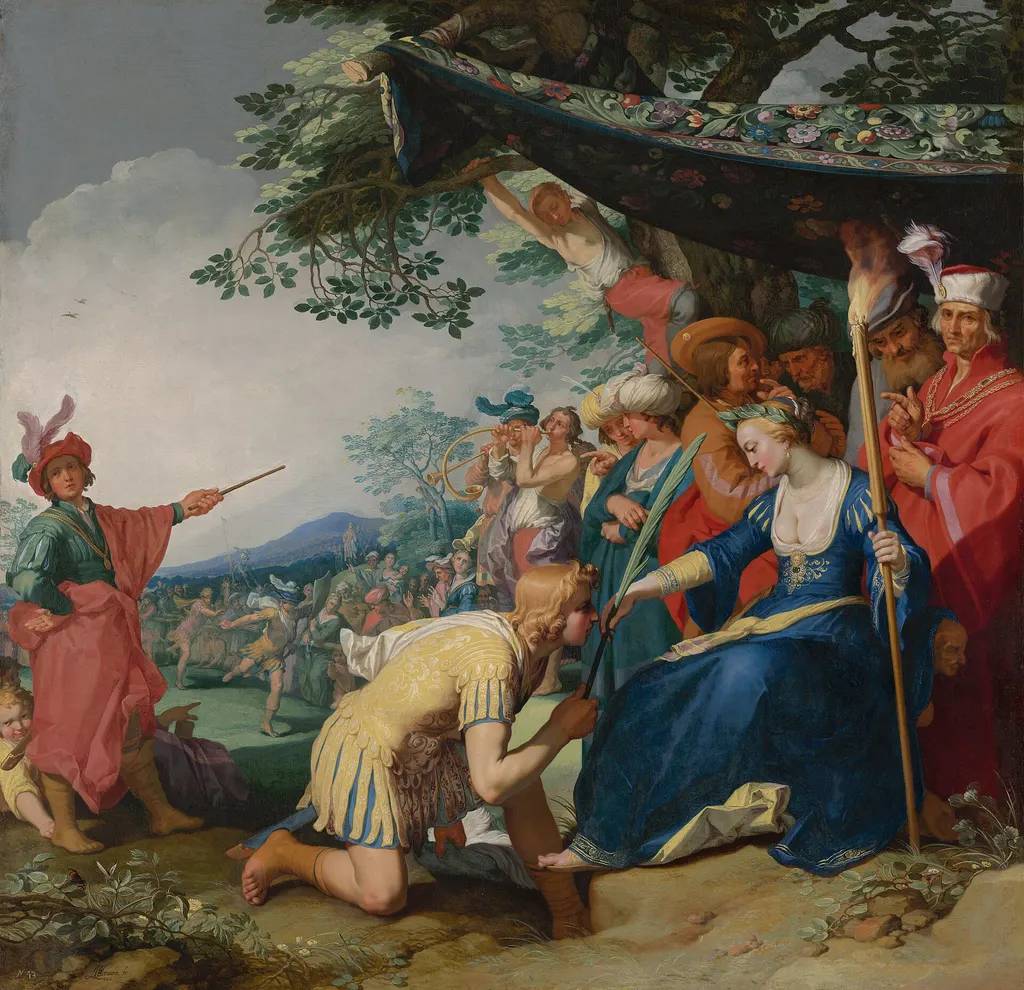
Abraham BloemaertTheagenes Receiving the Palm of Honour from Chariclea, 1626Mauritshuis (via Wikimedia Commons), collection record. Public domain
A beach at the mouth of the Nile, strewn with bodies. A ship lies stranded offshore, still laden with cargo. On a rock sits a young woman of startling beauty, a bow in her hand, tending a wounded young man. Watching from the cliffs above is a band of Egyptian robbers, who cannot decide whether they are looking at a goddess or a survivor.
That is how one of the great adventure stories of antiquity begins, and it is also the subject of a drawing by the Utrecht painter Abraham Bloemaert, now in Museum Boijmans Van Beuningen in Rotterdam. The drawing is the surviving design for one of three large canvases that Bloemaert painted in the mid-1620s for the stadholder Frederik Hendrik, each taken from the Aethiopica of Heliodorus. This article follows the story from its late antique author to the walls of a Dutch princely palace, and explains what the three paintings tell us about taste at the court in The Hague.
A Greek novel with a long afterlife
The Aethiopica, also known as Theagenes and Chariclea, is a Greek prose romance written by a Heliodorus who, at the end of the book, describes himself as a Phoenician from Emesa (modern Homs in Syria). Scholars still debate when he wrote it: the third and the fourth century CE both have their advocates.
Its plot is the stuff of a television serial. Chariclea is the daughter of the black king and queen of Ethiopia, Hydaspes and Persinna, but she is born white, and her frightened mother, fearing accusations of adultery, sends her away. Raised as the ward of a priest at Delphi, Chariclea falls in love with Theagenes, a young Thessalian nobleman who has come to the sanctuary. Helped by the wise Egyptian priest Calasiris, the lovers flee, and are tossed between pirates, bandits, a jealous Persian princess and a war between Egypt and Ethiopia before a final recognition scene in Meroë restores Chariclea to her parents and allows the couple to marry.
What made the book admired by later readers was not just its incident but its construction. Heliodorus opens in medias res, on that blood-soaked beach, and only gradually reveals how his characters got there. After a manuscript surfaced in the sixteenth century the novel was printed in Greek at Basel in 1534, and Jacques Amyot's French translation of 1547 made it a favourite of European readers. Painters, playwrights and tapestry designers followed. The virtuous heroine, chaste lovers and exotic settings suited a courtly culture that liked its romance improving as well as exciting.
Bloemaert, the elder statesman of Utrecht painting
By the 1620s Abraham Bloemaert was the senior figure of Utrecht painting. Born in Gorinchem in 1566, the son of the sculptor and architect Cornelis Bloemaert, he had trained in Utrecht and spent time in Paris in the early 1580s, worked briefly in Amsterdam from 1591, and settled back in Utrecht after his father's death in 1593. He would remain there until he died in 1651.
Bloemaert's career spanned an extraordinary range of styles. His early work is elegantly Mannerist, full of twisting figures and artificial colour. In the 1620s, influenced in part by his own former pupils returning from Rome, he absorbed something of the Caravaggesque taste for strong light and solid, close-up figures. The list of artists who passed through his studio reads like a roll-call of the Utrecht school: Gerard van Honthorst, Hendrick ter Brugghen, Cornelis van Poelenburch and Jan van Bijlert among them. (Ter Brugghen's own Italian travels are explored in Did Hendrick ter Brugghen Return to Italy?.)
Three canvases for Honselaarsdijk
Frederik Hendrik, Prince of Orange, married Amalia van Solms in 1625. The couple set about turning the house of Honselaarsdijk, south-west of The Hague, into a palace whose decoration would match the courts of their European peers. Bloemaert was among the painters they turned to.
According to the Boijmans catalogue, Bloemaert painted three canvases from the Aethiopica in these years. They seem to have been intended as chimney-pieces rather than as a continuous narrative cycle:
| Date | Scene | Present location |
|---|---|---|
| 1625 | Theagenes and Chariclea among the slain pirates on the Nile shore (the novel's opening) | Potsdam, Schloss Sanssouci |
| 1626 | Theagenes receiving the palm of honour from Chariclea | The Hague, Mauritshuis |
| 1628 | Theagenes and Chariclea arriving at the Pythian Games | Formerly Schwedt Castle; lost in the Second World War |
The Mauritshuis picture, signed and dated 1626, is the one most visitors know. It shows Theagenes, victorious in the race at the Pythian Games in Delphi, receiving the victor's palm from Chariclea's hand. In the novel this is the moment at which the two first truly see one another, and the painting puts that exchange at its centre: the kneeling youth, the young woman leaning towards him, and the crowd of onlookers pressing in from the sides. The Mauritshuis interprets the subject as a compliment to the newly married stadholder and his wife, whose own union could be read into the story of a virtuous love blessed by the gods.
How the paintings scattered
The story of how the three canvases ended up in three different places is a story of dynastic inheritance. After the death of William III in 1702 the Orange estates were contested, and Honselaarsdijk with much of its contents passed to the Prussian royal house, which had its own claim through Frederik Hendrik's daughter Louise Henriette, wife of the Elector of Brandenburg. That is why two of the Heliodorus scenes went east to the palaces around Berlin and Potsdam. The palm scene took a different route: it stayed with the Nassau line, hung at Het Loo, and entered the Mauritshuis in 1822. Honselaarsdijk itself was largely demolished in the early nineteenth century.
The drawing in Rotterdam
The Boijmans sheet is a rare survival. Executed in black chalk, pen and brown ink, brown wash and white heightening, it is a vidimus, a finished composition drawing of the kind an artist might show a patron for approval. It records the beach scene: Chariclea with her bow and quiver among the dead, Theagenes wounded beside her, the robbers on the cliff, and in the distance a second group of thieves already plundering the ship.
Comparing it with the finished painting in Potsdam, the museum's curators note a series of changes. The ship lost its sail and was updated to a more modern type, vegetation was added to the cliff, arrows were introduced and a jar in the foreground was replaced by shells. Bloemaert also included a figure of Calasiris praying on a hill, although in Heliodorus's text the old priest is not present at this point. Small adjustments like these let us watch a painter turning a written narrative into a convincing picture, and perhaps responding to his patron's comments along the way.
Look closer: In the Mauritshuis painting, follow the hands. The palm passes from Chariclea to Theagenes at the exact centre of the composition, while the gestures of the onlookers steer your eye back to that single point. It is a classic piece of history-painting staging, and a good example of how Bloemaert adapted Caravaggesque solidity to a large decorative canvas.
Why Heliodorus suited a Dutch court
It is easy to assume that the Dutch Republic was a land of tavern scenes and still lifes, but the court in The Hague wanted something else. Frederik Hendrik and Amalia van Solms commissioned mythological, pastoral and literary subjects that announced their cultivation and their connections to the courts of France and England. A romance like the Aethiopica, already celebrated in French translation, carried exactly that kind of cosmopolitan prestige.
The story had other virtues. Its lovers are steadfastly chaste; its heroine is clever and brave; its climax is a triumph of providence and legitimate birth. For a young princely couple founding a dynasty, those were flattering associations. If you want to see how such learned subject matter fits into the broader picture of Dutch painting, our introduction to Dutch Golden Age painting and the guide on how to appreciate a historical painting are good companions.
Seeing Bloemaert's Heliodorus today
- The Mauritshuis, The Hague holds Theagenes Receiving the Palm of Honour from Chariclea (1626), usually on display.
- Schloss Sanssouci, Potsdam holds the 1625 beach scene, one of the paintings that travelled east with the Orange inheritance.
- Museum Boijmans Van Beuningen, Rotterdam owns the preparatory drawing. Works on paper are light-sensitive and are shown only occasionally, so check before you visit.
- Further reading: Heliodorus is available in several modern English translations. Reading the opening chapter before looking at the Boijmans drawing is the best way to appreciate how faithfully, and where unfaithfully, Bloemaert followed his text.
For more on the painters who shaped this period, browse our art history topic page.
Sources
- Theagenes Receiving the Palm of Honour from Chariclea (Abraham Bloemaert, 1626), Mauritshuis via Google Arts & Culture
- Theagenes and Chariclea Amidst Slain Pirates on the Bank of the Nile Estuary ('After the Shipwreck'), Museum Boijmans Van Beuningen
- Abraham Bloemaert (1566–1651), Städel Museum
- Aethiopica, Wikipedia