Jan Lievens: A Dutch Master Rediscovered
Jan Lievens, the Leiden prodigy who rivalled the young Rembrandt, worked in London, Antwerp and Amsterdam, then slipped from view. How he was rediscovered.
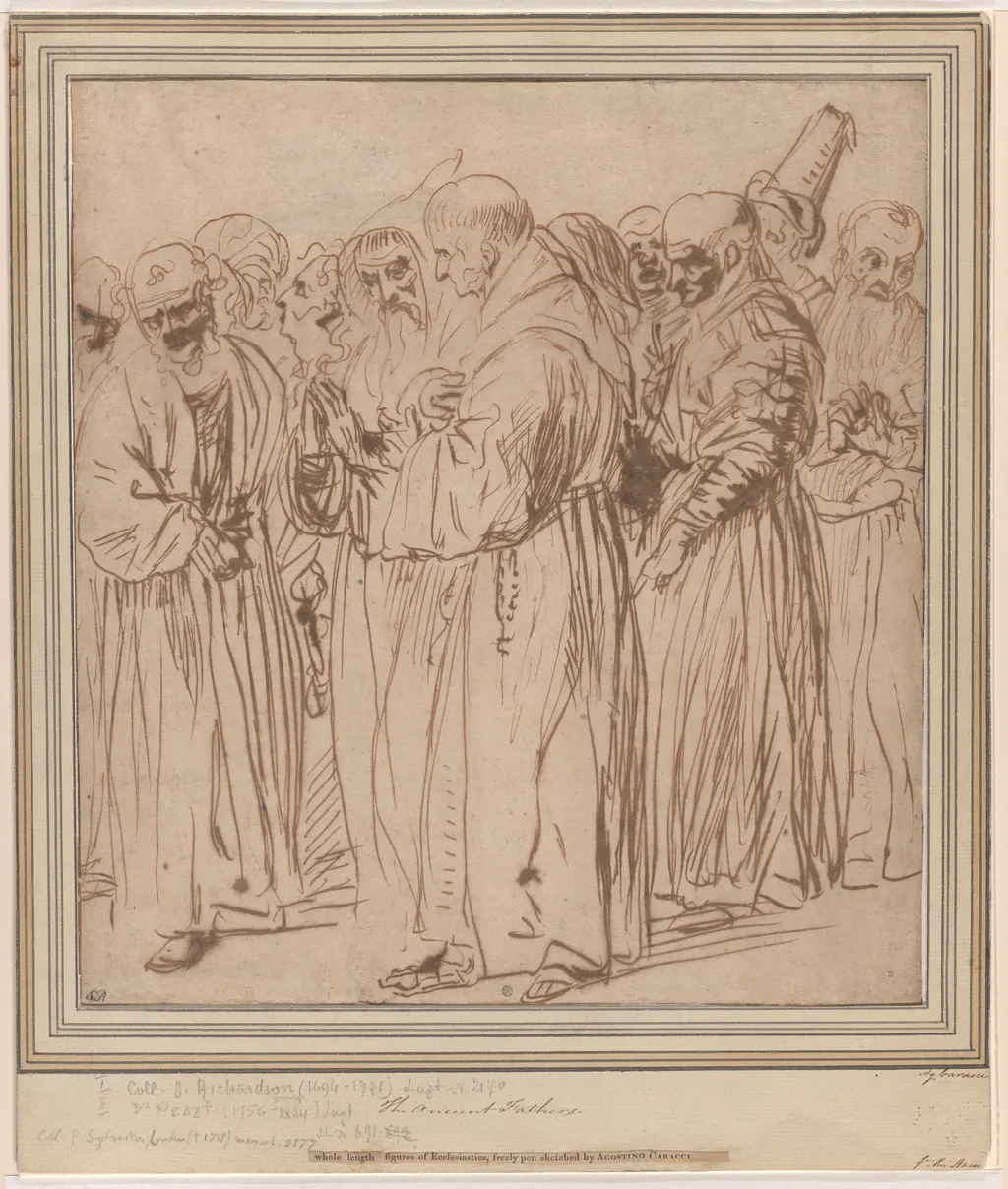
Jan LievensA Group of Standing Monks and other Figures, 1630s–40sPen and brown inkThe Metropolitan Museum of Art, collection record. CC0 1.0 (Public Domain)
In the Rijksmuseum hangs a candlelit Samson and Delilah: the hero asleep in Delilah's lap, a man creeping forward with shears, light falling on skin and silk while the rest of the room sinks into brown shadow. For generations the canvas carried the words "Rembrandt f 1633" in its upper right corner. The inscription was false. Under examination, the painting yielded a different signature, a monogram reading "IL", and the museum now dates it to about 1626–27 and gives it to Jan Lievens.
That story of a false signature sums up Lievens's afterlife. In his own day he was a celebrity: a teenage prodigy in Leiden, a painter sought by princes in The Hague and London before he was 25, and later a supplier of grand canvases to town halls and courts. After his death his reputation shrank to that of "Rembrandt's friend" or even "Rembrandt's follower", and several of his best pictures quietly acquired Rembrandt's name.
This article follows Lievens from Leiden to London, Antwerp and Amsterdam, looks at the famous rivalry with Rembrandt, and explains how scholars and museums brought him back into focus.
A prodigy in Leiden
Lievens was born in Leiden on 24 October 1607, the son of Lieven Hendricx, an embroiderer, and Machtelt Jansdr van Noortsant. At about eight he was apprenticed to the Leiden painter Joris van Schooten, and around 1617 he went to Amsterdam to spend two years with the history painter Pieter Lastman. By 1619 he was back in Leiden, working on his own in his father's house, still only about twelve years old.
His early pictures are large, bold and theatrical: half-length figures pressed close to the picture plane, strong light, rough-textured paint. Some scholars have linked this manner to the Utrecht followers of Caravaggio, such as Gerrit van Honthorst and Dirck van Baburen, and the exhibition organisers of 2008 suggested that Lievens may have spent time in Utrecht in the early 1620s. No document confirms this, so it remains a hypothesis based on style.
Rembrandt, born in Leiden in 1606, followed a similar path a few years later, including a short spell with Lastman in Amsterdam around 1624–25. By the mid-1620s both young men were independent painters in the same small university town.
Rivals, friends, perhaps studio-mates
How close were they? Museums do not agree. The Rijksmuseum states plainly that the two shared a workshop in Leiden. The National Gallery in London says more cautiously that Lievens may have shared a studio with Rembrandt, and the Leiden Collection's biography of Lievens points out that there is no documentary evidence of a shared workshop at all, and prefers to speak of "creative competition".
What is certain is that they watched each other closely. Between about 1628 and 1631 they painted the same subjects again and again: Samson and Delilah, The Raising of Lazarus, Christ on the Cross, and old men lost in thought, Rembrandt's Jeremiah Lamenting the Destruction of Jerusalem answering Lievens's Job in His Misery. They also painted each other. A small Portrait of Rembrandt of about 1629, on loan to the Rijksmuseum from a private collection, shows the young Rembrandt in a beret and steel gorget; here Lievens even borrows his friend's dark tonality and the tiny scratches Rembrandt made in wet paint.
The pair's most important early admirer was Constantijn Huygens, secretary to Prince Frederik Hendrik of Orange. Huygens met them around 1628–29 and wrote about both in his autobiography. He judged Rembrandt the stronger in judgement and in conveying emotion, and Lievens the stronger in grandeur of invention and boldness, adding that Lievens liked to paint things larger than life.
Look closer: Lievens's Portrait of Constantijn Huygens (c. 1628–29), on loan to the Rijksmuseum from the Musée de la Chartreuse in Douai, shows the sitter turned in his chair as though interrupted. Huygens recorded that Lievens painted the clothes and hands first and the face at a later sitting, which the museum suggests explains why the head looks slightly small for the body. When the picture was bequeathed to Douai in 1857, it was catalogued as a work by Bartholomeus van der Helst.
Through Huygens, Lievens reached the court. Frederik Hendrik acquired his work, and the young painter attracted diplomatic patrons. A large canvas in the J. Paul Getty Museum, Prince Charles Louis of the Palatinate with His Tutor, dated 1631, shows the son of the exiled "Winter King" and Queen of Bohemia cast as the young Alexander being taught by Aristotle.
London and Antwerp
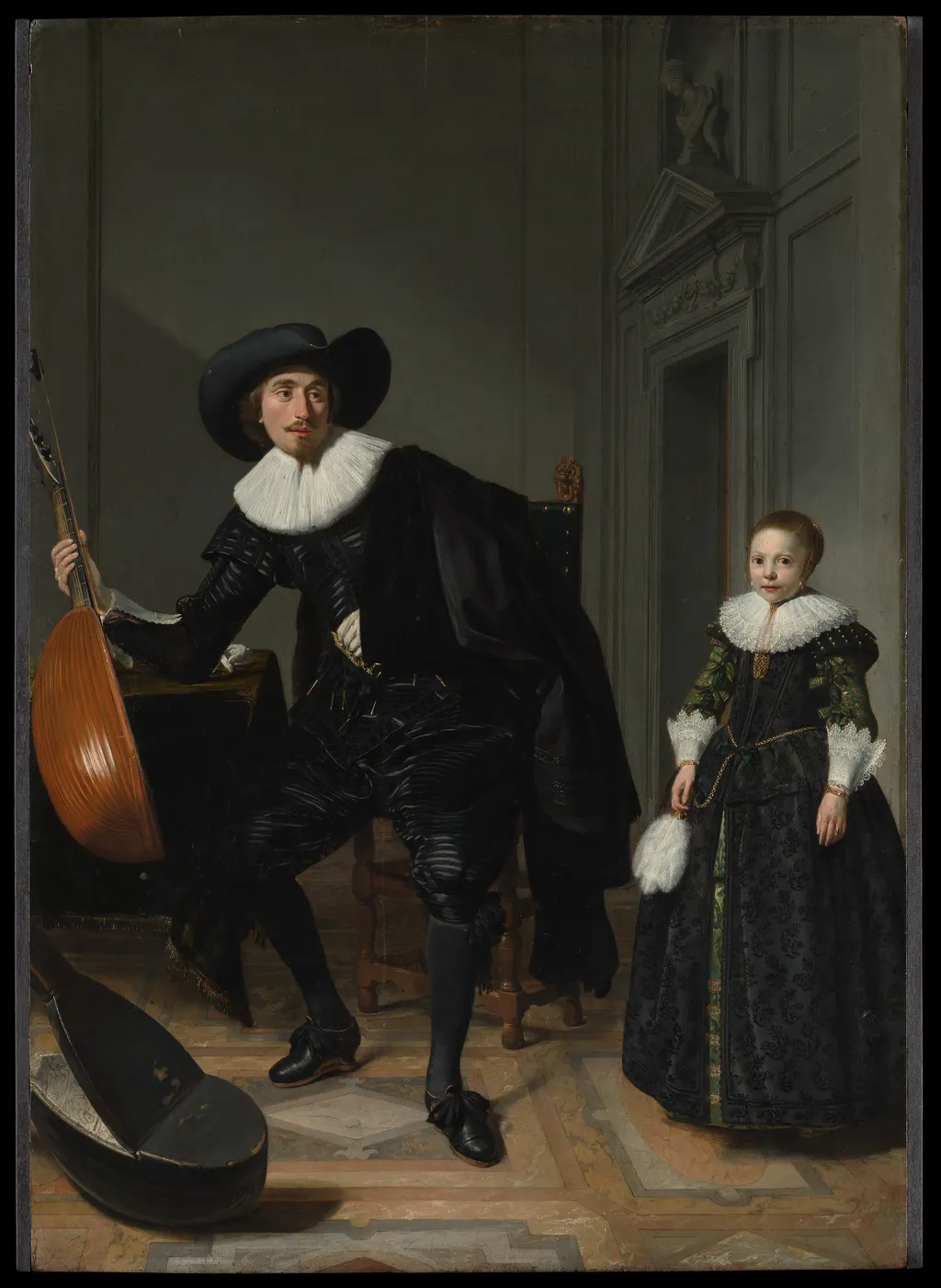
The partnership, if it ever was one, ended in the early 1630s. Rembrandt moved to Amsterdam, and Lievens left for London, where he worked at the court of Charles I from about 1632 to 1635. The biographer Arnold Houbraken, writing nearly a century later, says that he painted the king, queen and Prince of Wales; modern research has not identified any of his English portraits. He may have worked alongside Anthony van Dyck, whose elegant portrait manner left a mark on him, but that too is unconfirmed.
In 1635 he settled in Antwerp, joined the city's painters' Guild of Saint Luke, and in 1638 married Susanna Colijns de Nole. His Antwerp years broadened his range. He painted altarpieces and devotional works, including commissions for the Jesuits, and a Lamentation of Christ of about 1640 in the Alte Pinakothek, Munich. He also turned to landscape, producing small, moody panels such as Landscape with Willows (early 1640s), now in the Frits Lugt Collection in Paris, and continued to paint tronies, character heads in exotic costume. In 1639–40 he painted a large Continence of Scipio for the town hall of Leiden, for which he received 1,500 guilders; it was destroyed by fire in 1929.
Amsterdam, the court and the town hall
In March 1644 Lievens moved to Amsterdam. A portrait of the wealthy merchant Adriaen Trip that year opened doors to the city's leading families. His wife died around 1646, shortly after the move, and in 1648 he married Cornelia de Bray.
The following quarter-century was full of prestigious public work:
- 1650: The Five Muses for the Oranjezaal at Huis ten Bosch in The Hague, the memorial hall to Frederik Hendrik decorated by leading Dutch and Flemish painters.
- 1653: an invitation to Berlin from Elector Frederick William of Brandenburg.
- 1656: a chimneypiece showing Quintus Fabius Maximus for Amsterdam's new town hall (today the Royal Palace on the Dam); in the same year he was among the founders of the painters' confraternity Pictura in The Hague.
- 1660: a scene from the Batavian revolt against Rome for the same town hall, whose decoration also drew on painters such as Govert Flinck and Ferdinand Bol. The poet Joost van den Vondel wrote verses on Lievens's town hall painting and on several of his portraits.
Yet his finances did not match his commissions. In 1671 his household goods were seized for unpaid rent. He died in Amsterdam on 4 June 1674, and his children renounced their inheritance because of his debts.
Why he disappeared, and how he came back
Several things worked against Lievens's posthumous reputation. He moved often and changed his style to suit Leiden, London, Antwerp and Amsterdam, so his work never looked like a single, recognisable "brand". Rembrandt's fame, meanwhile, grew steadily until it eclipsed everyone around him. The consequence was that strong pictures by Lievens were absorbed into Rembrandt's oeuvre or given to other painters, as the false "Rembrandt" on Samson and Delilah and the Van der Helst label on the Huygens portrait show. Even a small panel in the Agnes Etherington Art Centre in Kingston, Ontario, Profile Head of an Old Woman (c. 1630), still carries the traditional nickname "Rembrandt's Mother".
The turning point for the wider public was the exhibition Jan Lievens: A Dutch Master Rediscovered, organised by the National Gallery of Art in Washington with the Milwaukee Art Museum and the Rembrandt House Museum in Amsterdam. Curated by Arthur K. Wheelock Jr., the National Gallery's curator of Northern Baroque painting, it opened in Washington in 2008, was shown in Milwaukee from 7 February to 26 April 2009, and then travelled to Amsterdam. It brought together about 45 paintings and some 80 drawings and prints, and was presented as the first exhibition to survey his entire career. Its argument was pointed: in the late 1620s, Lievens was often the one setting the pace, and Rembrandt the one responding.
The rivalry is still debated, and no one now claims Lievens matched Rembrandt's later achievement. But the young Lievens can no longer be treated as a footnote. For the wider context, see our guide to Dutch Golden Age painting and our look at portrait painters in Rembrandt's Amsterdam.
Where to see Lievens today
Collections that hold works by Lievens include:
- Rijksmuseum, Amsterdam: Samson and Delilah (c. 1626–27), Still Life with Books (c. 1628–32), and, on loan, the portraits of Huygens and Rembrandt.
- The National Gallery, London: a Self Portrait, a Portrait of Anna Maria van Schurman and A Landscape with Tobias and the Angel.
- J. Paul Getty Museum, Los Angeles: Prince Charles Louis of the Palatinate with His Tutor (1631).
- Alte Pinakothek, Munich: The Lamentation of Christ (c. 1640).
Display changes, so check a museum's online collection before you travel.
In Amsterdam, a visit to the house where Rembrandt lived and worked (see our article on Rembrandt and the Rembrandt House Museum) makes a natural companion to seeing Lievens at the Rijksmuseum.
When you stand in front of a Lievens, look for the qualities Huygens singled out: the scale and daring of the composition, the large figures crowding the frame, the willingness to take risks with light and paint. Then compare him with Rembrandt in the next room and ask who was leading whom. Contemporary writers already disagreed. For how the eighteenth century told Lievens's story, including the tale that as a boy he went on drawing undisturbed through a street riot in Leiden in 1618, read our article on Houbraken's lives of Dutch artists. More painters from this period appear under artists and movements.
Sources
- Jan Lievens (Leiden 1607 – Amsterdam 1674): biography, The Leiden Collection
- Jan Lievens: A Dutch Master Rediscovered (exhibition site and chronology), Milwaukee Art Museum
- Jan Lievens, Portrait of Constantijn Huygens, c. 1628–29 (SK-C-1467), Rijksmuseum, Amsterdam
- Jan Lievens, Samson and Delilah, c. 1626–27 (SK-A-1627), Rijksmuseum, Amsterdam
- Jan Lievens, The National Gallery, London
- Arnold Houbraken, De groote schouburgh: Jan Lievensz., DBNL (Digitale Bibliotheek voor de Nederlandse Letteren)