Portrait Painters in Rembrandt's Amsterdam
Thomas de Keyser, Pickenoy, Flinck, Bol and Van der Helst: the rivals, pupils and neighbours who shaped Amsterdam's booming seventeenth-century portrait market.
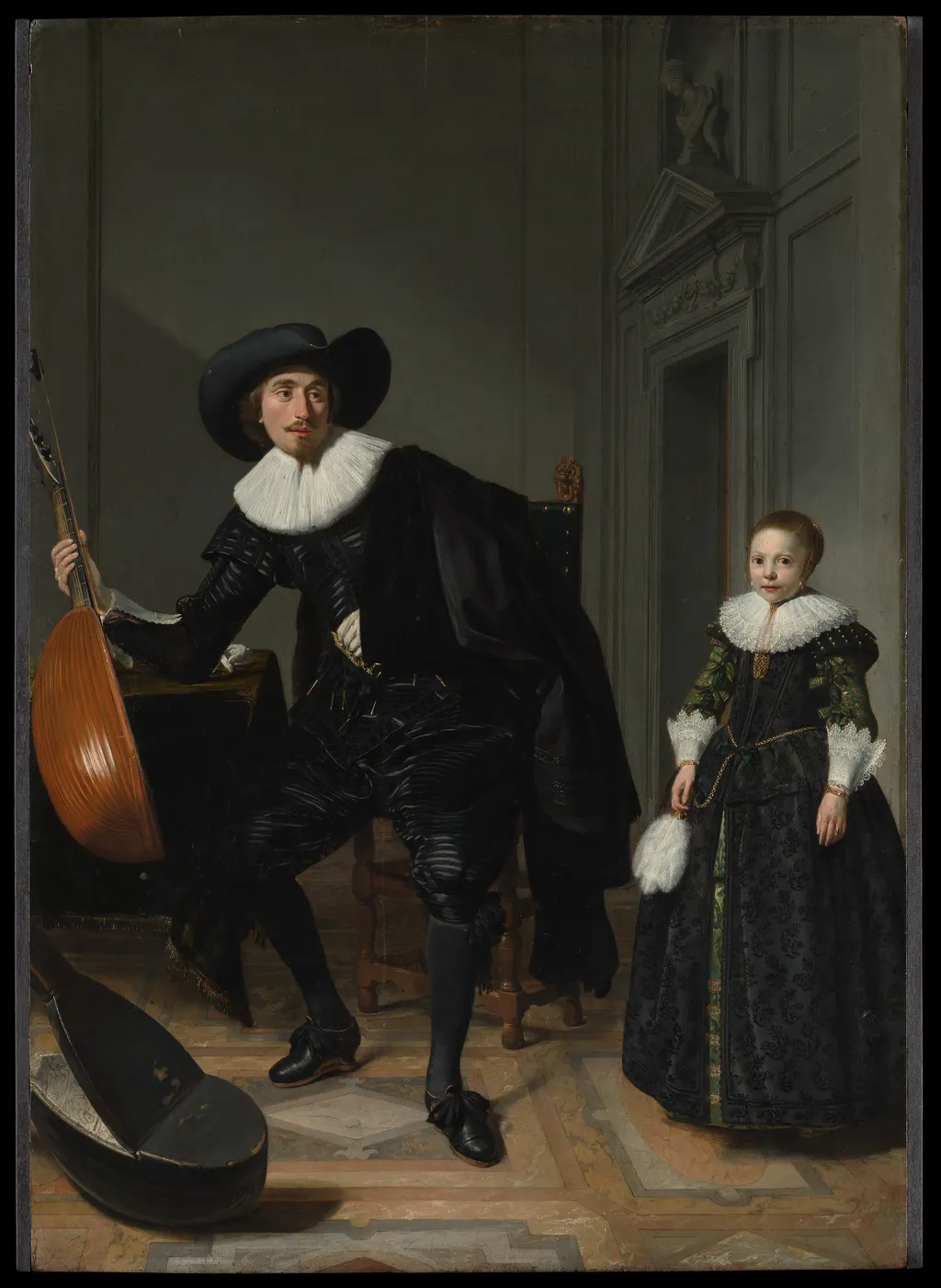
Thomas de KeyserA Musician and His Daughter, 1629Oil on woodThe Metropolitan Museum of Art, collection record. CC0 1.0 (Public Domain)
In 1629 Thomas de Keyser painted a musician with his young daughter. The picture, now in the Metropolitan Museum of Art, is modest in size, and that was its appeal. De Keyser had perfected the small full-length portrait, in which a sitter could be shown head to toe, with furniture, instruments and floor tiles, on a panel that would hang comfortably in a merchant's house. Two or three years later, a young painter from Leiden arrived in Amsterdam and began to take his clients away. His name was Rembrandt van Rijn.
We tend to see seventeenth-century Amsterdam through Rembrandt's eyes. But the city's portrait market was crowded and competitive, and for long stretches other painters were busier and better paid. Some were older rivals, some were Rembrandt's own pupils, and one was his next-door neighbour.
This article introduces five of them, explains what kind of portraits each offered, and suggests how to look at their work alongside Rembrandt's.
A city of sitters
By the 1620s Amsterdam was one of the richest cities in Europe. Its merchants, magistrates and professionals wanted likenesses of themselves, often in matching pairs of husband and wife. Its institutions wanted group portraits: the officers of civic guard companies, the regents of orphanages and almshouses, the governors of guilds, and surgeons gathered for an anatomy lesson. These group commissions were large, prestigious and profitable, and they sustained a whole generation of specialists.
The established rivals
Thomas de Keyser (c. 1596–1667)
The son of the architect and sculptor Hendrick de Keyser, Thomas joined the Amsterdam painters' Guild of St Luke in 1622. Until the early 1630s he was the most sought-after portrait painter in the city. His works include the Syndics of the Amsterdam Goldsmiths' Guild (1627), a civic guard company under Captain Allaert Cloeck (1632), and the Four Burgomasters of Amsterdam Receiving Marie de' Medici (1638), now in the Mauritshuis.
Rembrandt clearly studied him, and a number of De Keyser's portraits were later mistaken for Rembrandt's. Once the younger man took the lead, De Keyser turned increasingly to the family trade in stone. In 1662 he became chief supervisor of construction at Amsterdam's new town hall, now the Royal Palace on Dam Square, a post he held until his death.
Nicolaes Eliasz Pickenoy (1588–1653/56)
Pickenoy came from a family of Flemish origin; his father, an Antwerp mason, had settled in Amsterdam before he was born. He painted solid, carefully observed portraits of the city's elite, including the surgeon Nicolaes Tulp and the admiral Maarten Tromp, and his most productive years were roughly 1630 to 1637.
His career shows how attributions change. An anatomical demonstration by Dr Sebastiaen Egbertsz, dated 1619 and now in the Amsterdam Museum, was long given to Thomas de Keyser; it is now credited to Pickenoy.
He was also Rembrandt's neighbour. Around 1638 Pickenoy bought a house on the Jodenbreestraat, and in 1639 Rembrandt bought the house next door, the building that is now the Rembrandt House Museum. Both men later ran into financial trouble, and Pickenoy sold his house in 1645.
Rembrandt changes the market
Rembrandt moved from Leiden to Amsterdam in the early 1630s and quickly made his name with The Anatomy Lesson of Dr Nicolaes Tulp (1632, Mauritshuis). Where earlier anatomy pictures lined their sitters up for inspection, Rembrandt gathered them around the corpse as if caught at a moment of attention. Ten years later, The Night Watch (1642, Rijksmuseum) transformed the civic guard portrait into a scene of movement and light.
His studio also became a training ground. Several of the painters who would compete with him for the city's commissions learned their craft there.
The pupils
Govert Flinck (1615–1660)
Born in Cleves, Flinck trained first in Leeuwarden with the painter and Mennonite preacher Lambert Jacobsz, then joined Rembrandt's circle in Amsterdam. For roughly a decade, from about 1636, he painted so convincingly in Rembrandt's manner that his works have sometimes been confused with his master's.
Flinck then moved towards a lighter, more elegant style that appealed to Amsterdam's patricians. He was a friend of the poet Joost van den Vondel and received diplomatic and courtly commissions. In 1659 the city ordered twelve large canvases from him for the new town hall, but he died in February 1660 having completed only sketches. Rembrandt was later asked to provide one of the paintings, The Conspiracy of Claudius Civilis, which the authorities rejected.
Ferdinand Bol (1616–1680)
Bol, from Dordrecht, worked in Rembrandt's studio in the 1630s and was one of his most gifted pupils. His best-known portrait, Elisabeth Bas in the Rijksmuseum, was long believed to be by Rembrandt before scholars reassigned it to Bol. Around 1655 he received commissions for chimney pieces in the new town hall and for the Admiralty, and he painted group portraits of the regents and regentesses of Amsterdam's charitable institutions.
The Met's portrait of Petronella Elias with a Basket of Fruit (1657) shows his later manner: a richly dressed child, painted with an even, polished clarity far from Rembrandt's shadows. After his second marriage in 1669, to a wealthy widow, Bol gave up painting.
The fashionable favourite: Bartholomeus van der Helst (1613–1670)
Born in Haarlem, Van der Helst probably trained with Pickenoy in Amsterdam. His first great commission, a civic guard company under Captain Roelof Bicker, was ordered in 1639 and finished around 1642, the same years as The Night Watch. His most famous work, the Banquet of the Amsterdam Civic Guard in Celebration of the Peace of Münster (1648, Rijksmuseum), crowds a long canvas with portraits of the company feasting.
Van der Helst's polished likenesses, with clear drawing, even light and a bright palette influenced by Anthony van Dyck, made him the most fashionable portraitist in Amsterdam by the 1650s. To many patrons his flattering finish was more appealing than Rembrandt's increasingly dark and introspective late manner.
Five painters at a glance
| Painter | Dates | Link to Rembrandt | Hallmark |
|---|---|---|---|
| Thomas de Keyser | c. 1596–1667 | Older rival he influenced | Small full-length portraits, crisp detail |
| Nicolaes Eliasz Pickenoy | 1588–1653/56 | Next-door neighbour | Sober, solid likenesses, group portraits |
| Govert Flinck | 1615–1660 | Pupil, later rival | Rembrandtesque, then elegant and light |
| Ferdinand Bol | 1616–1680 | Pupil | Bright, formal portraits and regents' groups |
| Bartholomeus van der Helst | 1613–1670 | Contemporary rival | Polished, even light, van Dyck-like grace |
Look closer: Compare how each painter handles a white collar. De Keyser and Van der Helst describe every fold and edge of lace; Rembrandt, especially later, may suggest it with a few loaded strokes. The difference is not skill but intention: one offers a perfect record, the other the impression of a living presence.
Where to see them
The Rijksmuseum in Amsterdam holds The Night Watch, Van der Helst's Banquet and many portraits by all five painters. The Amsterdam Museum keeps group portraits commissioned by the city's institutions, and the Mauritshuis in The Hague has both Rembrandt's Anatomy Lesson and De Keyser's Burgomasters. In New York, the Metropolitan Museum's Dutch galleries allow a close comparison of De Keyser, Bol, Flinck and Van der Helst with Rembrandt himself.
For background, read Dutch Golden Age painting: a beginner's guide and visit Rembrandt's own home through our article on the Rembrandt House Museum. For a parallel circle in another Dutch city, see Vermeer and his milieu, and for practical looking tips, how to appreciate a historical painting. More in artists and movements.
Sources
- Thomas de Keyser, A Musician and His Daughter, 1629, The Metropolitan Museum of Art
- Bartholomeus van der Helst, Portrait of a Man, 1647, The Metropolitan Museum of Art
- Ferdinand Bol, Petronella Elias (1648–1667) with a Basket of Fruit, 1657, The Metropolitan Museum of Art
- Rembrandt (1606–1669): Paintings, The Metropolitan Museum of Art, Heilbrunn Timeline of Art History
- Nicolaes Eliaszoon Pickenoy, Wikipedia