Igbo Maiden Spirit Masks
Agbogho mmuo, the maiden spirit masquerades of the northern Igbo of Nigeria: who performs them, what the masks show, and how to look at them in a museum.
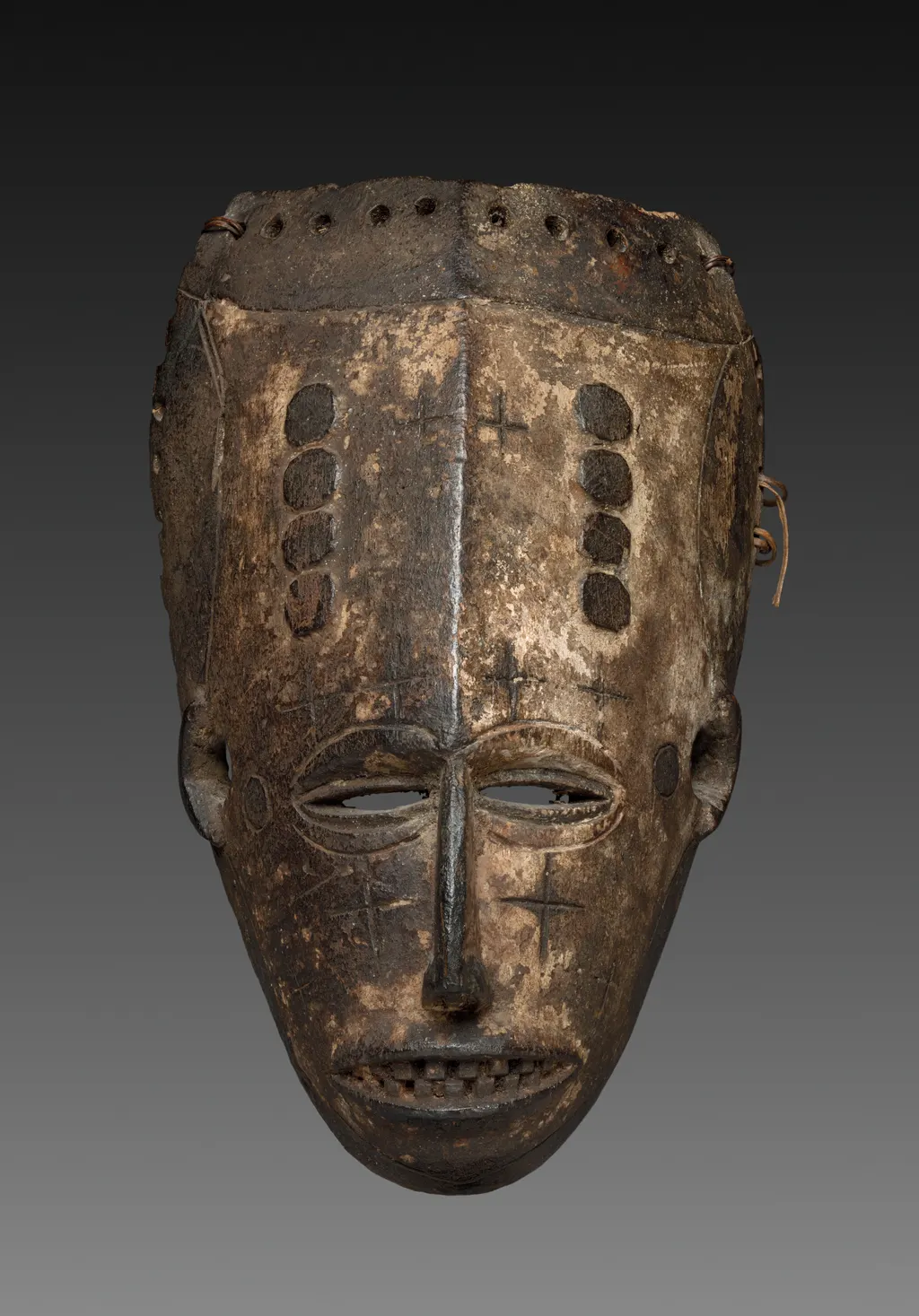
Africa, West Africa, Nigeria, Igbo-style makerFace Mask (Agboho mmuo), possibly early 1900sWood, pigment, plant fiber, and cottonCleveland Museum of Art, collection record. CC0 1.0 (Public Domain)
The drums quicken and a slender figure steps into the open space of the village square. The face is small and pale, the features fine, the lips dark; a crest of carved hair rises above the forehead. The dancer moves with the poise and coquetry of a young woman, turning, pausing, then breaking into a burst of rapid steps. Yet the dancer is a man, and the being he embodies is not a girl at all but a spirit.
This is agbogho mmuo, the "maiden spirit" masquerade of the northern Igbo of south-eastern Nigeria. The masks made for these performances are among the most admired works of Igbo sculpture, and many now hang in museums far from the festivals for which they were carved. This article explains the masquerade's setting, the features of the masks, and how to look at them with their performance in mind.
Masquerade in Igbo life
The Igbo are one of the largest peoples of Nigeria, living mainly in the south-east of the country. Igbo society has historically been organised around villages and village groups rather than large kingdoms, and many forms of public ceremony are carried out through associations of men and women, age grades and title societies.
Masquerade is central to this public life. In northern Igbo communities masked performers are often called mmanwu, and they are understood not as people in costume but as spirits, frequently associated with ancestors, who visit the human world. They appear at festivals, funerals and initiations; some entertain, some judge and discipline, and some frighten. Their identities are concealed, and the masks are made and kept under the authority of men's associations.
Agbogho mmuo: the maiden spirit
Agbogho mmuo translates literally as "maiden spirit". The masquerade is associated especially with the area around Nri and Awka in northern Igboland, where it has traditionally appeared in annual performances during the dry season, and also at funerals and initiations. In the Onitsha area a related form is known by another name.
The masks are danced by men, who imitate and exaggerate the beauty and movements of adolescent girls. The performance celebrates an ideal of young womanhood, its grace, poise and adornment, while also being a display of skill by the dancer and the musicians who accompany him. Some scholars have argued that the name refers more broadly to a "female essence" than to individual young spirits, a reminder that these performances carry layers of meaning that a single translation cannot capture.
Reading the mask
Although no two masks are identical, they share a recognisable vocabulary:
| Feature | What to look for |
|---|---|
| Face | Small, delicate and narrow, with a fine nose and a small mouth |
| Colour | A whitened face, with base colours of white, pink or yellow; eyebrows and lips often darkened |
| Surface patterns | Fine linear designs, including triangles, dots and crescents, recalling uli, the body and wall designs traditionally painted by Igbo women |
| Headdress | Tall crests, combs and openwork forms modelled on elaborate ceremonial hairstyles of the late nineteenth century |
| Format | Face masks and helmet masks, worn with a costume that conceals the dancer completely |
The crest is often the most spectacular element. Carved openwork rising high above the face, often incorporating carved combs, it records the kind of elaborate hairstyles that required hours of work and were closely associated with young women's beauty.
Look closer: Study the face from the side as well as from the front. Notice how the carver keeps the features small and close together, leaving broad, smooth planes of white. Then trace the dark lines on the cheeks and forehead: these are not random decoration but references to uli, a living art of body painting that was itself a mark of beauty.
One museum example
The Cleveland Museum of Art holds a mask it catalogues as Agboho mmuo, dated to about the 1930s (accession number 1973.222). The museum describes it as embodying a returning spirit of the dead, performed at the new year, at harvest festivals and at funerals, where it helps guide the deceased to the realm of the ancestors. Its whitened face, thin nose, small mouth and delicate facial markings express a young woman's beauty, while two pairs of large horns, according to the museum, signify masculine courage. The combination is a reminder that categories such as "maiden" in museum labels can simplify sculptures that bring together several qualities at once.
Beauty and its opposites
In many Igbo communities the delicate maiden spirits are only one part of a wider world of masquerade. Other masked spirits are large, dark, aggressive and deliberately ugly, embodying power, danger and male strength. Seen together, the masquerades present a debate about values: refinement and restraint on one side, force and threat on the other. A maiden spirit mask in a museum case is only half of that conversation.
From performance to museum
A mask on a wall is a fragment. In performance it was part of a full ensemble, with a costume that concealed the dancer's body, music, song and an audience that knew what to expect and judged the performance keenly. Masks were also often repainted and refurbished between performances, so their colours were never meant to be fixed.
Many Igbo masks entered Western collections during the colonial period and the decades after Nigerian independence, often with little or no information about who carved them, which community used them, or how they left Nigeria. When you see one in a museum, the label's provenance line is worth reading: it tells you how the object travelled. Questions of provenance and return are discussed in Protecting Cultural Heritage and Provenance Explained.
It is also important to remember that Igbo masquerade is not a thing of the past. Masquerades continue to perform at festivals and funerals across Igboland and in Igbo communities elsewhere, and their forms continue to change.
Masks made for performance and masks made for sale can look similar. A mask made for the market is not a fake if it is honestly described, but a buyer should be wary of claims of age or ritual use that come without documentation.
Where to see maiden spirit masks
- The Cleveland Museum of Art (1973.222) and the Brooklyn Museum are among the museums whose collections include Igbo maiden spirit masks.
- Related reading: For other West African traditions in which carved figures carry social and spiritual meaning, see Ere Ibeji: Yoruba Twin Figures, and for an approach to African objects in their own cultural terms, Understanding African Weapons as Art and Culture.
Explore more on carving and modelling on our sculpture and ceramics topic page.
Sources
- Mask (Agboho mmuo), c. 1930s (1973.222), Cleveland Museum of Art
- Agbogho Mmuo, Wikipedia
- Igbo people, Wikipedia