Silenus, Isabella d'Este and a Maiolica Masterpiece
Nicola da Urbino's maiolica service for Isabella d'Este, its mottoes and devices, and why the drunken old satyr Silenus mattered to Renaissance humanists.
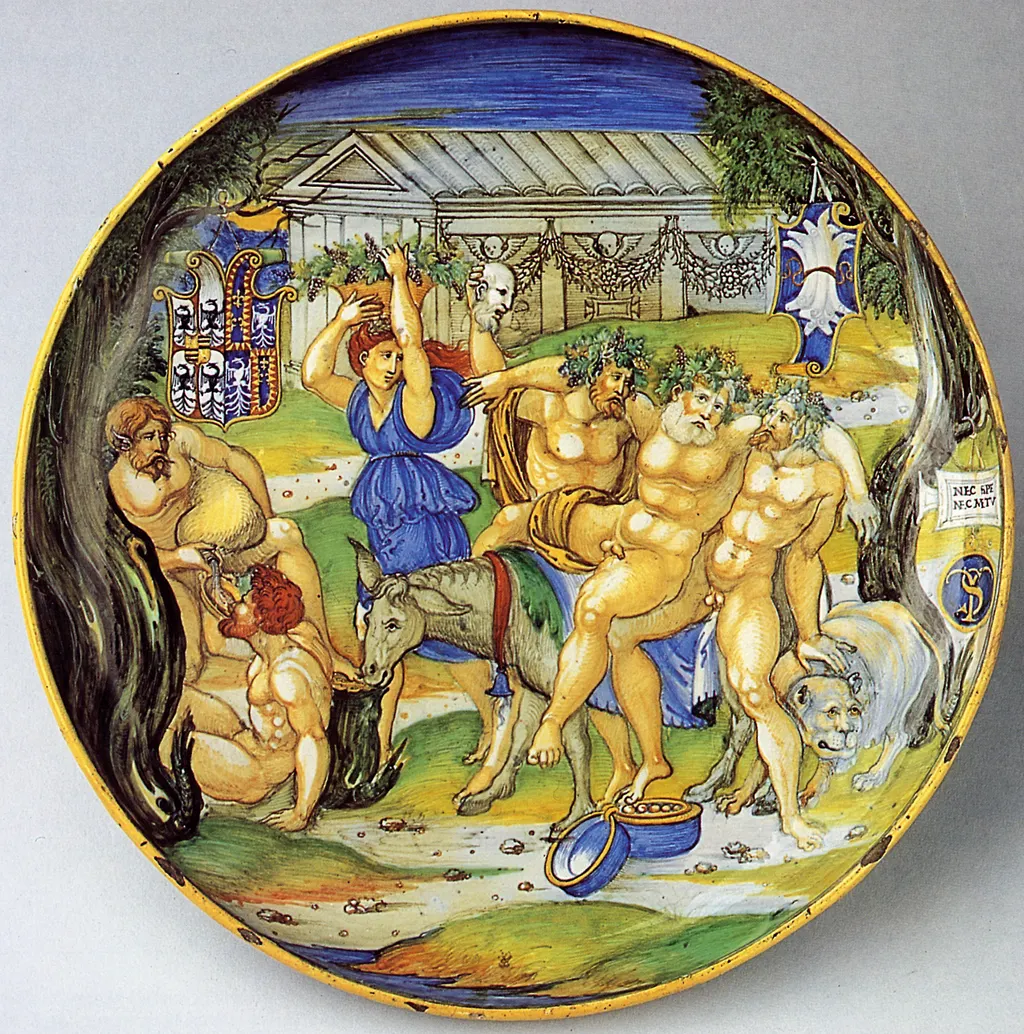
Nicola da UrbinoArmorial Plate: Silenus on an ass, supported by Bacchic revelers, ca. 1520–25Maiolica (tin-glazed earthenware)The Metropolitan Museum of Art, collection record. CC0 1.0 (Public Domain)
An old man, pot-bellied and bald, slumps on the back of a donkey, so drunk that two companions must hold him upright. He is Silenus, the tutor of the wine god Bacchus, and he appears again and again in Renaissance art: laughable, disreputable and, to the learned, strangely wise.
Silenus also sets in motion one of the stories painted on a group of Italian maiolica made in the 1520s for Isabella d'Este, Marchioness of Mantua, one of the most discerning patrons of her age. This article introduces that service and its painter, Nicola da Urbino, explains the personal devices that mark every piece, and looks at why a tipsy satyr was worth a humanist's attention.
Isabella d'Este, collector and patron
Isabella d'Este (1474–1539) was the daughter of Ercole I d'Este, Duke of Ferrara, and in 1490 married Francesco II Gonzaga, Marquess of Mantua. Educated in Latin and music, she became one of the most celebrated women of the Italian Renaissance, corresponding with scholars and commissioning artists with exacting precision.
Her private rooms in the Gonzaga palace at Mantua, the studiolo and the grotta, held antiquities, gems, musical instruments and specially commissioned paintings of allegorical subjects by Andrea Mantegna, Pietro Perugino and Lorenzo Costa, now in the Louvre. She had firm ideas about subject matter and was not shy of telling painters what to include. A dinner service of maiolica bearing her arms belongs in this world of learned, personal display.
Nicola da Urbino and the istoriato style
Maiolica is tin-glazed earthenware. A fired clay body is coated in a white glaze made opaque with tin oxide, painted with metal-oxide colours and fired again, so that the colours fuse into the glaze. In the workshops of the Duchy of Urbino in the early sixteenth century, painters turned plates and dishes into miniature history paintings, a manner known as istoriato, "story-painted", in which a single narrative scene covers the whole surface.
Nicola da Urbino (c. 1480 – between 1540 and 1547) is regarded as the master who brought the istoriato style to its classic form. He was once confused with a "Nicola Pellipario", a painter whom later scholarship has argued never existed as a separate artist. Nicola drew on woodcut illustrations in printed books, especially illustrated editions of Ovid's Metamorphoses, and later on engravings after Raphael, adapting them with a graceful line and a luminous palette of blues, greens, yellows and ochres. Two dishes signed by him survive, in the Bargello in Florence and the Hermitage in St Petersburg, and many other works are attributed to him on grounds of style.
The Isabella d'Este service
The service was made in Urbino in the mid-1520s. A letter of 15 November 1524 from Isabella's daughter Eleonora Gonzaga, Duchess of Urbino, may refer to it, and it is often described as a gift from Eleonora to her mother, although the Victoria and Albert Museum notes that no document confirms the connection. Twenty-two pieces are known to survive, now dispersed among museums in Europe and North America.
Each piece carries the arms of Gonzaga impaling Este, that is, the two family coats of arms combined side by side in a single shield, often held by putti. Around this heraldic core Nicola painted mythological and historical scenes.
Reading Isabella's devices
What makes the service personal is a set of imprese, emblematic devices that Isabella used throughout her life. On the V&A's plate showing the story of Hippolytus and Phaedra, the museum identifies three:
| Device | What it shows | Meaning usually given |
|---|---|---|
| Impresa delle pause | Musical notation of rests, without notes | Interpreted as a musical emblem of measured silence and restraint, fitting a famously musical patron |
| NEC SPE NEC METU | A Latin motto on a balustrade | "Neither hope nor fear": a stoic composure in the face of fortune |
| XXVII (written as "VII" twice) | A number puzzle | Read as vinti sette, "twenty-seven", punning on vinte sette, "factions defeated" or difficulties overcome |
These devices turn each plate into a kind of signature. To an educated guest they announced not only whose table this was but what kind of person sat at it.
Look closer: On an istoriato plate, start at the centre and work outwards. Find the coat of arms, then the devices, then follow the narrative around the plate. Notice how the painter fits a landscape, architecture and several episodes of a story onto a curved surface only about 27 cm across.
King Midas, and the satyr who started it all
One plate from the service, in the Robert Lehman Collection at the Metropolitan Museum of Art in New York, is catalogued as Armorial Plate (tondino): The story of King Midas and dated about 1520–25.
In Ovid's Metamorphoses (Book XI), the Midas story begins with Silenus. Wandering drunk after the revels of Bacchus, the old satyr is captured by Phrygian peasants and brought to King Midas, who recognises him, entertains him for ten days and returns him to his divine pupil. Grateful, Bacchus offers Midas any gift he chooses. Midas asks that everything he touches should turn to gold, and soon finds that he cannot eat or drink. Later in the same book Midas, judging a musical contest between Apollo and Pan, prefers Pan's rustic pipes, and Apollo punishes his bad ear by giving him the ears of an ass.
It is a cautionary tale about greed and poor judgement, but it is also a tale about hospitality and recognition. Without Midas's courtesy to a disreputable old drunk there would be no golden touch at all.
Why Silenus fascinated the Renaissance
To most people Silenus was a comic figure: the fat, wine-sodden companion of Bacchus, often shown asleep or propped on his donkey. Yet ancient tradition also credited him with deep, if bleak, wisdom; in one story Midas captures him to learn his secrets, and Silenus answers that the best thing for mortals is never to have been born.
Renaissance humanists found another layer in Plato's Symposium, where Alcibiades compares Socrates to the little statues of Silenus sold in Athens: ugly on the outside, but opening to reveal images of gods within. Erasmus developed the image in his essay on the "Sileni of Alcibiades", first published in an expanded edition of his Adages in 1515, making the satyr a symbol of hidden worth beneath an unpromising exterior.
For a collector like Isabella, steeped in classical learning, the figure was ideal: a subject that could amuse at a banquet and reward reflection afterwards. Whether the painter of the Midas plate intended any such reading cannot be proved, but the guests at Isabella's table were exactly the kind of people who would have enjoyed debating it.
Seeing the service and learning more
- Victoria and Albert Museum, London: the plate with Hippolytus and Phaedra, about 1524, in the ceramics galleries.
- The Metropolitan Museum of Art, New York: the Midas plate in the Robert Lehman Collection.
- Other pieces are scattered among European museums; museum online catalogues searched for "Isabella d'Este" and "Nicola da Urbino" will bring them up.
For background on how maiolica relates to other ceramic bodies, see Identifying Ceramic Styles; for its Dutch descendant, Delftware: The Story of Dutch Blue and White. If classical subjects in art intrigue you, How to Appreciate a Historical Painting offers a way in. More ceramics features are on our sculpture and ceramics topic page.
Sources
- Plate with Hippolytus and Phaedra, Nicola da Urbino, about 1524 (C.2229-1910), Victoria and Albert Museum
- Armorial Plate (tondino): The story of King Midas (1975.1.1019), The Metropolitan Museum of Art
- Isabella d'Este, Encyclopaedia Britannica
- Silenus, Encyclopaedia Britannica