Understanding African Weapons as Art and Culture
How Zande throwing knives, the Kuba ikul and Asante state swords moved between battle, status and ceremony, and what collectors should ask about provenance.
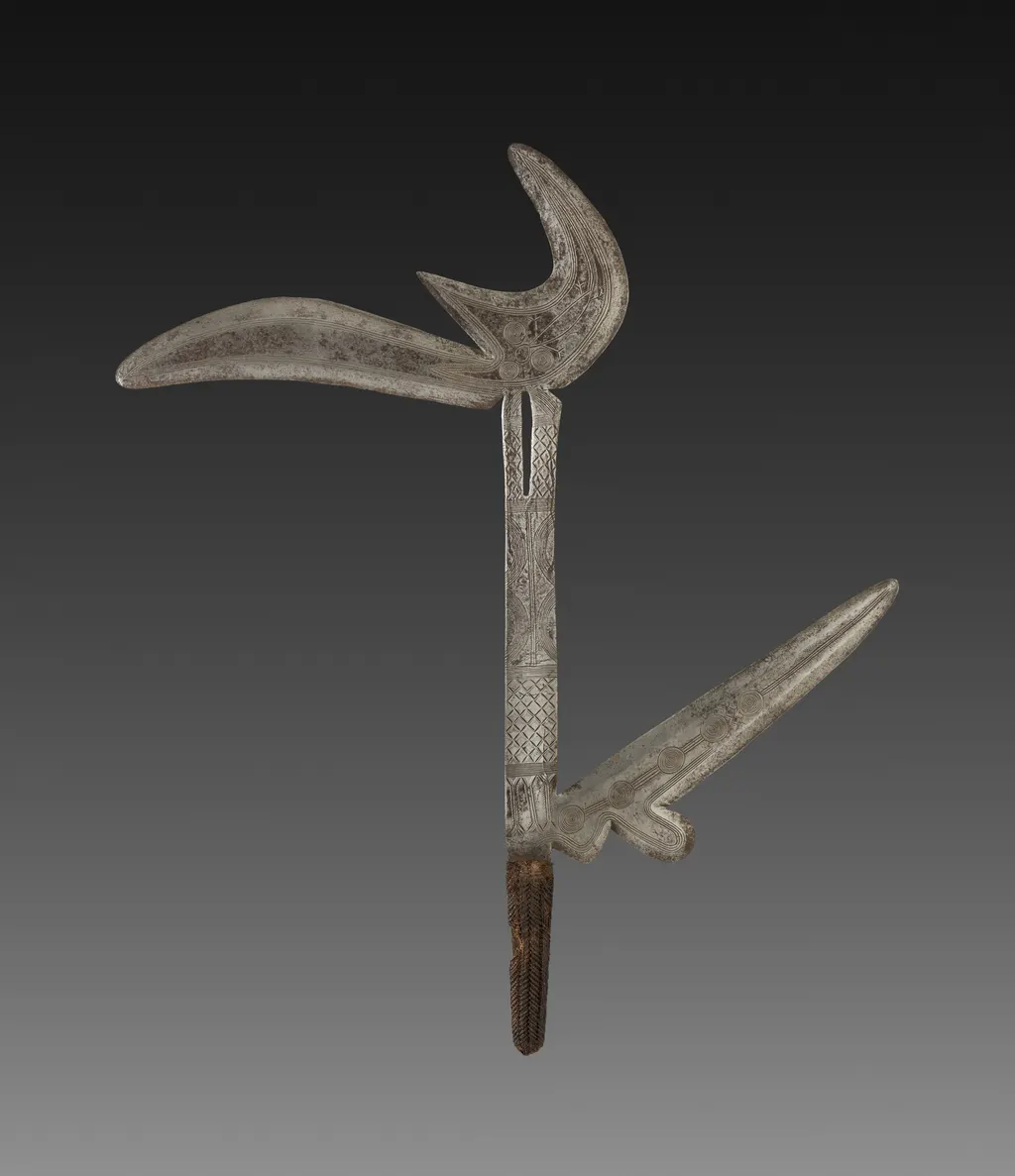
Africa, Central or Eastern Africa, Democratic Republic of the Congo, Central African Republic, and Sudan, Zande-style makerThrowing Knife / Prestige Scepter (pingha), 1800–mid-1900sIron alloy and plant fiberCleveland Museum of Art, collection record. CC0 1.0 (Public Domain)
In the Cleveland Museum of Art there is an iron object that refuses to sit still in the eye. Several flat blades branch from a single shaft at odd, deliberate angles, and the grip is bound with plant fibre. The museum calls it a throwing knife and a prestige sceptre in the same breath, giving its Zande name, pingha. Both labels are correct, and the tension between them is the subject of this article.
Museums in Europe and North America hold many thousands of blades, spears, shields and clubs from across Africa. For a long time they were displayed as trophies or arranged in fan-shaped wall displays like specimens. Looked at more carefully, many turn out to be among the most sophisticated metalwork of their regions. They were made by smiths whose craft was linked to power, and they were carried to show rank, settle marriages, swear oaths and honour the dead as well as to fight.
What follows looks at three well-documented traditions: Zande throwing knives, the Kuba ikul and Asante state swords. It then turns to the questions anyone looking at, or thinking of buying, such an object should be asking.
Weapon, emblem or both?
The first habit to unlearn is the idea that a weapon is either "real" or "ceremonial". In most societies, our own included, the line moves. A European dress sword, a mace carried before a mayor and a regimental sabre all began as working arms and gradually became signs of office. African weapons followed similar paths, often within a single lifetime of an object type.
So "Was this used?" is the less useful question. Better to ask who was allowed to carry it, when, and what it said about them. The answers usually lie in a mix of the object's form and wear, its museum records, and the histories kept by the communities that made it.
The Zande throwing knife
The multi-bladed throwing knives of north-central Africa are among the most recognisable African metal objects. They are associated above all with the Azande, whose lands span parts of today's Democratic Republic of the Congo, the Central African Republic and South Sudan. In Zande the knife is kpinga or pingha (plural kipinga).
Museum records agree on the outline of their military use. Warriors carried several on the inner face of a shield and threw them once their spears were spent, and the blades were balanced so they would spin in flight. Cleveland's catalogue adds a telling social detail: the knives were regarded as the property of the king, and so were carried by those who fought for him, such as royal bodyguards and court attendants.
The knives also had a second life. The Pitt Rivers Museum in Oxford records that kpinga formed part of the marriage payment a Zande man made to his bride's family. Some scholars go further and describe throwing knives as a kind of currency. Not everyone agrees. The Smithsonian's National Museum of African Art notes in its records that other evidence points to their being emblems of office carried in dances and ceremonies rather than money. It is a debate, and it should be presented as one.
By the twentieth century the knives were obsolete in war but stayed in use as prestige objects at ancestral ceremonies and the funerals of important men. Attribution is not always simple either. Collectors' labels tend to say "Zande" by default, but some blade forms have been linked by researchers to neighbouring peoples. Specialists still return to Peter Westerdijk's 1988 dissertation on African throwing knives and to Christopher Spring's survey African Arms and Armour (1993).
The Kuba ikul: a knife for peace
Further south-west, in the Kasai region of the Democratic Republic of the Congo, the Kuba kingdom produced a very different blade. The ikul is a short, broad, leaf-shaped knife, often with a Z-shaped (ogee) cross-section and curving grooves along the blade. Kuba tradition credits King Shyaam aMbul aNgoong, in the early seventeenth century, with introducing the form after a period of war. That is why it is often described as a "peace knife", and the Brooklyn Museum's catalogue uses that very name.
The Pitt Rivers Museum's example (1907.21.25) shows how much meaning was packed into small details. According to the museum, all adult Kuba men once carried an ikul, as a sign of adult manhood. A version with a conical pommel was reserved for men of the ruling Bushoong clan, while men of other Kuba groups carried a flat-pommelled form. The Oxford knife has a flat pommel, its top decorated with interlace recalling Kuba raffia weaving. On the blade, one half of each face is polished bright and the other dulled black, so the two sides mirror each other like a positive and a negative.
Smithing, like weaving, was regarded as a royal art among the Kuba, and skilled smiths were held in high esteem. An ikul tells you that a man was an adult, which group he belonged to and that he lived under a king who claimed to bring peace. None of that requires the blade to be sharp.
Asante state swords
In the Asante kingdom of present-day Ghana, swords of state, afena, belong among the most important royal regalia, second only to the stools that embody the kingship. The Detroit Institute of Arts notes that the ceremonial afena has no cutting edge, yet in Asante regalia it stands for a leader's supreme authority over life and death. The University of Michigan Museum of Art adds that officials sent to deliver messages or conduct negotiations were escorted by sword-bearers, so a sword could also act as a kind of credential.
The greatest of these, the Mpomponsuo, is the sword on which oaths of office were sworn: the Asantehene swore to serve his people, and chiefs swore allegiance to him. The British Museum holds a Mpomponsuo taken from the royal palace in Kumasi by British troops during the Anglo-Asante war of 1895–96, and its catalogue notes that the sword in use in Kumasi today was presumably made as a replacement. In 2024 the British Museum and the Victoria and Albert Museum lent 32 Asante royal objects, among them that sword, to the Manhyia Palace Museum in Kumasi. The display opened on 1 May 2024, during the Asantehene's silver jubilee, under three-year agreements that can be renewed.
How to read a blade
Look closer: Before reading the label, examine the edge, the grip and the surface. A sharp, honed edge, a worn grip and a plain finish suggest use. Blunt or very thin blades, elaborate openwork, inlay, or a decorated surface on only one side suggest display, though one object can carry both kinds of evidence.
| Clue | What it may suggest | Caution |
|---|---|---|
| Sharp, polished edge | Made or kept for fighting or cutting | Edges can be re-sharpened by later owners |
| Blackened or rusty surface | Some museum records link this to exchange forms of the Zande knife | Corrosion can also simply reflect storage |
| Non-functional openwork or very thin iron | Display, dance or regalia | Some working blades were also elaborately decorated |
| Brass, copper or lead inlay | Prestige and the patron's wealth | Inlay was sometimes added for the market |
| Collection date and collector named | Reliable context for dating | Early labels can still mis-attribute peoples |
Provenance and ethics
Many African weapons in Western collections left the continent in the late nineteenth and early twentieth centuries, at the height of colonial conquest. Some were bought or exchanged, some were commissioned, and some were seized in military campaigns, as the Asante regalia were. The Kuba knife in Oxford, for instance, was collected in Kasai by the Hungarian ethnographer Emil Torday and reached the museum in 1907, during a period when the region was under brutal colonial rule. A full collection history is the starting point for any honest discussion of such objects. Our guide to provenance explains how to trace one.
For anyone thinking about acquiring an African blade, the essentials are covered in collecting art responsibly. In brief:
- Ask for documented ownership history, ideally back to the period before 1970, when the UNESCO Convention on illicit trafficking was adopted.
- Be wary of objects described only as "old" or "from an old collection" with no names or dates.
- Remember that many forms continued to be made for sale throughout the twentieth century. That does not make them worthless, but they should be described honestly.
- Treat objects linked to royal regalia, shrines or known punitive expeditions as especially sensitive. Wider debates on return and restitution are set out in protecting cultural heritage.
Where to see examples
The Pitt Rivers Museum in Oxford has one of the densest displays of African arms, organised by type rather than region, so you can compare forms side by side. The British Museum, the Cleveland Museum of Art and the Brooklyn Museum all publish well-documented examples online. In Kumasi, the Manhyia Palace Museum now shows Asante regalia in the palace context it came from.
For related West and Central African traditions, see our articles on Kotoko horse-and-rider figures and on Yoruba twin figures, or browse more in cultural heritage.
Sources
- Throwing Knife / Prestige Scepter (pingha), Cleveland Museum of Art
- Arms and armour: Africa (ikul), Pitt Rivers Museum, University of Oxford
- Ikula Knife ("Peace" Knife), Brooklyn Museum
- UK returns looted Ghana artefacts on loan after 150 years, Al Jazeera