Jan Sluijters as a Book Illustrator
Alongside his daring modernist canvases, Jan Sluijters illustrated scores of Dutch children's books, designed bindings and drew covers for Wendingen.
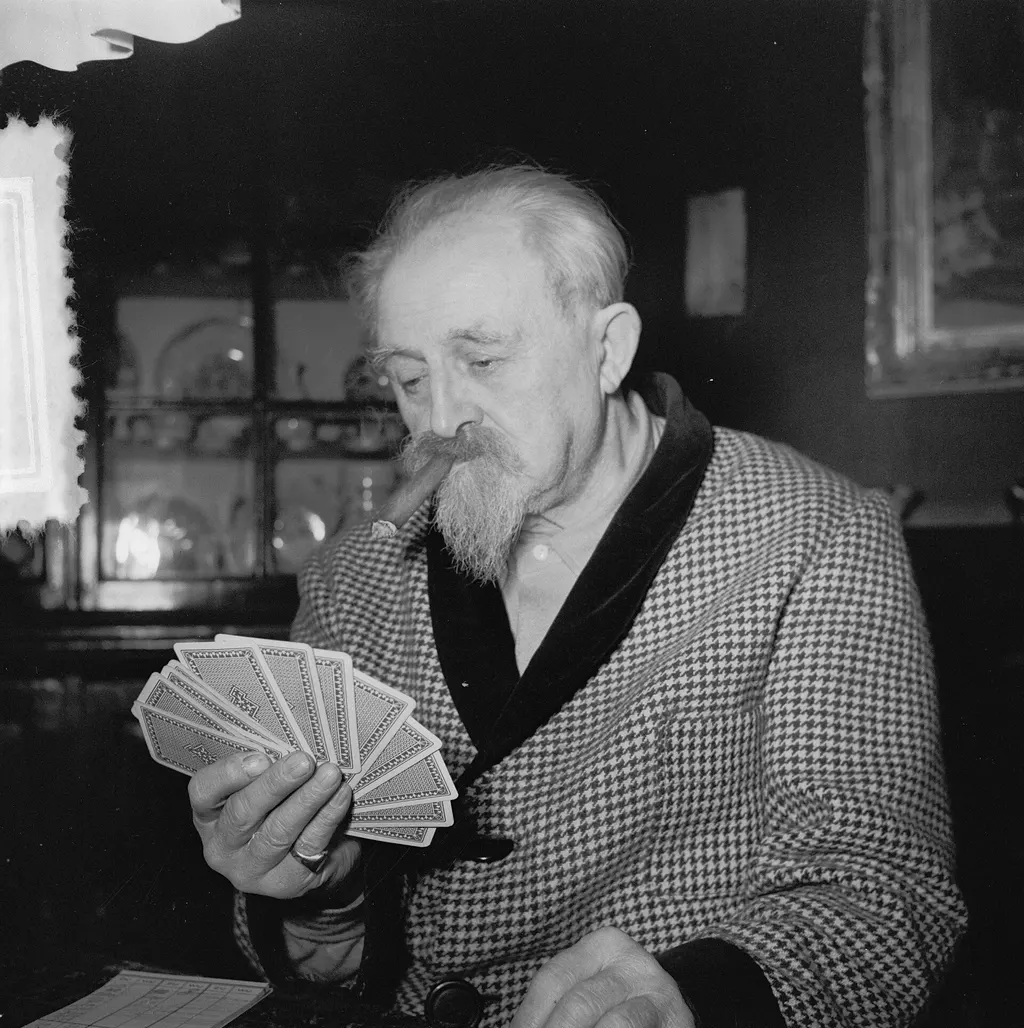
Anefo photographer, Nationaal ArchiefJan Sluijters on his seventieth birthday, 12 December 1951Wikimedia Commons, collection record. CC0 1.0 (Public Domain)
In 1898 a seventeen-year-old art student in Amsterdam received a commission to illustrate Onder ons: drie verhalen, a book of three stories by the popular author Tine van Berken, for the publisher H.J.W. Becht. It was a modest beginning, the kind of job that kept many young artists afloat. Few readers of the book could have guessed that its illustrator, Jan Sluijters, would within a decade become the most talked-about modern painter in the Netherlands.
Sluijters (1881–1957) is remembered for blazing colour: the Paris dance halls of 1906, the luminous landscapes that followed, the nudes and later the society portraits. Much less known is the steady stream of book illustrations, bindings and printed designs he produced for over a quarter of a century. Exhibitions and general accounts have largely passed over this side of his work, yet it was substantial and revealing.
This article looks at how Sluijters became an illustrator, what kinds of books he worked on, how his illustrations differ from his paintings, and where his graphic work led.
A wood engraver's son
Johannes Carolus Bernardus Sluijters was born in 's-Hertogenbosch on 17 December 1881. His father, Gijsbertus Antonius Sluijters, was a wood engraver who made illustrations for advertisements and catalogues, so the boy grew up around the practical business of printed images. When he was fourteen the family moved to Amsterdam, which remained his home for most of his life.
From 1898 to 1901 he trained at the Rijksnormaalschool voor Teekenonderwijs, the state school for drawing teachers. During those years he took his first independent illustration jobs, including drawings for the weekly Geïllustreerd Politie-nieuws and several children's books. In 1901 he entered the Rijksakademie in Amsterdam, studying painting under Nicolaas van der Waay and attending evening drawing classes with August Allebé.
The other Sluijters
His painting career then took a dramatic course. In 1904 he won the Prix de Rome with an academic picture of the prophet Elisha and the Shunammite woman's son. The travel grant took him with his wife, Bertha Langerhorst, to Italy and Spain in 1905 and 1906, and then to Paris, where he discovered the Fauves, the Neo-Impressionists, Toulouse-Lautrec and Kees van Dongen. Canvases such as Bal Tabarin scandalised the Prix de Rome jury, which condemned the "false cleverness" of the newest French tendency, and his stipend was stopped. The controversy also made him famous.
Back in the Netherlands from November 1906, he painted luminist landscapes and, from 1910, worked in Laren and the Gooi. In the autumn of 1910 he was among the founders of the Moderne Kunstkring, with Piet Mondriaan, Leo Gestel, Conrad Kickert, Jan Toorop and Cees Spoor. By around 1930 he was regarded as the country's leading portrait painter.
Through all of this, the illustration work continued.
Books for young readers
How much did he illustrate? The standard Dutch book trade catalogue of the period, known as Brinkman, credits Sluijters as illustrator of 68 titles between 1901 and 1910, another 68 between 1911 and 1915, 20 between 1916 and 1920 and 22 between 1921 and 1925. Because Brinkman often omitted illustrators' names, the true figure is likely higher. Even on these numbers, the busiest years of his illustration career coincide with the years of his most radical painting.
Most of the books were for children and young people. His main publisher was H.J.W. Becht in Amsterdam, and he also worked for L.J. Veerman's series De nieuwe bibliotheek voor de jeugd. His favourite authors appear to have been Suze Andriessen, Tine van Berken and P. Louwerse, and he also illustrated books by Theo Thijssen, Top Naeff, Karl May in Dutch translation, J. Stamperius and others.
A few examples give the flavour:
| Year | Title | Author |
|---|---|---|
| 1902 | Genoveva (2nd edition) | after E. de Pressensé |
| 1903 | Een Engelsche jongen op een Hollandsche school (4th edition) | P.J. Andriessen |
| 1903 | Ab en zijne vrienden | C. Joh. Kieviet |
| 1903 | Wilde wingerd (2nd edition) | Tine van Berken |
| 1909 | Jongensdagen | Theo Thijssen |
| 1909 | Levende beelden: schetsen uit de hoofdstad | S. Abramsz |
| 1929 | Onze kinderversjes van vroeger en nu (5th edition) | S. Abramsz |
Theo Thijssen's Jongensdagen, stories of Amsterdam boyhood by the writer later famous for Kees de jongen, is a particularly apt pairing of an Amsterdam author with an illustrator who had lived in the city since the age of fourteen.
A different hand
What is striking is how unlike his paintings these illustrations are. The art historian Saskia de Bodt, in her study of Dutch picture books and illustration from 1890 to 1950, describes Sluijters's illustrative style as conservative and realistic, quite different from his painting. His techniques ranged from fine line drawings to silhouettes, with some images resembling linocuts and others using a spattered texture. She characterises the results as atmospheric, sensitive and humorous.
There are good reasons for the contrast. Illustrations had to serve a story and a publisher's expectations, and early twentieth-century children's books were a conservative market. They also had to reproduce well by the line-block and halftone processes of the day, which rewarded clear contours and controlled tones. Sluijters seems to have treated illustration as a craft with its own rules rather than a place to experiment, which may be why it has been so easy to overlook.
Look closer: If you find an old Becht or Veerman children's book, check the title page and the plates for an illustrator's name, and look at the cloth binding as well. Sluijters designed many bindings, and because catalogues did not always credit illustrators, his work can turn up unannounced.
Bindings, cartoons and Wendingen
Beyond the illustrations themselves, Sluijters designed many book bindings, the decorated covers that made a children's book attractive in a bookshop window. His graphic work also moved beyond children's books. During the First World War he made political prints for the weekly De Nieuwe Amsterdammer; 77 of these cartoons, first published as supplements to the magazine, were exhibited at Museum de Fundatie in Zwolle in 2014.
In 1918 and 1919 he designed posters and covers for Wendingen, the square-format Amsterdam magazine of architecture and design closely associated with the Amsterdam School. Here the modernist painter and the experienced book designer finally met on the same page. He also designed posters and, in 1928, a Dutch postage stamp featuring the physician Herman Boerhaave.
Finding and looking at his graphic work
- Library catalogues and the RKD. The RKD (Netherlands Institute for Art History) records his work, and Dutch libraries with historical children's book collections hold many of the titles he illustrated.
- Later editions. Many of his illustrations appeared in second, fourth or fifth editions; reprints can be the easiest copies to find.
- Condition. Bindings of children's books were well used. Look for intact spines and covers if the binding is the point of interest.
- Context. Compare an illustration from 1906 or 1907 with a painting from the same year. The gap between the two is the most interesting thing about Sluijters as an illustrator.
For the wider story of pictures in books, read a short history of illustration, and for the processes that reproduced them, printmaking techniques explained. The design world of Wendingen is placed in context in Art Nouveau and Art Deco: how to tell them apart. More in painting and drawing.
Sources
- Jeannette Kok, Jan Sluijters als illustrator (2014), Stichting Geschiedenis Kinder- en Jeugdliteratuur
- Jacqueline de Raad, Sluijters, Johannes Carolus Bernardus (1881–1957), Biografisch Woordenboek van Nederland, Huygens Instituut
- Jan Sluijters (RKDartists record 73135), RKD – Netherlands Institute for Art History