A Hidden Marriage: Clara Peeters and the Early Still Life
Clara Peeters's earliest dated still life of 1607, its candle, rosemary and jewels, and the debate over whether it warns of mortality or celebrates a wedding.
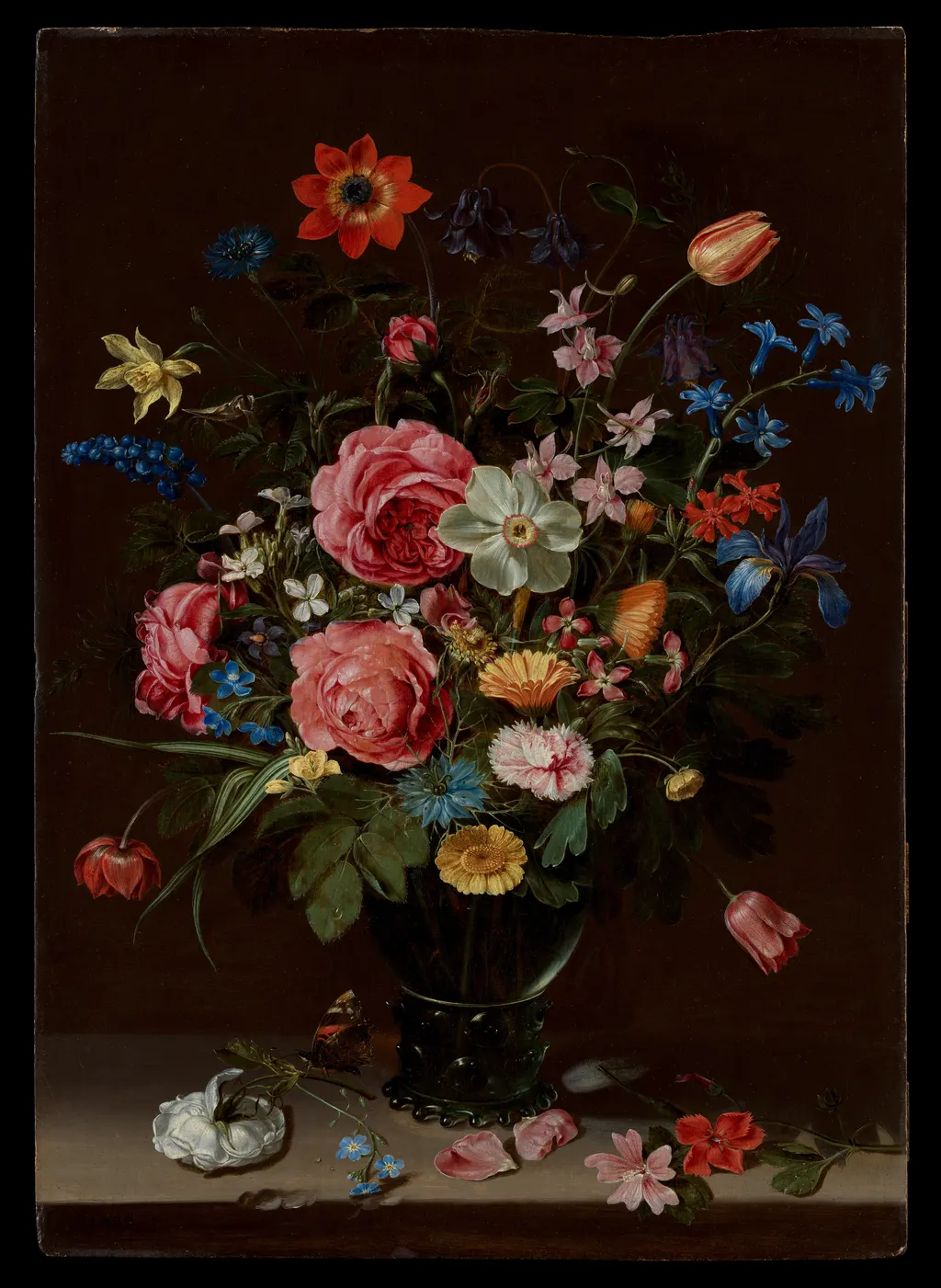
Clara PeetersA Bouquet of Flowers, ca. 1612Oil on woodThe Metropolitan Museum of Art, collection record. CC0 1.0 (Public Domain)
A candle burns in a small brass holder. Beside it stand two drinking vessels: a slender, airy Venetian-style wine glass and a sturdier green rummer. On a pewter plate lie sweetmeats and biscuits; a sprig of rosemary rests on the white cloth, with golden jewels hanging from it, and a ring lies close by. The panel is barely larger than a sheet of writing paper, about 24 by 37 centimetres, and it carries a signature and a date: 1607.
This little painting, now in a private collection, is the earliest known dated work by Clara Peeters, one of the first painters anywhere in Europe to specialise in still life, and one of very few women working as professional painters in the early seventeenth century. It is also a puzzle. Read one way, it is a meditation on the passing of time. Read another, it is a quiet celebration of a wedding. This article looks at what we know about Peeters, what the 1607 picture contains, and why the question of its meaning is still open.
A painter almost without a biography
Almost everything about Clara Peeters's life is uncertain. The Metropolitan Museum gives her dates as about 1587 to after 1636; the Mauritshuis gives 1588/89 to after 1636. A Clara Peeters, daughter of Jan Peeters, was baptised in Antwerp in 1594, but both names were common in the city, and if that record were hers she would have signed the 1607 picture at the age of about twelve or thirteen. Because the painting already shows the control of a trained artist, many scholars place her birth in the 1580s instead. No record of her membership of Antwerp's Guild of Saint Luke has been found, nobody knows for certain who taught her, and no death record survives.
What does survive is a body of signed and often dated paintings, the earliest from 1607 and 1608, and a clear sense of her standing. Four large still lifes, three of them dated 1611, were in the Spanish royal collection by the following century and are now in the Prado in Madrid. One of them may be the earliest still life of dead game birds in European painting.
Reading the 1607 still life
Early seventeenth-century still life was a young genre, and painters in Antwerp were inventing its vocabulary as they went. Peeters's earliest picture already shows the habits that would define her work: a low viewpoint, a dark background, objects arranged along a table edge, and an almost obsessive attention to how light behaves on different materials, from the thin bubble of Venetian-style glass to the dull sheen of pewter and the hard sparkle of gold.
The traditional interpretation treats the painting as a vanitas, a reminder of mortality. The burning candle measures out time; a fly on the cloth suggests decay; rosemary, whose leaves keep their scent long after picking, was associated with memory and remembrance. On this reading, the precious objects on the table are beautiful but transient, and the viewer is invited to look past them. For the wider grammar of such images, see our guide to reading the symbols in still life painting.
The case for a wedding
More recent research has proposed a happier subject. The key lies in the jewellery. Golden ornaments of this kind decorated banquet tables in the period and could afterwards be presented to the bride; the ring on the cloth is a type associated with weddings; rosemary was strewn at weddings and carried in wedding processions as a sign of fidelity as well as memory; and the sweet dishes on the plate are the sort served at wedding feasts. On this view the picture is less a sermon than a toast.
Peeters's other work lends the idea some weight. She painted rosemary again as the decoration of a wedding cake in another still life, and in her Still Life with Cheeses, Almonds and Pretzels in the Mauritshuis she placed her full signature, CLARA PEETERS, on the handle of a bridal knife, the kind of gift a bridegroom gave his bride, precisely where the names of a couple would normally be engraved. The knife appears in at least five of her still lifes. Clearly, wedding objects belonged to her repertoire.
Two readings side by side
Candle: vanitas, time running out, or festive light at a celebration.
Rosemary: remembrance of the dead, or fidelity between spouses.
Gold jewels and ring: worldly riches that will not last, or bridal gifts.
Sweetmeats and wine: fleeting pleasures, or a wedding feast.
Neither interpretation can be proved. No document records who commissioned the panel, and in Flemish painting of this period a single object could carry several meanings at once. It is quite possible that a contemporary would have enjoyed both: a picture made for a marriage that also reminded the couple that time is short. What the debate shows is how much meaning Peeters could pack into a very small space.
The painter in the pewter
If the "hidden marriage" is one secret of Peeters's work, the other is the artist herself. In at least eight paintings she included tiny reflections of her own face in the polished surfaces of goblets, cups and jugs, sometimes holding a palette. In the Prado's 1611 Still Life with Flowers, a Silver-gilt Goblet, she appears several times over in the gilt goblet and on the pewter jug, wearing a cap and ruff. In the Mauritshuis cheese still life, a woman's face in a white cap is reflected in the pewter lid of the stoneware jug.
The device had precedents going back more than a century in Netherlandish painting, most famously in Jan van Eyck's convex mirror in the Arnolfini Portrait. For a woman whose life left almost no trace in the archives, these miniature self-portraits read as a quiet insistence: I made this. Combined with her prominent signatures, they suggest an artist very conscious of her reputation in a crowded Antwerp market that exported paintings across Europe. How oil paint makes such reflections possible is explained in how oil painting works.
Look closer: When you stand in front of a Peeters still life, find the brightest metal object, usually a goblet, a jug lid or a knife handle, and look at its highlights from close to. The reflections of windows are often the first thing you notice; a tiny figure may be hiding among them. Then step back and see how the same object anchors the whole composition.
A belated spotlight
Peeters's reputation has grown sharply in recent decades. In 2012 the Mauritshuis acquired its cheese still life, and in 2016 the Prado opened The Art of Clara Peeters (25 October 2016 to 19 February 2017), curated by Alejandro Vergara and organised with the Royal Museum of Fine Arts in Antwerp. It was the first exhibition the Prado had ever devoted to a woman painter, nearly two centuries after the museum opened. More recently the Metropolitan Museum acquired her A Bouquet of Flowers of about 1612.
Her importance is not only as a pioneering woman. She stands at the start of a tradition: the laid table, the breakfast piece and the fish still life that Dutch and Flemish painters would develop through the seventeenth century, discussed further in our introduction to Dutch Golden Age painting. The inverted kitchen and market scenes of an earlier Antwerp generation, explored in our article on Pieter Aertsen, form part of the same story.
Where to see Clara Peeters
- Museo del Prado, Madrid: the set of large still lifes from the Spanish royal collection, including the 1611 picture with her reflections.
- Mauritshuis, The Hague: Still Life with Cheeses, Almonds and Pretzels, with the signed bridal knife.
- Metropolitan Museum of Art, New York: A Bouquet of Flowers, about 1612.
- Elsewhere: examples are in the Staatliche Kunsthalle Karlsruhe, the Rijksmuseum in Amsterdam and the National Museum of Women in the Arts in Washington.
The 1607 panel itself remains in private hands, so it is seen mainly through reproductions and exhibitions. More painting history is collected under painting and drawing.
Sources
- A Bouquet of Flowers, Clara Peeters (collection record), The Metropolitan Museum of Art
- Still Life with Cheeses, Almonds and Pretzels, Clara Peeters, Mauritshuis
- Still Life with Flowers, a Silver-gilt Goblet, Dried Fruit, Sweetmeats, Bread Sticks, Wine and a Pewter Pitcher, Museo Nacional del Prado
- The Art of Clara Peeters (exhibition, 2016–17), Museo Nacional del Prado
- Clara Peeters, the pioneer of still life, The Low Countries