The Arts and Crafts Movement: William Morris and After
How Ruskin's ideas and William Morris's workshops grew into the Arts and Crafts Movement, its spread to America and Europe, and how to recognise its work.
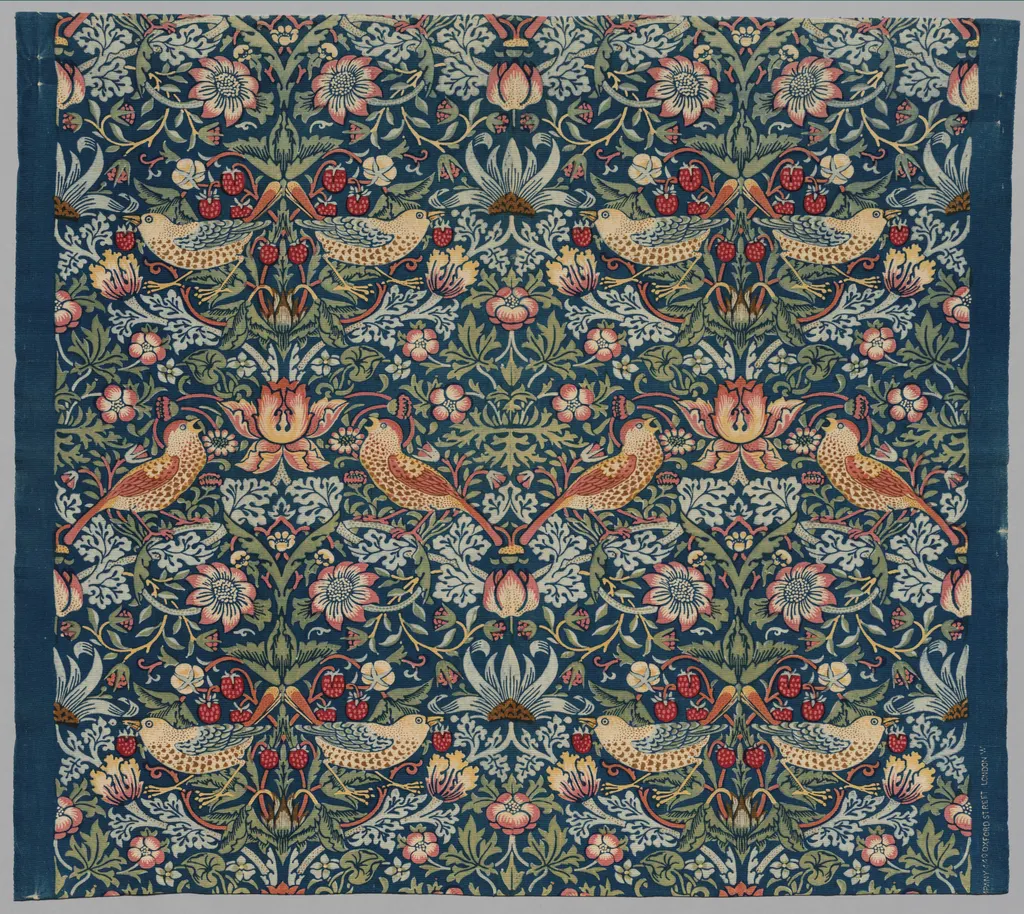
William MorrisStrawberry Thief, c 1936plain weave cotton, discharge printedCleveland Museum of Art, collection record. CC0 1.0 (Public Domain)
In 1859 a young man with money, strong opinions and no suitable furniture commissioned a house in the orchards of Kent, at what is now Bexleyheath. The architect was his friend Philip Webb; the client was William Morris. Red House, finished in 1860, was built in plain red brick with steep roofs and a well in the garden, and because nothing in the shops seemed good enough, Morris and his friends set about decorating it themselves: painted furniture, embroidered hangings, murals and stained glass. Out of that collaborative, slightly chaotic project came a firm, and out of the firm, in time, a movement.
The Arts and Crafts Movement was less a style than a set of convictions: that the way an object is made matters as much as how it looks, that makers should take pleasure in their work, and that ordinary homes deserve well-designed things. This article traces those ideas from John Ruskin to William Morris, follows them to Chipping Campden, East Aurora and Vienna, and ends with a guide to recognising Arts and Crafts work today.
Ruskin and the revolt against the machine
By the middle of the nineteenth century Britain led the world in mechanised manufacture. Factories could produce ornament cheaply and in quantity, and critics increasingly felt that the result was shoddy goods and degraded work. The Victoria and Albert Museum dates the recognition of these damaging effects in Britain to around 1840.
The most influential critic was John Ruskin. In "The Nature of Gothic", a chapter of The Stones of Venice (1851–53), he argued that the irregularities of medieval carving were evidence of free, thinking workers, and that the perfect finish demanded by industry turned men into tools. The argument was moral as much as aesthetic, and it struck a generation of young designers with great force. Morris later printed the chapter as a separate book at his own press.
William Morris and the firm
Morris (1834–1896) was poet, designer, businessman and, in later life, a committed socialist. In 1861, building on the Red House experience, he founded Morris, Marshall, Faulkner & Co. with partners including the painters Dante Gabriel Rossetti, Edward Burne-Jones and Ford Madox Brown, and Philip Webb. The firm made stained glass, painted tiles, furniture, embroidery, wallpapers and printed textiles, and in 1875 Morris reorganised it under his sole control as Morris & Co.
Morris learned techniques by doing them. He experimented with natural dyes such as indigo and madder, revived woodblock printing for textiles, and taught himself to weave tapestry. His Strawberry Thief furnishing fabric of 1883, with thrushes stealing fruit in the kitchen garden at Kelmscott Manor, was printed by the laborious indigo-discharge method at the firm's works at Merton Abbey in Surrey. The process took days, which is exactly what Morris intended: it produced a depth of colour that cheaper methods could not match.
His most famous sentence, from the 1880 lecture "The Beauty of Life", is still quoted in design schools: "Have nothing in your houses that you do not know to be useful, or believe to be beautiful."
The Kelmscott Press
In 1891 Morris founded the Kelmscott Press in Hammersmith, London, to print books as he believed medieval printers had: on handmade paper, with type he designed himself, dense black ink and decorated borders and initials. Its masterpiece, The Works of Geoffrey Chaucer (1896), contains 87 illustrations by Burne-Jones set within Morris's borders. Morris died on 3 October that year. The Kelmscott books inspired a wave of private presses and changed how designers thought about the printed page; our history of illustration follows that thread.
The paradox Morris could not solve
Handmade work using the best materials was expensive. Morris's wallpapers and textiles were bought by the prosperous middle classes, not the workers whose lives he hoped to improve, and he was acutely aware of the contradiction. It remained the movement's central tension: ideals of democratic design, delivered in objects that only some could afford.
Guilds, societies and a name
By the 1880s Morris's ideas had become a movement with institutions. Architects and designers founded the Art Workers' Guild in 1884 to bring the "fine" and "applied" arts together on equal terms. In 1887 the Arts and Crafts Exhibition Society was founded in London, with Walter Crane as its first president, and it held its first exhibition in 1888. The bookbinder T. J. Cobden-Sanderson is credited with proposing the name "Arts and Crafts", which gave the whole movement its label. According to the V&A, more than a hundred Arts and Crafts organisations and guilds were created in Britain between 1895 and 1905.
The most ambitious experiment was C. R. Ashbee's Guild of Handicraft, founded in 1888 in East London. In 1902 Ashbee moved the workshops, and around 150 men, women and children, to Chipping Campden in the Cotswolds, hoping that country life would make better craftsmen and happier families. The Guild produced superb silver, jewellery, furniture and printed books, but it struggled to compete commercially and the company did not survive the decade, though some of its craftsmen stayed on in the town.
Women were central to the movement, even if the guilds often excluded them. May Morris, William's daughter, ran the embroidery department of Morris & Co. from 1885 and was a designer, teacher and writer on embroidery in her own right. Many women trained in the new art schools and worked in metalwork, enamelling, bookbinding and pottery.
America: Stickley, Roycroft and the bungalow
The movement crossed the Atlantic in the 1890s, and in the United States it took on a different character. As the Met's Heilbrunn Timeline notes, its socialist undercurrent did not spread much beyond a few utopian communities; American Arts and Crafts was more varied and often more commercial.
- Gustav Stickley (1858–1942) founded the United Crafts, later the Craftsman Workshops, and between 1901 and 1916 published The Craftsman magazine, which promoted his sturdy oak furniture, house plans and the ideal of a simple, honest home.
- Elbert Hubbard founded the Roycroft community at East Aurora, New York, in 1895, where printers, bookbinders, furniture makers and metalsmiths worked together. The name came from the seventeenth-century London printers Samuel and Thomas Roycroft.
- Charles and Henry Greene, working as Greene & Greene in Pasadena, California, designed houses such as the Gamble House (1908), with every joint, light fitting and piece of furniture considered as part of a whole.
Europe and the road to modernism
In Glasgow, Charles Rennie Mackintosh and his circle developed a distinctive linear style. In Vienna, the Wiener Werkstätte, founded in 1903 by Josef Hoffmann and Koloman Moser, applied Arts and Crafts ideals of workshop production and unified design to an elegant geometric vocabulary. In Germany and Scandinavia similar reform movements took root.
The relationship between Arts and Crafts and modernism is a curious one. The movement rejected the machine, yet its insistence on honest materials, visible construction and fitness for purpose fed directly into modernist design, as the V&A points out. In Britain the movement lost momentum after the First World War, although the Arts and Crafts Exhibition Society continued to hold exhibitions and in 1960 merged with the Cambridgeshire Guild of Craftsmen to form the Society of Designer Craftsmen. For the decorative styles that developed alongside it, see Art Nouveau and Art Deco compared.
Timeline
- 1851–53: Ruskin's The Stones of Venice, including "The Nature of Gothic".
- 1859–60: Red House built for Morris by Philip Webb.
- 1861: Morris, Marshall, Faulkner & Co. founded.
- 1875: The firm reorganised as Morris & Co.
- 1883: Strawberry Thief textile.
- 1884: Art Workers' Guild founded.
- 1887–88: Arts and Crafts Exhibition Society founded; first exhibition.
- 1888: C. R. Ashbee's Guild of Handicraft founded.
- 1891: Kelmscott Press founded.
- 1895: Roycroft founded at East Aurora, New York.
- 1896: Kelmscott Chaucer published; Morris dies.
- 1901–16: Stickley's The Craftsman magazine.
- 1902: Guild of Handicraft moves to Chipping Campden.
- 1903: Wiener Werkstätte founded in Vienna.
How to recognise Arts and Crafts work
Whether in a museum, a historic house or an antiques shop, these are the signs to look for:
- Construction on show. Through-tenons, pegs, dovetails and strap hinges are displayed rather than hidden. Our guide to identifying antique furniture explains how to read joints.
- Honest materials. Plain oak, often quarter-sawn in American work to show the ray figure; beaten copper and silver; leather; natural-dyed wool and linen.
- The mark of the hand. Planishing (hammer) marks left visible on metal, slight irregularity in enamels and hand-printed textiles.
- Nature, stylised. Birds, flowers, fruit and leaves, flattened into repeating patterns rather than painted naturalistically.
- Restraint. Ornament is integrated into form, not applied as an afterthought.
- Beware later work. Arts and Crafts designs have been reproduced continuously; Morris patterns are still printed. Marks, labels, construction and wear all need checking before an attribution is accepted.
Good places to see the movement include the V&A in London, the William Morris Gallery in Walthamstow, Red House in Bexleyheath (National Trust), Kelmscott Manor in Oxfordshire, the Court Barn museum in Chipping Campden, and the Met's American Wing in New York. For background on how such objects fit into the wider field, read understanding the decorative arts, and explore more in our arts and crafts section.
Sources
- Arts and Crafts: an introduction, Victoria and Albert Museum
- The Arts and Crafts Movement in America, The Metropolitan Museum of Art, Heilbrunn Timeline of Art History
- The Kelmscott Chaucer, The Fitzwilliam Museum, University of Cambridge
- Arts and Crafts movement, Encyclopaedia Britannica
- Red House, National Trust