Traditional Crafts from Around the World
Six living craft traditions explained, from Indonesian batik and Bangladeshi jamdani to Turkish ebru, Japanese washi, Ghanaian kente and Mexican talavera.
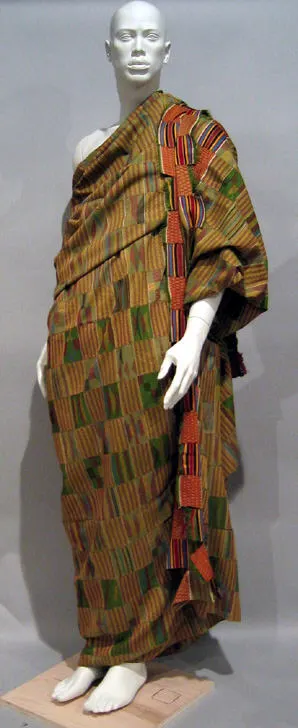
Asante-Akan artistMan's kente (prestige cloth), 19th centuryCotton, silkThe Metropolitan Museum of Art, collection record. CC0 1.0 (Public Domain)
Hold a length of kente cloth up to the light and you can see how it was made. Running down the cloth at regular intervals are seams: the whole textile is built from long, narrow strips, each only a few inches wide, woven on a small loom and then cut and sewn edge to edge. The blocks of colour that seem to float across the surface were planned so that they would line up, or deliberately not line up, once the strips were joined. A single object tells you about the tool, the weaver's planning and the community that wore it.
Traditional crafts reward that kind of attention. They are not quaint survivals but living systems of knowledge, passed from one maker to the next, adapted to new materials and markets, and often closely tied to identity. UNESCO's Convention for the Safeguarding of the Intangible Cultural Heritage, adopted in 2003, recognises many of them on its Representative List, which records practices rather than objects.
This article looks at six traditions from four continents: what is made, how it is made, and what to look for when you see an example in a museum or market.
Wax and dye: batik in Indonesia
Batik is a resist technique. Hot wax is applied to cloth wherever the maker wants the fabric to stay its existing colour; the cloth is dyed; the wax is removed; and the process is repeated for each further colour. Because each dye bath builds on the last, complex batik is planned from light to dark, like a reduction print.
In Java, fine work is drawn by hand with a canting, a small copper reservoir with a spout fixed to a handle, which lets the maker trace lines of molten wax as fine as a pen stroke. Hand-drawn cloth is known as batik tulis. Faster production uses a cap, a copper stamp that applies a whole repeat of the pattern at once. Indonesian Batik was inscribed on UNESCO's Representative List in 2009, and UNESCO's description stresses that its colours and motifs carry symbolic meanings tied to region and occasion.
What to look for: On hand-drawn batik the pattern usually shows clearly on both sides of the cloth, and small irregularities in line weight betray the hand. Fine, spidery veining where the dye has seeped through cracks in the wax is characteristic of the technique.
Pattern woven in: jamdani of Bangladesh
Jamdani is a fine, sheer cotton cloth, best known as saris, woven on hand looms in the area around Dhaka. Its floating motifs, often flowers, vines and geometric figures, are not printed or embroidered on afterwards: they are woven in as the cloth grows, using a discontinuous supplementary weft. The weaver lays extra threads into the shed by hand, just across the area of each motif, so that the pattern appears suspended in the gauzy ground.
UNESCO inscribed the traditional art of jamdani weaving in 2013, noting that skills pass from master weavers to apprentices, often within families working in home workshops. The Committee's decision also asked that producers remain the main beneficiaries of the craft's commercial success, a reminder that heritage status and fair reward do not automatically go together.
What to look for: Hold jamdani to the light: motifs are opaque while the ground is translucent, and on the reverse you will see the supplementary threads turning back at the edge of each motif rather than running across the whole width.
Colour on water: Turkish ebru
Ebru is the Turkish art of marbling. The maker fills a shallow tray with water thickened so that colours float on its surface, then sprinkles and brushes pigments onto it. Using styluses, combs and brushes, the colours are drawn into patterns, from loose stone-like veining to precise flowers such as tulips and carnations. A sheet of paper is laid on the surface for a moment and lifted, carrying the whole design with it. Each pattern can be printed only once.
Marbled papers were used for bookbinding and as grounds for calligraphy. UNESCO inscribed Ebru, Turkish art of marbling, on its Representative List in 2014, noting that it is learned through master-apprentice relationships and that gaining basic skills takes at least two years.
What to look for: True marbling shows soft, slightly feathered edges where colours meet, and no two sheets are identical. Printed imitations repeat exactly.
Fibres and screens: Japanese washi
Washi is handmade Japanese paper. In its traditional form it is made from the inner bark of the paper mulberry (kōzo). The fibres are cleaned, beaten, suspended in clear water and gathered on a bamboo screen, which the papermaker rocks so that the long fibres interlock. The result is thin, strong and surprisingly durable, which is why washi has been used for documents, books, sliding doors and screens, and why conservators around the world use it to repair torn paper and prints. Washi craftsmanship is recognised on UNESCO's Representative List, which highlights the role of families, preservation associations and local communities in keeping the knowledge alive.
What to look for: Hold a sheet to the light to see long, irregular fibres. Torn edges feather out into soft wisps rather than breaking cleanly as machine-made wood-pulp paper does.
Strips into cloth: kente of Ghana
Kente is the best-known of West Africa's strip-woven textiles. It is woven, traditionally by men, on narrow portable looms. The Cooper Hewitt, Smithsonian Design Museum, describes strips commonly between about three and a half and five inches wide, woven as one continuous length that is then cut and sewn selvedge to selvedge to make a cloth large enough to wrap the body.
Two main traditions are associated with kente in Ghana and neighbouring Togo. Asante weavers, with Bonwire as a renowned centre, are known for bold geometric designs, historically in silk, and certain patterns were reserved for the Asantehene (the Asante king) and those he permitted to wear them. Ewe weavers also use geometric designs but are known for including figurative motifs such as animals, people and objects.
What to look for: Count the strips and check how carefully the blocks align across the seams. Many patterns have names, and in Ghana a cloth's name and design can carry proverbs or historical associations.
Tin glaze in two worlds: talavera
Talavera is a tin-glazed earthenware tradition shared by Spain and Mexico. Its Spanish roots lie in the towns of Talavera de la Reina and El Puente del Arzobispo; in Mexico it is made in Puebla and Tlaxcala, where the tradition developed during the colonial period. Pots and tiles are shaped on the wheel or in moulds, dipped in an opaque white glaze, and painted with metal-oxide colours before a second firing. In 2019 UNESCO inscribed the artisanal talavera of Puebla and Tlaxcala, together with the ceramics of Talavera de la Reina and El Puente del Arzobispo, as a joint entry from Mexico and Spain.
Talavera belongs to the same broad family as Italian maiolica and Dutch Delftware, which also cover a red or buff body with a white tin glaze to imitate the look of porcelain. Our guides to identifying ceramic styles and the history of Delftware explain the wider story.
What to look for: Where the glaze has chipped, you should see the coloured earthenware body beneath. Painted colours often stand slightly proud of the surface and may pool or run a little in the firing.
The six traditions compare as follows.
| Craft | Where | Material | Key technique | UNESCO Representative List |
|---|---|---|---|---|
| Batik | Indonesia | Cotton or silk cloth | Wax resist and dyeing | Inscribed 2009 |
| Jamdani | Bangladesh | Fine cotton | Discontinuous supplementary weft | Inscribed 2013 |
| Ebru | Türkiye | Paper | Marbling on thickened water | Inscribed 2014 |
| Washi | Japan | Paper mulberry fibre | Sheet-forming on a bamboo screen | Listed |
| Kente | Ghana and Togo | Silk, cotton, rayon | Narrow strip weaving | — |
| Talavera | Mexico and Spain | Earthenware | Tin glaze and painted decoration | Inscribed 2019 |
Seeing, buying and learning responsibly
Traditional crafts are livelihoods as well as heritage. A few habits help make appreciation fair:
- Ask who made it. Where possible, buy from makers, cooperatives or shops that can name them. Heritage status has not always meant better pay for the people doing the work.
- Learn the difference between technique and look. Batik-style prints, machine-made "kente" fabric and printed marbled paper are widely sold. They are not wrong to own, but they are not the same thing as the handmade craft.
- Use the makers' own words. Canting, cap, kōzo, ebru: the vocabulary often explains the process better than an English approximation.
- Look for living practitioners, not only museum pieces. Many of these crafts are taught in workshops and demonstrated at festivals; watching a maker for ten minutes teaches more than a page of description.
- Treat sacred or restricted designs with care. Some patterns are reserved for particular people or occasions. Ask before copying them.
If these crafts interest you, follow the thread further with our guides to embroidery traditions of the world, how to read an oriental rug and the Arts and Crafts Movement, whose founders looked to handwork as an answer to industrial production. More is collected in our arts and crafts section.
Sources
- Indonesian Batik, UNESCO Intangible Cultural Heritage
- Traditional art of Jamdani weaving, UNESCO Intangible Cultural Heritage
- Ebru, Turkish art of marbling, UNESCO Intangible Cultural Heritage
- Artisanal talavera of Puebla and Tlaxcala (Mexico) and ceramics of Talavera de la Reina and El Puente del Arzobispo (Spain) making process, UNESCO Intangible Cultural Heritage
- Washi, craftsmanship of traditional Japanese hand-made paper, UNESCO Intangible Cultural Heritage
- Kente cloth (collection object), Cooper Hewitt, Smithsonian Design Museum