Impressionism Explained: Light, Paint and Modern Life
How a group of independent Paris artists changed painting after 1874: their exhibitions, techniques, subjects and materials, and what to look for in their work.
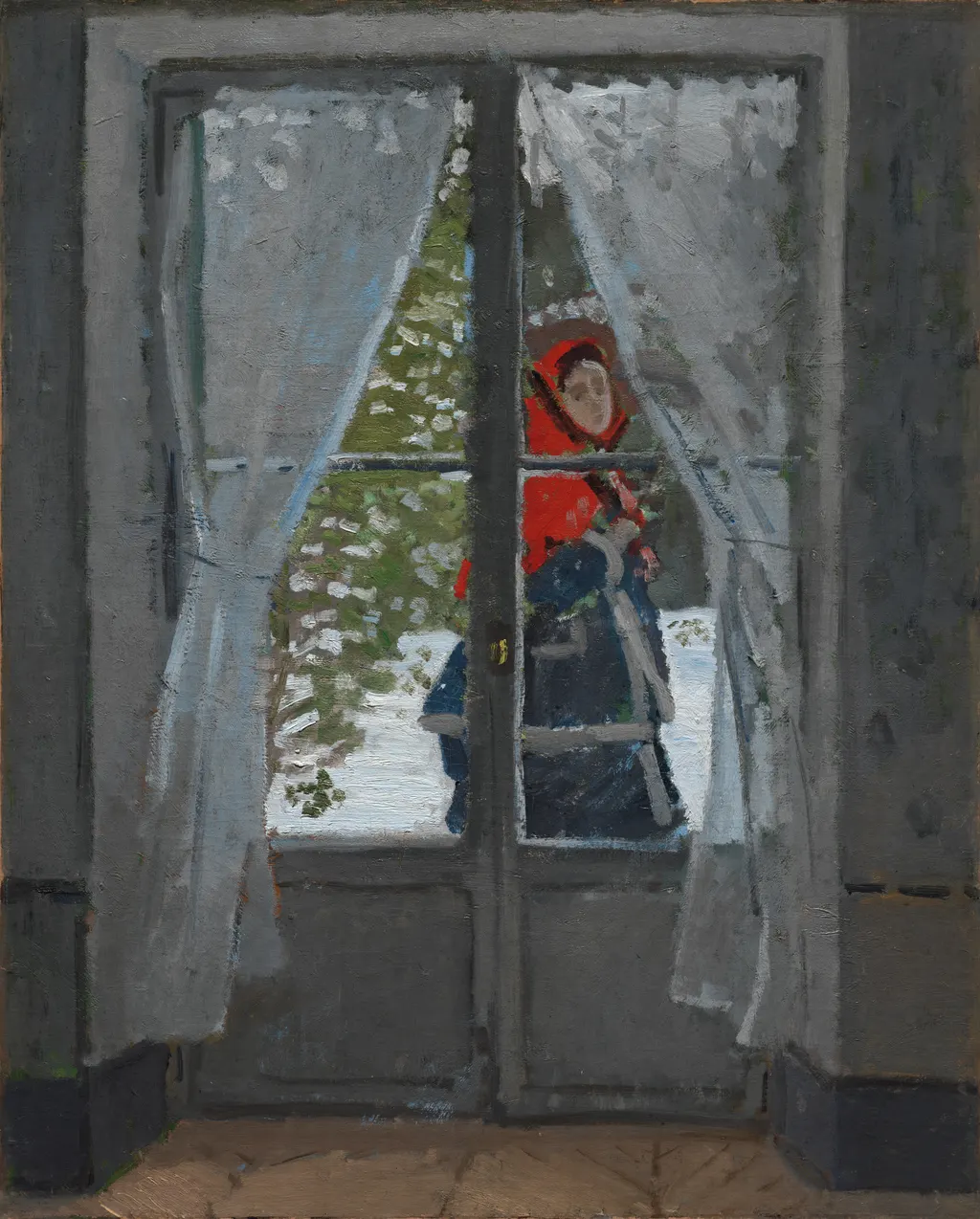
Claude MonetThe Red Kerchief, c. 1868–73oil on fabricCleveland Museum of Art, collection record. CC0 1.0 (Public Domain)
The harbour of Le Havre at dawn: grey-blue water, the dim shapes of masts and cranes, a few small boats as dark smudges, and a low orange sun whose reflection breaks into a ladder of bright strokes across the water. Claude Monet painted it quickly, in 1872, and called it Impression, Sunrise. When it was shown in Paris two years later, a critic took the title and turned it into a joke. The artists, he implied, were not painting pictures at all, only impressions.
The name stuck, and the joke backfired. Impressionism became one of the most popular movements in the history of art, and the paintings once dismissed as unfinished sketches now draw some of the largest crowds in the world's museums. This article explains who the Impressionists were, what they were rebelling against, how they painted, what they chose to paint, and what to look for when you stand in front of their work.
The Salon and its discontents
In mid-nineteenth-century France, an artist's career depended on the Salon, the huge official exhibition in Paris, whose jury favoured carefully finished history paintings, mythologies and polished portraits. Rejection could mean obscurity.
Tension grew through the 1860s. In 1863 so many works were refused that Emperor Napoleon III allowed a separate exhibition of rejected pictures, the Salon des Refusés. Its most notorious exhibit was Édouard Manet's Le Déjeuner sur l'herbe, which shocked visitors with a nude woman picnicking beside clothed men in modern dress. Manet became a hero to younger painters, though he never exhibited with the Impressionists himself.
The independent exhibitions, 1874–1886
In December 1873 a group of artists founded a cooperative society, the Société anonyme des artistes peintres, sculpteurs, graveurs, to organise their own exhibitions, free of juries and prizes. The first opened in April 1874 in the former studio of the photographer Nadar on the boulevard des Capucines. Thirty artists took part, among them Monet, Pierre-Auguste Renoir, Camille Pissarro, Alfred Sisley, Edgar Degas, Berthe Morisot and Paul Cézanne.
The critic Louis Leroy's satirical review in the magazine Le Charivari, headed "The Exhibition of the Impressionists", gave the group its name. Over the next twelve years they held eight exhibitions in all, the last in 1886. Membership shifted: Cézanne showed only twice; Gustave Caillebotte, a wealthy painter who also bought his friends' work, joined in 1876; the American Mary Cassatt was invited by Degas to show from 1879. Pissarro was the only artist to exhibit at all eight, and Morisot showed at all but one.
Not one style. The group was a loose alliance, not a school. Degas disliked the label "Impressionist" and painted mostly indoors, from memory and drawings; Monet and Sisley painted landscapes outdoors; Morisot and Cassatt focused on domestic and social life. What united them was independence from the Salon and a commitment to modern subjects.
How they painted
Outdoors, in changing light
Painting sketches outdoors was not new, but the Impressionists made the outdoor painting itself the finished work. Working en plein air ("in the open air") meant painting fast before the light changed, which encouraged broad, rapid brushwork.
Two practical developments helped. Collapsible metal paint tubes, patented in 1841 by the American painter John Goffe Rand, made oil paint portable and stopped it drying out. And the expanding railway network made it easy to travel from Paris to the riverbanks and coast.
Colour and broken brushwork
Instead of blending colours smoothly, Impressionists often laid down separate dabs and dashes of colour side by side, leaving the viewer's eye to combine them at a distance. They avoided black for shadows where possible, observing that shadows outdoors are tinged with blue, violet or the reflected colour of their surroundings. New and newly affordable pigments, including cobalt blue, synthetic ultramarine, viridian and cadmium yellow, gave them a brighter palette than earlier painters had.
They often worked on canvases primed in white or pale tones rather than the darker grounds traditional in studio painting, which made colours look lighter and more luminous. For a fuller explanation of the medium, see How Oil Painting Works.
New ways of framing
Japanese woodblock prints, widely available in Paris from the 1860s, encouraged unconventional compositions: high viewpoints, figures cut off by the edge of the canvas, empty foregrounds and asymmetrical arrangements. Degas, who collected Japanese prints, was a master of these off-centre, snapshot-like views.
What they painted
The Impressionists turned to the world around them, in a Paris being transformed. Under Napoleon III, Baron Haussmann had driven wide new boulevards through the medieval city, lined with cafés, theatres and department stores. A growing middle class enjoyed new leisure: boating on the Seine, dancing in open-air cafés, Sundays in the suburbs.
- Modern Paris: Caillebotte's Paris Street; Rainy Day (1877, Art Institute of Chicago), shown at the third Impressionist exhibition, depicts well-dressed pedestrians under umbrellas at a new Haussmann intersection.
- Leisure and pleasure: Renoir's Bal du moulin de la Galette (1876, Musée d'Orsay) captures a Sunday afternoon dance in Montmartre, dappled with sunlight through trees.
- Domestic and private life: Morisot's The Cradle (1872, Musée d'Orsay) and Cassatt's Little Girl in a Blue Armchair (1878, National Gallery of Art, Washington) look closely at women's and children's lives, often from inside the home.
- Work and performance: Degas painted dancers rehearsing and resting, laundresses, milliners and café singers.
- Landscape and the river: Monet at Argenteuil, Sisley along the Seine and Loing, and Pissarro in the villages around Pontoise painted fields, riverbanks, orchards and towns in every season.
Look closer: In front of an Impressionist landscape, walk slowly towards it. At a distance, the scene holds together; up close, it breaks into separate strokes of unexpected colour, such as violet in a shadow or pink in a cloud. Find the point where the two views switch over. That threshold is where the painting does its work.
Series and later directions
From the 1880s the group drifted apart. Some members questioned the loss of form in pure Impressionism. Renoir turned towards firmer drawing; Pissarro briefly adopted the systematic dots of the younger Georges Seurat.
Monet pursued the study of light to its limits. In the 1890s he painted series of the same motif under different conditions: grainstacks in fields near his home at Giverny (1890–91), poplars, and the façade of Rouen Cathedral (1892–94), sometimes working on several canvases in one day as the light changed. In his last decades he devoted himself to the water-lily pond in his garden at Giverny; his great water-lily panels were installed at the Musée de l'Orangerie in Paris in 1927, after his death.
Meanwhile, the artists later grouped as Post-Impressionists, a term coined by the critic Roger Fry in 1910, took Impressionism's lessons in new directions: Cézanne towards solid structure, Seurat towards optical theory, Gauguin and van Gogh towards symbolic and expressive colour.
A short timeline
- 1863: Salon des Refusés; Manet's Le Déjeuner sur l'herbe causes a scandal.
- 1872: Monet paints Impression, Sunrise at Le Havre.
- 1873: The artists' cooperative society is founded in December.
- 1874: First independent exhibition, at Nadar's former studio; Leroy's review names the group.
- 1876–77: Second and third exhibitions; Renoir's Bal du moulin de la Galette and Caillebotte's Paris Street; Rainy Day.
- 1879: Mary Cassatt exhibits with the group for the first time.
- 1886: Eighth and final exhibition; the dealer Paul Durand-Ruel shows Impressionist paintings in New York.
- 1890s: Monet's series paintings.
- 1927: Monet's water-lily decorations open at the Orangerie.
Where to see Impressionism
The Musée d'Orsay in Paris has the world's richest collection, much of it from Caillebotte's bequest to the French state, which was accepted only in part after long hesitation, and from later gifts. The Musée Marmottan Monet in Paris holds Impression, Sunrise, and the Musée de l'Orangerie the water lilies. Outside France, the Art Institute of Chicago, the Metropolitan Museum of Art, the National Gallery of Art in Washington, the Museum of Fine Arts in Boston, the National Gallery and the Courtauld Gallery in London all have outstanding Impressionist holdings.
To place the movement in the longer story of European art, see Understanding the Major Art Movements, and for a step-by-step way of looking at any painting, How to Appreciate a Historical Painting. Families can try Impressionist-style painting at home with ideas from Art Activities Inspired by Famous Artists. More on artists and movements is collected under artists and movements.
Sources
- Impressionism (art term), Tate
- Impressionism: Art and Modernity, The Metropolitan Museum of Art, Heilbrunn Timeline of Art History
- Paris Street; Rainy Day, Gustave Caillebotte, 1877, Art Institute of Chicago
- Post-Impressionism (art term), Tate