Understanding the Major Art Movements, from Renaissance to Pop
A clear guide to the major Western art movements from the Renaissance to Pop Art: when they happened, what they valued, and the artists and works to know.
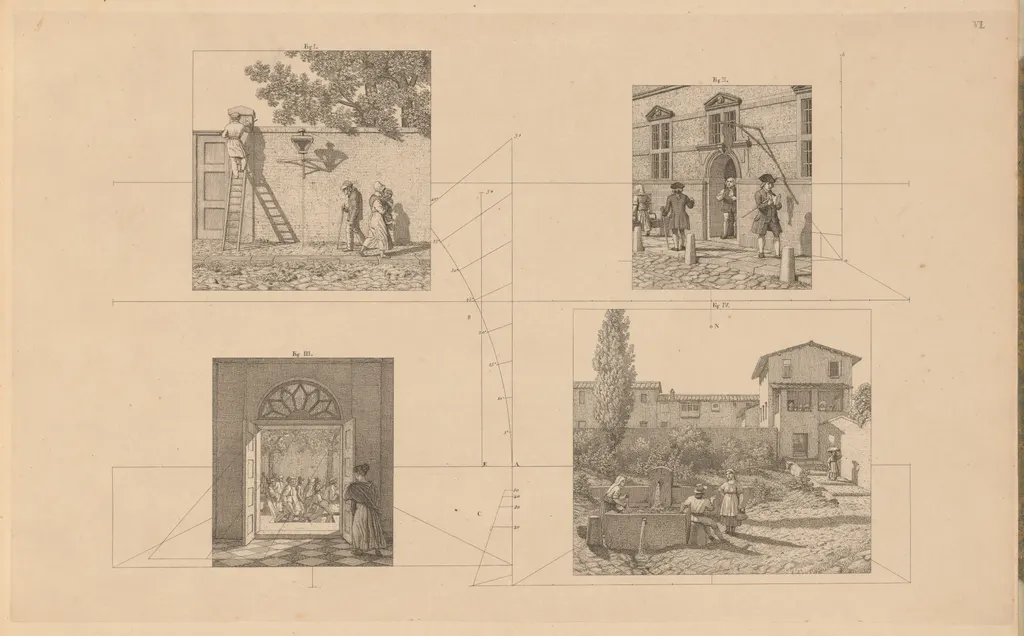
Christoffer Wilhelm EckersbergLinear Perspective, Applied to the Art of Painting: A Collection of Studies in Perspective, 1841Eleven etched platesThe Metropolitan Museum of Art, collection record. CC0 1.0 (Public Domain)
Walk through a large museum such as the Louvre, the National Gallery in London or the Metropolitan Museum of Art in chronological order, and you can watch European painting change its mind about almost everything. Gold backgrounds give way to convincing rooms and landscapes. Calm, balanced compositions are overtaken by swirling drama, then by elegant frivolity, then by stern classical virtue. By the late nineteenth century painters are dissolving solid forms into flickering light; a few decades later, they are taking objects apart into geometric fragments, or exhibiting a mass-produced urinal as art.
Art historians group these shifts into "movements" and "styles". The labels are tools rather than laws: many were invented after the fact, some were coined as insults, and plenty of great artists do not fit neatly into any of them. Still, knowing the main movements gives you a mental map. This guide walks through the major Western movements from the fifteenth century to the 1960s, explaining what each valued, when and where it flourished, and which artists and works best represent it.
A note on scope. This is a guide to the European and North American tradition that most Western museums are organised around. Art in China, Japan, the Islamic world, Africa and the Americas has its own histories and periods, which do not map onto these labels, and the exchanges between traditions, such as the impact of Japanese prints on the Impressionists, are part of the story.
The Renaissance and its aftermath (c. 1400–1600)
Renaissance
The word means "rebirth", referring to a revival of interest in the art and learning of ancient Greece and Rome. It began in Florence in the early fifteenth century. The architect Filippo Brunelleschi worked out a mathematical system of linear perspective, and the painter Masaccio applied it in his fresco of The Holy Trinity in the church of Santa Maria Novella (c. 1427), which seems to open a real chapel in the wall.
Renaissance artists valued harmony, proportion, the study of anatomy and nature, and the dignity of the human figure. The so-called High Renaissance, around 1490 to 1527, is associated with Leonardo da Vinci, Michelangelo (whose Sistine Chapel ceiling was painted between 1508 and 1512) and Raphael. North of the Alps, painters such as Jan van Eyck in Bruges and Albrecht Dürer in Nuremberg developed their own Renaissance, rooted in minute observation and the new medium of oil paint.
Mannerism
From around the 1520s, a generation of Italian artists including Pontormo, Parmigianino and Bronzino moved away from Renaissance balance towards elongated figures, unusual colours, crowded or ambiguous spaces and conscious elegance. Parmigianino's Madonna with the Long Neck (c. 1534–40, Uffizi, Florence) is the textbook example. The term was long used disapprovingly; it is now seen as a sophisticated style in its own right.
Drama, delight and reason (c. 1600–1830)
Baroque (c. 1600–1750)
Baroque art aims to move the viewer: through dramatic lighting, dynamic diagonals, emotional intensity and the merging of painting, sculpture and architecture. It was closely tied to the Catholic Church's renewal after the Council of Trent, but also flourished at royal courts and in Protestant Holland. Key figures include Caravaggio, Gian Lorenzo Bernini, Peter Paul Rubens, Artemisia Gentileschi, Diego Velázquez and Rembrandt. Our article What Was the Baroque? explores it in depth.
Rococo (c. 1720–1770s)
Born in France after the death of Louis XIV in 1715, Rococo is lighter, more playful and more intimate than the Baroque: pastel colours, curving ornament, scenes of flirtation in parkland. Antoine Watteau invented the fête galante, an outdoor gathering of elegant figures; François Boucher and Jean-Honoré Fragonard took the style to its height. Fragonard's The Swing (c. 1767) in the Wallace Collection, London, with its flying pink slipper, sums it up.
Neoclassicism (c. 1760–1830)
In reaction against Rococo frivolity, and inspired by the excavations at Herculaneum and Pompeii and the writings of Johann Joachim Winckelmann, Neoclassical artists turned to the clarity, restraint and moral seriousness they admired in ancient art. Jacques-Louis David's Oath of the Horatii (1784, Louvre), with its rigid, heroic figures, became a manifesto of civic virtue. The sculptor Antonio Canova is the movement's other great name.
Romanticism (c. 1790–1850)
Romanticism prized emotion, imagination, individual experience and the overwhelming power of nature over classical rules. Its painters include Caspar David Friedrich in Germany, J.M.W. Turner and John Constable in Britain, Théodore Géricault and Eugène Delacroix in France, and Francisco de Goya in Spain. Delacroix's Liberty Leading the People (1830, Louvre) and Géricault's Raft of the Medusa (1818–19, Louvre) are among its landmarks. See Romanticism in Art for more.
Modern life and modern vision (c. 1840–1905)
Realism
From the 1840s, artists led by Gustave Courbet in France rejected both classical idealism and Romantic escapism in favour of ordinary people and contemporary life, painted at full scale. Courbet's A Burial at Ornans (1849–50) and Jean-François Millet's The Gleaners (1857), both in the Musée d'Orsay, Paris, gave peasants and rural labourers the monumental treatment once reserved for heroes and saints.
Impressionism
In 1874 a group of artists including Claude Monet, Pierre-Auguste Renoir, Camille Pissarro, Edgar Degas and Berthe Morisot held an independent exhibition in Paris, outside the official Salon. A hostile critic seized on the title of Monet's Impression, Sunrise to mock them, and the name stuck. Their concerns were light, atmosphere, modern urban and suburban life, and the fleeting moment, captured with visible brushstrokes and bright colour. Read Impressionism Explained for the full story.
Post-Impressionism
This is less a movement than an umbrella term, coined by the British critic Roger Fry for his 1910 exhibition Manet and the Post-Impressionists. It covers artists who built on Impressionism but pushed it in very different directions: Paul Cézanne towards solid structure, Georges Seurat towards scientific systems of colour dots, Paul Gauguin towards symbolic colour and simplified form, and Vincent van Gogh towards intense personal expression.
Around the same years, the decorative arts had their own revolutions, described in The Arts and Crafts Movement and Art Nouveau and Art Deco: How to Tell Them Apart.
The avant-gardes (c. 1905–1945)
The early twentieth century brought a rapid succession of movements, each announcing a break with the past.
- Fauvism (c. 1905–08): At the Salon d'Automne in Paris in 1905, the critic Louis Vauxcelles called Henri Matisse, André Derain and their circle les fauves, "the wild beasts", for their violent, non-naturalistic colour.
- Expressionism (c. 1905–1920s): In Germany, the Die Brücke group, founded in Dresden in 1905, and Der Blaue Reiter in Munich, associated with Wassily Kandinsky and Franz Marc, used distorted forms and colour to express inner states and spiritual ideas.
- Cubism (c. 1907–14): Pablo Picasso and Georges Braque broke objects and figures into overlapping planes seen from several viewpoints at once. Picasso's Les Demoiselles d'Avignon (1907, Museum of Modern Art, New York) is usually taken as its starting point. Tate distinguishes an austere "analytical" phase (1908–12) from a brighter "synthetic" phase (c. 1912–14) that introduced collage.
- Futurism (from 1909): Launched by the Italian poet Filippo Tommaso Marinetti's manifesto, published in Le Figaro, it celebrated speed, machines and the modern city.
- Dada (c. 1916–1920s): Born at the Cabaret Voltaire in Zurich during the First World War, Dada mocked reason and convention through performance, collage and provocation. Marcel Duchamp's Fountain (1917), a urinal signed "R. Mutt", posed the question of what makes something art.
- Surrealism (from 1924): Defined by André Breton's Surrealist Manifesto of 1924, it sought to release the creative power of dreams and the unconscious. Its artists included Salvador Dalí, René Magritte, Joan Miró, Max Ernst, Leonora Carrington and Dorothea Tanning.
After 1945: New York and the image world
Abstract Expressionism (1940s–1950s)
After the Second World War, the centre of the avant-garde shifted to New York. Painters including Jackson Pollock, Willem de Kooning, Lee Krasner, Mark Rothko and Barnett Newman made large abstract canvases that emphasised gesture, scale and emotional or spiritual intensity. Pollock's poured and dripped paintings, made with the canvas on the floor, became emblematic.
Pop Art (mid-1950s–1960s)
Pop Art emerged in Britain in the mid-1950s, out of the discussions of the Independent Group in London, and in the United States in the late 1950s. It took its imagery from advertising, comics, packaging, film and celebrity. In Britain, Richard Hamilton's small 1956 collage Just what is it that makes today's homes so different, so appealing? is often cited as an early landmark. In America, Andy Warhol's Campbell's Soup Cans (1962) and Marilyn Diptych (1962) and Roy Lichtenstein's comic-strip Whaam! (1963, Tate) brought mass culture into the gallery.
The movements at a glance
| Movement | Approximate dates | Centre(s) | Key values |
|---|---|---|---|
| Renaissance | c. 1400–1600 | Florence, Rome, Venice; Flanders | Harmony, perspective, classical revival |
| Mannerism | c. 1520–1600 | Florence, Rome | Elegance, artifice, elongation |
| Baroque | c. 1600–1750 | Rome, Antwerp, Madrid, Amsterdam | Drama, movement, emotion |
| Rococo | c. 1720–1770s | Paris | Lightness, intimacy, ornament |
| Neoclassicism | c. 1760–1830 | Rome, Paris | Clarity, virtue, antiquity |
| Romanticism | c. 1790–1850 | Germany, Britain, France | Emotion, nature, the sublime |
| Realism | c. 1840–1880 | France | Everyday life, truth to observation |
| Impressionism | 1874–1886 (group shows) | Paris | Light, modern life, the moment |
| Post-Impressionism | c. 1886–1905 | France | Structure, symbol, expression |
| Cubism | c. 1907–1914 | Paris | Multiple viewpoints, geometry |
| Surrealism | from 1924 | Paris | Dreams, the unconscious |
| Abstract Expressionism | 1940s–1950s | New York | Gesture, scale, abstraction |
| Pop Art | mid-1950s–1960s | London, New York | Mass culture, consumer imagery |
Using movements wisely
Labels help you orient yourself, but they can also blind you. A few habits keep them useful:
- Treat dates as approximate. Movements overlap, and styles arrived in different countries at different times.
- Look for exceptions. Many artists, such as Goya, Turner or Degas, belong to more than one category, or none comfortably.
- Remember who named them. "Gothic", "Baroque", "Impressionist" and "Fauve" all began as terms of disapproval.
- Ask what each movement reacted against. Most defined themselves in opposition to what came before; knowing the previous style explains the new one.
- Look at the work first. A label should be a conclusion you reach after looking, not a substitute for looking.
More articles exploring periods and styles are collected under art history.
Sources
- Post-Impressionism (art term), Tate
- Fauvism (art term), Tate
- Cubism (art term), Tate
- Surrealism (art term), Tate
- Pop art (art term), Tate