Art Price Guides: How to Research What Art Is Worth
How auction records, price databases and professional appraisers work, how to read a sale result properly, and why no price guide can value your object alone.
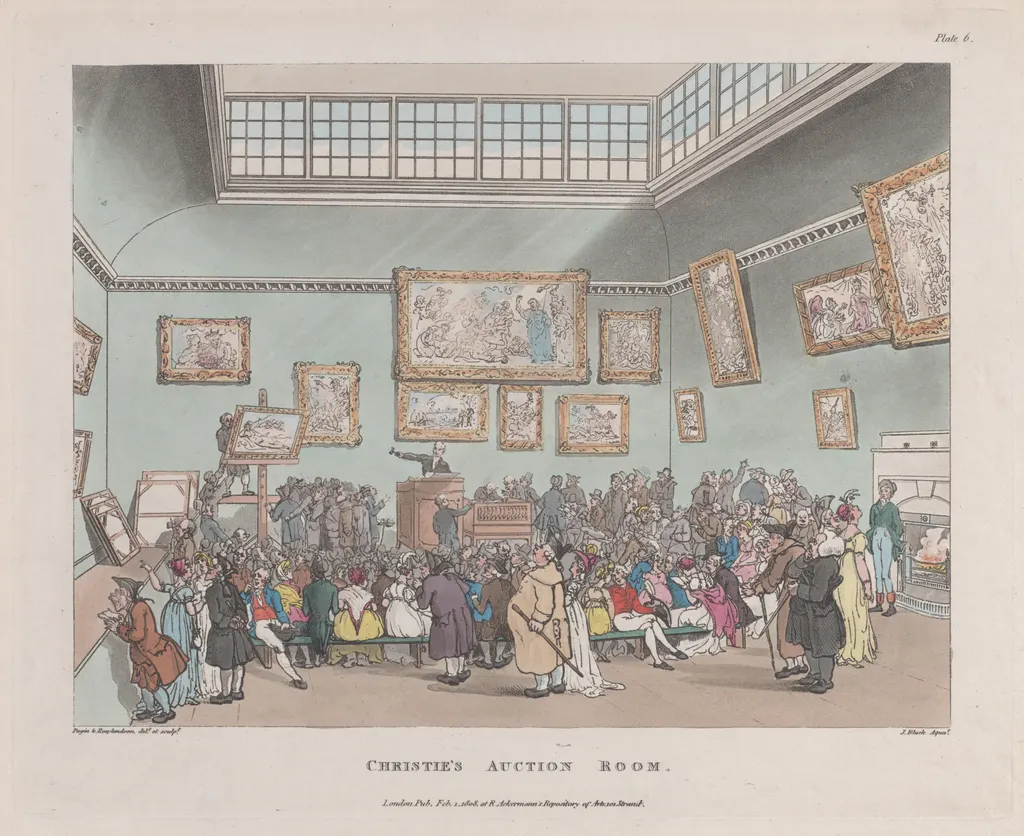
Thomas RowlandsonChristie's Auction Rooms, February 1, 1808Hand-colored etching and aquatintThe Metropolitan Museum of Art, collection record. CC0 1.0 (Public Domain)
Imagine two watercolours by the same Victorian artist, the same size, sold in the same month. One makes several times the price of the other. Look closer and the reasons appear: one is a fresh, well-preserved coastal view that had hung in the same family since it was painted; the other is faded from decades in a sunny room, of a less popular subject, and had already passed through the saleroom twice in ten years. A price guide that lists "average price for this artist" would tell you almost nothing useful about either.
That is the central lesson of researching value. Prices are not properties of artists or categories; they are the result of particular objects meeting particular buyers on particular days. This guide explains where price information comes from, how to read an auction result correctly, what the main price databases offer, when to hire a professional appraiser, and the limits of every source.
Where art prices come from
Most of the price information available to the public comes from auctions, for a simple reason: auction houses publish their results. Private sales through dealers, galleries and agents are usually confidential, so the prices are rarely known, even though they make up a large share of the market.
That creates an important bias. Auction records are a sample of the market, not the whole of it. Some kinds of objects (contemporary art from primary galleries, for example, or very high-value private sales) are under-represented; others, particularly mid-market antiques that pass regularly through regional salerooms, are well documented.
How to read an auction result
An auction record looks simple, but each figure needs interpreting.
| Term | What it means | Why it matters |
|---|---|---|
| Estimate | The auction house's pre-sale guide range | A marketing judgement as well as an opinion of value; not a price |
| Reserve | The confidential minimum the seller will accept | Usually at or below the low estimate |
| Hammer price | The final bid when the hammer falls | Excludes the buyer's premium and taxes |
| Premium-inclusive price | Hammer price plus the buyer's premium | Most houses now publish this figure; check which you are reading |
| Bought in / unsold | The lot failed to reach its reserve | Often missing from free listings, but just as informative as a sale |
Buyer's premiums vary between auction houses and are often tiered, so a hammer price at one house and a premium-inclusive price at another are not directly comparable. Exchange rates and inflation matter too: a result from twenty years ago needs adjusting before it says anything about today.
The comparable question. A useful comparison shares as many qualities as possible with your object: the same maker or artist, a similar date, subject, size, medium and condition, and ideally a similar standard of provenance. One close comparable is worth more than ten loose ones.
Price databases
Several commercial services gather auction results into searchable databases. They differ in coverage, cost and how they present data.
Subscription databases
- Artnet Price Database: one of the largest records of fine-art, design and decorative-art auction results, with records going back to 1985 and coverage of lots estimated at about US$500 and above. Access is paid, with day passes and subscriptions.
- Artprice: a French-based service, part of the listed company Artmarket.com, offering auction results, artist indexes and market reports through paid subscriptions.
- Other services, including MutualArt and askART, offer comparable searches with differing strengths; it is worth trying more than one, since none covers every saleroom.
Bidding platforms with archives
Online bidding platforms that host sales for many auction houses, such as Invaluable, LiveAuctioneers and the-saleroom, keep archives of past lots with prices realised. Some results are free to browse; others require registration or a subscription. These archives are particularly good for antiques and collectables sold by regional houses.
Auction houses themselves
The large international houses publish searchable results for their own sales online, often with full catalogue descriptions, condition notes and provenance. These catalogue entries are frequently more useful than the bare price, because they explain why a lot was estimated as it was.
Printed price guides
Annual printed guides to antiques and collectables remain popular. They are good for learning what kinds of objects exist and roughly how categories compare, but a single illustrated example with a price range cannot account for the condition, quality or history of your piece, and printed figures date quickly.
Look closer: When you find a comparable sale, open the full catalogue entry. Read the condition report if there is one, check the dimensions against your object, and look at the provenance. Then look for the same artist or maker at other houses in the same year. A single high result can be an outlier caused by two determined bidders.
When to use a professional appraiser
Price research helps you understand a market. It is not a valuation. For insurance, probate, tax, charitable donation, division of property or a significant sale, you need a written appraisal from a qualified professional.
A few points to know before you commission one:
- The purpose determines the value. An insurance replacement value (what it would cost to buy a comparable object at retail) is typically higher than a fair market value (what a willing buyer and willing seller would agree), and an appraisal should state clearly which it is.
- Look for professional credentials. In the United States, the American Society of Appraisers, the Appraisers Association of America and the International Society of Appraisers train and accredit personal-property appraisers. American appraisers are commonly expected to follow USPAP, the Uniform Standards of Professional Appraisal Practice, issued through The Appraisal Foundation. In the United Kingdom, the Royal Institution of Chartered Surveyors (RICS) includes valuers specialising in arts and antiques and publishes professional valuation standards.
- Check independence. An appraiser should charge a flat or hourly fee, never a percentage of the appraised value, and should disclose any interest in buying the object.
- Expect a written report. A proper appraisal describes the object, states the purpose and type of value, explains the comparables and reasoning, and is signed and dated.
Free valuation days held by auction houses are a useful first step, but an auction estimate is an invitation to consign, not an independent appraisal.
The limits of every price guide
Even the best database cannot tell you:
- Whether your object is what you think it is. Attribution comes first; a price for a signed work by an artist is meaningless if your picture is by a follower or a later copy.
- How condition affects value. Restoration, fading, damage, relining or replaced parts can change value dramatically, and are rarely visible in thumbnail images.
- How provenance affects value. A documented ownership history, exhibition record or literature reference can add substantially to value; gaps in the record, especially for the years 1933–45 or for archaeological material, can make an object hard to sell at all. Our article on provenance explains why, and historical sources such as the Getty Provenance Index can help fill in the record.
- What the market will do next. Tastes change; categories that were fashionable a generation ago may now sell for far less, and vice versa.
A research checklist
Before you draw any conclusion about value:
- Photograph the object front and back, with any marks, labels and signatures.
- Measure it accurately and note the medium and condition honestly.
- Search museum collections and specialist literature to establish what it is.
- Gather three to five genuinely close comparables from the last few years, noting whether prices include premium.
- Check that it is not recorded as stolen; see our guide to stolen art registers.
- For anything significant, commission a written appraisal for a stated purpose.
- Look after it while you decide: our guide to caring for art at home covers light, humidity and handling.
For research databases, trade associations and collector societies, see our curated resource directory, and for the ethics of buying, Collecting Art Responsibly. More collecting guides are gathered under antiques and collectibles.
Sources
- Artnet Price Database, Artnet
- Artprice, Artprice by Artmarket.com
- American Society of Appraisers, American Society of Appraisers
- The Appraisal Foundation, The Appraisal Foundation
- Getty Provenance Index, Getty Research Institute