Stolen Art Registers: Where to Check Before You Buy
A practical guide to the main stolen and lost art databases, from the Art Loss Register and INTERPOL's ID-Art app to the FBI and the German Lost Art database.
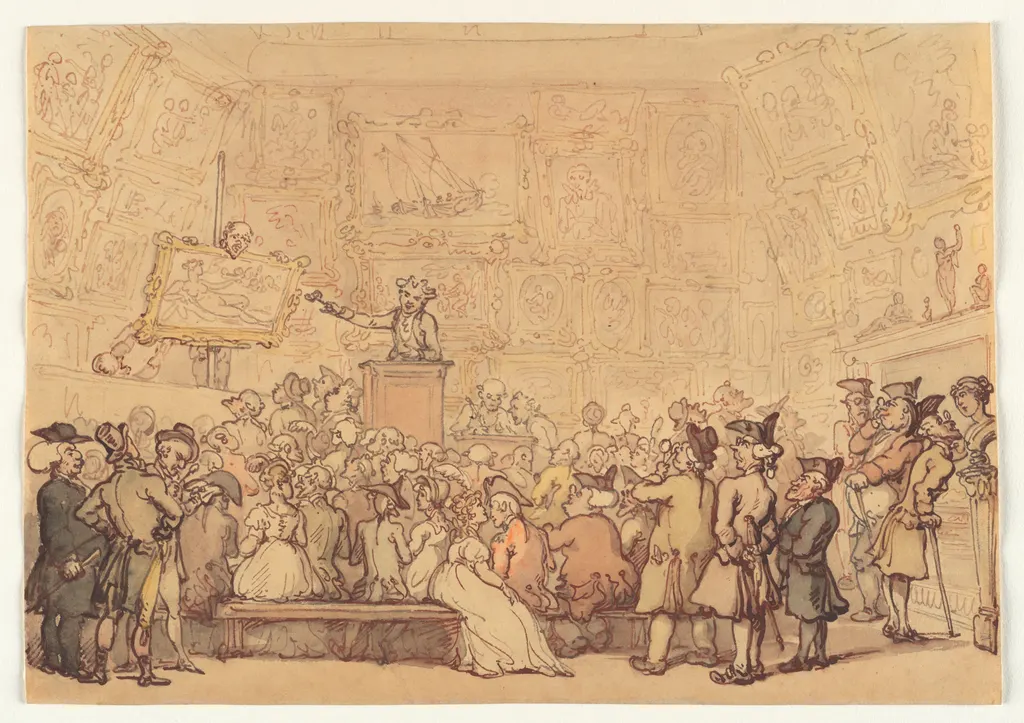
Thomas RowlandsonChristie's Auction Room, Pall Mall, ca. 1808–10Pen and brown ink and watercolor over traces of graphite on cream paper.The Metropolitan Museum of Art, collection record. CC0 1.0 (Public Domain)
Picture a small seventeenth-century Dutch landscape in a regional saleroom: a reasonable estimate, a plausible attribution, and a catalogue entry that says only "private collection". It may be exactly what it seems. It may also be a picture that disappeared from a country house thirty years ago, or one that was taken from a Jewish family in 1938. The painting will not tell you which.
Stolen art registers exist to close that gap. They are databases of objects reported stolen, missing or looted, and checking them has become a basic part of responsible buying. This guide describes the main registers, what each one covers, who can use it, and what a "clean" result does and does not mean.
Why checking matters
Buying a stolen object is not only an ethical problem. In many legal systems a thief cannot pass good title, so a buyer may lose the object, and the money paid for it, if the original owner comes forward, sometimes decades later. Auction houses, dealers and museums now search registers routinely, and a documented search is increasingly expected as evidence that a buyer acted in good faith.
Registers are only one strand of what the trade calls due diligence. The other is provenance: the documented history of ownership. Our guide Provenance Explained covers how to research it.
The main registers at a glance
| Register | Run by | What it covers | Who can search |
|---|---|---|---|
| Art Loss Register | Private company, London | Stolen, missing and disputed art, antiques and collectables worldwide | Anyone, via a paid search service |
| Stolen Works of Art database / ID-Art | INTERPOL | Cultural property reported stolen by member countries' police | Anyone, free, via the ID-Art app |
| National Stolen Art File | FBI (United States) | Stolen art and cultural property reported to US law enforcement | Anyone, free, online and via app |
| Lost Art Database | German Lost Art Foundation, Magdeburg | Nazi-era persecution-related losses and wartime losses | Anyone, free, online |
| Stolen cultural property database | Carabinieri Command for the Protection of Cultural Heritage (Italy) | Objects stolen in Italy and elsewhere | Partly accessible to the public via the iTPC app |
The Art Loss Register
Founded in London in 1990, the Art Loss Register (ALR) is a privately run database used widely by the art trade. Its website states that it holds about 700,000 items and handles around 450,000 searches a year. Owners, insurers and police can register stolen or missing objects; buyers, dealers and auction houses pay to have objects checked against it.
When a search finds no match, the ALR issues a certificate recording that the object was not found on the databases searched. When a search does produce a match, the transaction is normally halted while the claim is investigated, and the ALR also works on recoveries. It is the register most often cited in auction catalogues and dealers' paperwork.
INTERPOL's Stolen Works of Art database and the ID-Art app
INTERPOL maintains a database of cultural property reported stolen by police forces in its member countries; it contains tens of thousands of objects. Since 2021 the public has been able to search it through ID-Art, a free mobile app for Apple and Android devices, without needing to create an account.
The app allows manual searches by details such as object type, material, title, artist and country, and a visual search that compares a photograph with images in the database. Users can report a possible match directly to INTERPOL. A separate function lets owners and institutions create an inventory of their own objects, which can help police if something is later stolen. The app is available in INTERPOL's official languages: Arabic, English, French and Spanish.
The FBI's National Stolen Art File
The National Stolen Art File (NSAF) is the FBI's index of stolen art and cultural property reported to US law enforcement. It has been searchable online by the public since 2010, and in 2023 the FBI released a free app version. To be listed, objects must be identifiable and of historical or artistic significance. If you think you have found a listed object, the FBI asks you to contact a local field office or submit a tip online.
The Lost Art Database
The Lost Art Database is run by the German Lost Art Foundation (Deutsches Zentrum Kulturgutverluste), established in Magdeburg in 2015. It records cultural property seized from its owners as a result of Nazi persecution between 1933 and 1945, or where such a seizure cannot be ruled out, together with losses caused by the Second World War.
It contains two kinds of entries. Search requests are posted by former owners, heirs or institutions looking for lost objects. Found-object reports are posted by museums or private holders who have objects with a gap or a suspicious episode in their history. The aim is to bring the two sides together so they can reach what the 1998 Washington Principles call a "just and fair solution". The Foundation's related Proveana database publishes provenance research results.
Other bodies focus specifically on Nazi-era losses. The Commission for Looted Art in Europe, based in London, maintains a central registry of information and assists families with claims.
Italy's Carabinieri art squad
Italy's Comando Carabinieri per la Tutela del Patrimonio Culturale, founded in 1969, was the world's first specialist police unit for cultural heritage. Its database of stolen cultural property is one of the largest in existence, holding information on well over a million objects. Since 2014 the unit's free iTPC app has given the public access to part of that database, including the ability to compare a photograph with recorded images.
A due-diligence checklist before you buy
- Ask for the provenance in writing. Names, dates, exhibition and sale history, and any export licences. Vague answers are a warning sign.
- Check the free registers yourself. ID-Art, the FBI's NSAF and the Lost Art Database cost nothing to search.
- Ask the seller whether an ALR search has been done, and ask to see the certificate and its date. For significant purchases, consider commissioning a search yourself.
- Check the object's category. For archaeological and ethnographic material, look at the ICOM Red Lists, which describe categories of objects at particular risk of looting and illicit trafficking. Our article on Protecting Cultural Heritage explains the legal background.
- Look at the object. Collection labels, old inventory numbers and auction stickers on the back can all be traced.
- Keep records. File every search result, invoice and piece of correspondence with the object.
Look closer: A clean result is not a clean bill of health. Registers can only list what has been reported. Thefts that were never reported, objects looted from archaeological sites and never recorded, and losses registered in a database you did not search will not appear. Treat a search as one piece of evidence among several.
Further help
For broader advice on buying ethically, read Collecting Art Responsibly. If you are researching the value of an object as well as its history, our guide to Art Price Guides explains how to use auction records. More guidance for collectors is gathered on our antiques and collectibles topic page.
Sources
- The Art Loss Register, Art Loss Register
- ID-Art mobile app, INTERPOL
- National Stolen Art File, Federal Bureau of Investigation
- Lost Art Database, German Lost Art Foundation (Deutsches Zentrum Kulturgutverluste)